New BuggyMLE Framework Scales AI Machine Learning Engineering
Researchers introduced BuggyMLE to test AI agents on complex, multi-file machine learning repositories by injecting controlled bugs into real codebases.
 Source: Grafy Research Lab
Researchers have developed a new framework designed to push AI agents beyond simple code generation and into the realm of complex machine learning engineering (MLE). By injecting controlled bugs into real-world, multi-file repositories, the BuggyMLE framework provides a scalable way to evaluate how well AI can navigate the intricate tasks of designing, training, and debugging machine learning systems.
What is the BuggyMLE framework?
According to the research paper, BuggyMLE addresses a critical gap in current AI evaluation. Most existing machine learning benchmarks focus on single-file edits, which does not reflect how professional engineers work. Real-world MLE requires managing entire repositories, integrating new datasets, and porting frameworks across multiple files.
To solve this, the authors created a system that takes functional machine learning repositories and applies "controlled mutations" to them. This process synthesized over 6,600 bug-injected repository variants, involving nearly 260,000 lines of injected code, based on 222 original source repositories. This allows for the creation of tasks that range from very simple to extremely difficult, providing a structured way to test an agent's reasoning and engineering capabilities.
How is code complexity measured?
One of the core innovations presented by the authors is the Code Complexity Index (CCI). This is a metric that quantifies how difficult a coding task is using only the structural properties of the code, rather than relying on model performance data. The CCI is built upon ten structural features, which the researchers grouped into three main dimensions: repository scale, dependency complexity, and the complexity of the bugs or patches themselves.
Figure 1 shows how this index functions by plotting the CCI against the solve rates of various benchmarks. The researchers found that the CCI is a highly accurate predictor of how well models perform; specifically, the index showed an correlation with average solve rates across eight public coding benchmarks. This suggests that structural features like patch size and dependency depth are reliable indicators of how much an AI agent will struggle with a task.
How does the difficulty scaling work?
Using the CCI to guide task creation, the researchers developed BuggyMLEBench-Lite. This is a difficulty-graded version of existing benchmarks that allows for a clear progression of challenge. The researchers tested 14 different models on this benchmark and observed a dramatic drop in performance as the complexity increased.
As the difficulty scales from the easiest tier to the hardest, the top solve rate among evaluated models plummeted from 95% down to just 9%. This steep decline demonstrates that while current frontier models are excellent at simple coding tasks, they still face significant hurdles when required to manage complex, interconnected software environments.
Can training on these bugs improve AI performance?
Beyond just testing models, the researchers used BuggyMLE to create a training curriculum. They fine-tuned a Qwen3.5-9B model using a three-level difficulty ladder, essentially teaching the model to solve increasingly harder engineering problems.
The results of this curriculum-based training were notable. Not only did the trained model begin to rival much larger frontier models on the BuggyMLEBench-Lite tasks, but the improvements also transferred to other areas of software engineering. For example, the model's performance on the SWE-bench Lite benchmark rose from 24% to 33%, and its LiveCodeBench v6 pass@1 rate increased from 69% to 71%.
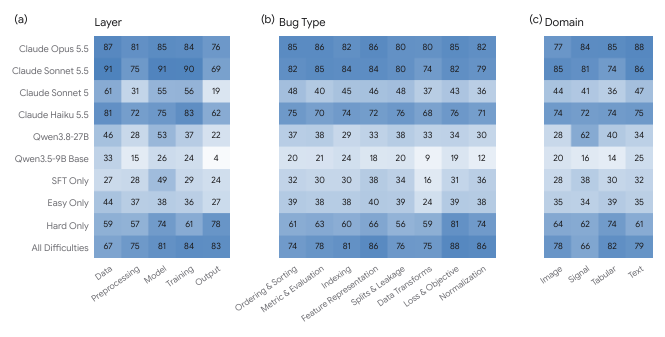
Figure 28 illustrates how high-complexity reinforcement learning (RL) helps close the gap with frontier models, particularly when dealing with different types of defects and pipeline layers. This suggests that training agents on realistic, high-complexity engineering tasks can build more robust, general-purpose coding capabilities.
How does this relate to AI development tools?
For developers and researchers working with AI-driven coding environments, these findings highlight the importance of moving toward "repository-aware" agents. As AI moves from being a simple autocomplete tool to an autonomous engineer, the ability to understand multi-file dependencies and complex execution environments becomes paramount.
While the BuggyMLE research focuses on the training and benchmarking of these agents, developers can explore the current state of AI-assisted coding through Grafy Code. While current tools may not yet reach the autonomous levels of the agents described in the paper, the integration of various models and the ability to run and test code provides a foundation for the kind of iterative engineering workflows the researchers are targeting.
Frequently asked questions
What is the main purpose of the BuggyMLE framework?
The framework is designed to create a scalable way to test and train AI agents on complex machine learning engineering tasks. By injecting bugs into real, multi-file repositories, it moves testing away from simple single-file scripts and toward the realistic, interconnected codebases that professional engineers manage daily.
How does the Code Complexity Index help researchers?
The Code Complexity Index provides a principled way to measure the difficulty of a coding task using only structural code features. Because it accurately predicts how well models will perform, researchers can use it to systematically design training curricula and create benchmarks that stay ahead of advancing AI capabilities.
Does training on machine learning bugs improve general coding skills?
Yes, the research indicates that training on these specialized tasks can lead to positive transfer. Models fine-tuned on the BuggyMLE curriculum showed improved performance on broader software engineering benchmarks and competitive coding tasks, suggesting that the engineering logic learned during ML debugging is applicable to general programming.
Source: Grafy Research Lab — BuggyMLE: Scaling Machine Learning Engineering Difficulty with Bug Injection
More news

ARISE architecture enables self-evolving memory for AI agents
Researchers have proposed ARISE, a memory architecture that allows enterprise AI agents to learn from failures without retraining their underlying models.

New Framework Improves AI Accuracy in Scientific Discovery
Researchers have introduced EpiCompass, a scaffold that helps AI agents manage hypotheses and evidence to reduce errors in automated scientific research.

New GUARD framework stabilizes AI agent self-improvement
Researchers have introduced GUARD, a framework designed to prevent AI agents from losing previously learned skills while they autonomously update their own.