Rich Hickey argues LLMs are automation, not tools, in a philosophical critique
In a 2026 essay, Clojure creator Rich Hickey argues that large language models are a form of automation that users do not 'wield,' sparking debate on Hacker News about th…
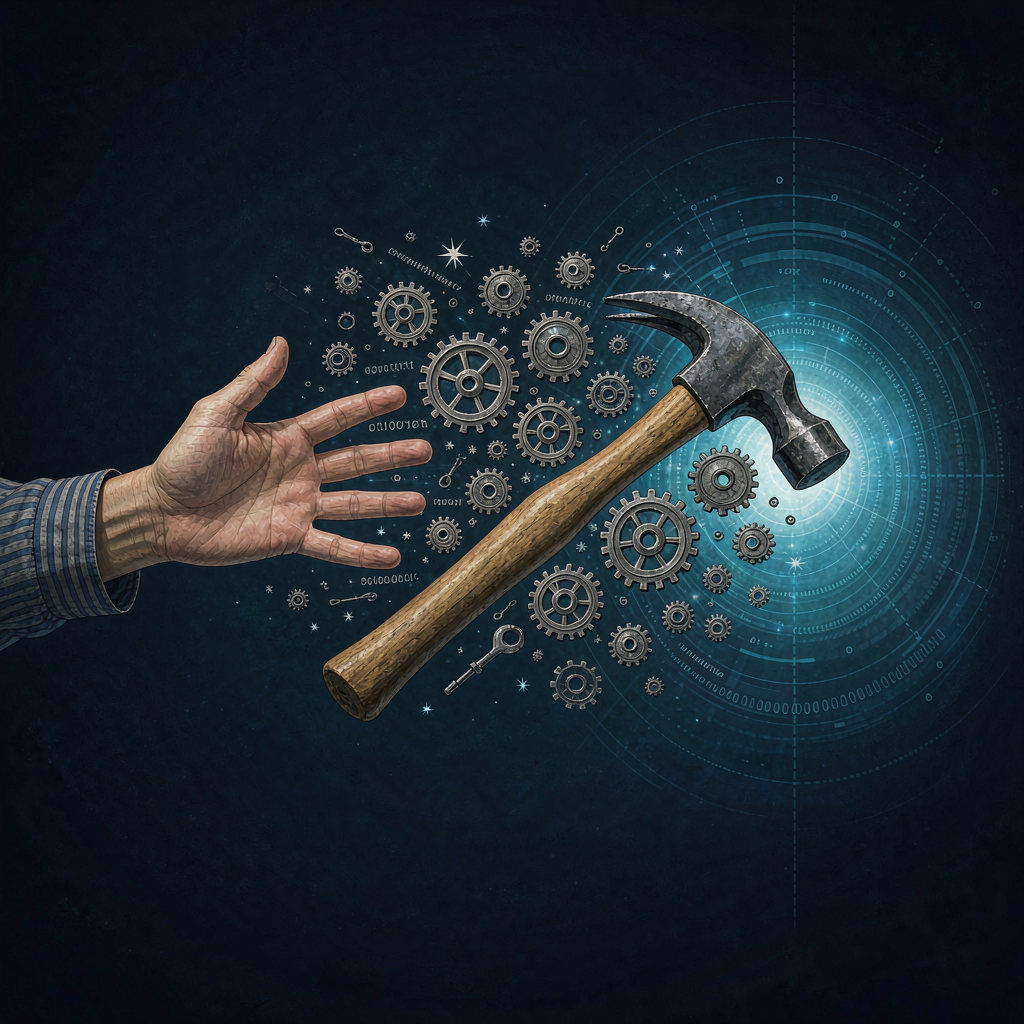
A philosophical critique by Rich Hickey, creator of the Clojure programming language, has ignited a debate about the fundamental nature of large language models. In an essay published on October 12, 2026, Hickey argues that calling LLMs 'tools' is a misnomer that obscures a critical shift in how we interact with technology, moving from active wielding to passive request-making.
According to his essay, which was posted to a GitHub gist and subsequently discussed on Hacker News, the distinction between a tool and automation has profound implications for learning, skill development, and control. Hickey contends that while tools like hammers or saws are predictable, deterministic, and require continuous human direction and skill, LLMs operate autonomously, fulfilling requests without the user's direct, continuous control.
What is Rich Hickey's definition of a tool?
Rich Hickey builds his argument on a specific definition of a tool. According to his essay, a tool is something you 'wield.' He emphasizes properties like being held in the hand, which provides direct control and sensory feedback, and the transmission of power and intention from the user to the task. Tools, he writes, are predictable, reliable, and have a bounded function. Using a tool builds expertise through continuous application of technique and energy, teaching the user about the world, the task, and themselves.
Why does Hickey say LLMs are automation, not tools?
Hickey asserts that large language models lack the core characteristics of tools. He states that control, sensory feedback, intention, and continuous direction are all missing from LLM use. Instead of wielding an LLM, a user makes a request, and the model acts on its own. This request-and-automate cycle, he argues, is not wielding; it is abdication.
He uses the analogy of a fast-food drive-thru: it is not a tool for cooking but automation for avoiding cooking. Similarly, he writes, "LLMs are not tools with which you write code - they are automation with which you avoid writing code, to which you abdicate writing code." The consequence, according to Hickey, is that users trade working with the world for "working for a capricious robot," learning only the transient quirks of the automaton rather than enduring truths.
What was the reaction on Hacker News?
The Hacker News discussion revealed a spectrum of responses to Hickey's thesis. One commenter, 'sparkofreason,' agreed with the distinction for marketed 'AI' as a phenomenon but argued that an LLM at its core is "just software"—a deterministic, pure function where given the same input and weights, it returns the same output. Another, 'ronmichael,' found the argument philosophically interesting but weak on practicality, noting that all programming involves abstraction, not just 'real-world truths.'
Other commenters engaged with the power dynamics Hickey implied. User 'bm3719' suggested that from a laborer's perspective, "automation wields the laborer," flipping the traditional tool relationship. Meanwhile, 'renaissance5550' proposed that AI represents an organizational elevation, transforming a person-with-a-wrench into a director of tool-users, requiring a different skill set.
How does this debate relate to using AI in Grafy?
The core of Hickey's argument—about maintaining control, intention, and learning—resonates with how AI is integrated into creative and development workflows. In Grafy, applications are designed to keep the user in the director's seat, using AI as a component within a larger, user-guided process.
For instance, in Grafy Code, the AI coding studio, the model assists with generation and explanation, but the user retains full control to edit, run, and debug the code directly within the environment. This aligns with the blog post /blog/ai-coding-studio-runs-your-code, which describes a studio that "installs packages and runs your code," emphasizing active development over pure abdication. The Graph app further visualizes this interaction as a branching history of prompts and outputs, making the AI's role in the workflow explicit and traceable.
For those wanting to explore Hickey's arguments or the broader philosophy of AI tools, Grafy Chat provides a space to debate the ideas with multiple AI models side-by-side, while Reader can be used to analyze and question philosophical texts or technical papers on the subject.
What are the practical implications for creators and developers?
Hickey's essay serves as a caution against conflating utility with tool use. The practical implication is that relying on LLMs for core creative or analytical tasks—like having an AI read and summarize research instead of doing it yourself—may come at the cost of deeper learning. As Hickey writes, you miss "learning how to formulate an argument," "noticing things," and "loading your background mind with fodder for novel ideas."
For developers and researchers, this suggests a mindful approach: using AI to handle boilerplate, explore possibilities, or explain concepts, while deliberately reserving complex reasoning, critical analysis, and final synthesis for human direction. It underscores the value of platforms that treat AI as one powerful element within a user-controlled workspace, rather than as an autonomous replacement for skill.
Frequently asked questions
Who is Rich Hickey?
Rich Hickey is the creator of the Clojure programming language and the Datomic database. He is known for his thoughtful essays on software design and complexity. His October 2026 essay, 'AI' is Not a Tool, applies his philosophical perspective to the debate around large language models.
What's the difference between a tool and automation?
According to Hickey, a tool is something you wield with direct control, continuous energy, and sensory feedback, like a hammer. Automation works by itself with little direct human control. You request an outcome from automation, but you do not direct its minute-by-minute actions, which limits learning and control.
Should I stop using AI coding assistants?
Not necessarily. The argument is about awareness, not abstinence. Recognize that using an AI to generate code is a form of automation that can distance you from the underlying logic. Balance it with hands-on debugging, writing complex logic yourself, and using AI within a controlled studio environment where you maintain oversight and run the final code.
Source: Hacker News — front page — 'AI' Is Not a Tool by Rich Hickey
More news

Study finds AI coding agents increase code volume, but not software output
A Harvard study of 700 firms finds AI agents increase code volume 30%, but human review becomes a bottleneck, leaving software output unchanged.
Asana cuts AI browser agent costs 76x with GPT-6.1 Sol
Asana achieved a 76x cost reduction and 5x speed improvement for its browser automation agent by switching to OpenAI's GPT-6.1 Sol model, according to a company case stud…

Janas LLM engine streams huge models from SSD, runs 80B models on 32GB RAM
A new C-based inference engine called Janas streams mixture-of-expert LLMs directly from an NVMe SSD, enabling a 48GB model to run on a 32GB laptop at 24 tokens per secon…