AutoMaster makes the same model a better teacher
Researchers have introduced AutoMaster, a system that uses natural-language skills to improve the quality of teacher demonstrations during post-training.
 Source: Grafy Research Lab
Researchers have developed a system called AutoMaster that can autonomously improve the quality of AI training data by teaching a model to be a better instructor for itself. This approach addresses a fundamental flaw in standard supervised fine-tuning: the fact that a model can reach a correct answer through flawed, repetitive, or superficial reasoning.
Why does task success not guarantee good training data?
In traditional supervised fine-tuning (SFT), models are trained on "trajectories"—the step-by-step reasoning and actions that lead to a successful outcome. However, according to the researchers, simply reaching the correct goal is not enough to ensure the behavior is worth mimicking. A model might achieve a successful result while making unsupported assumptions, repeating itself unnecessarily, or performing only a superficial verification of its work.
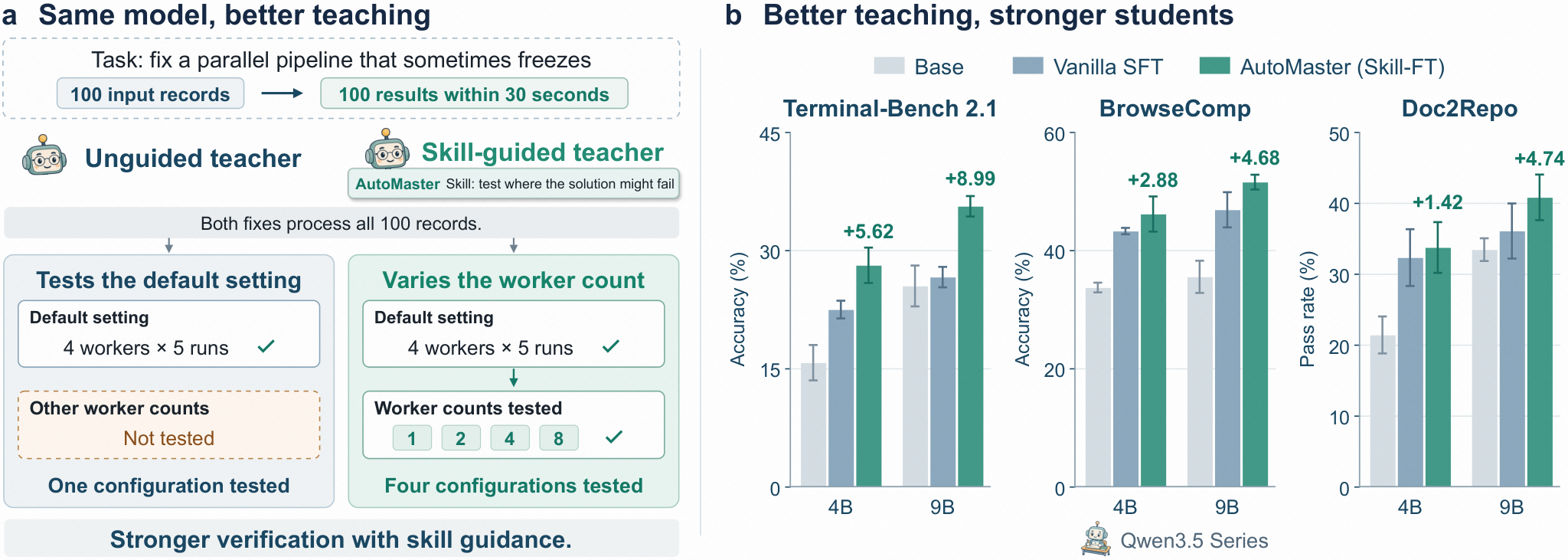
If a student model is trained on these successful but flawed trajectories, it may learn to adopt those same bad habits. Figure 1 illustrates this distinction, showing that a correct result is only one part of what a teacher demonstrates; the quality of the path taken to reach that result is equally critical for effective learning.
How does the AutoMaster system work?
To solve this, the researchers proposed Skill-FT (Skill-Guided Fine-Tuning). This method uses natural-language "skills"—specific instructions appended to a model's system prompt—to shape how the model behaves during its rollout phase. These skills are designed to suppress undesirable habits and encourage effective behaviors that might otherwise be underrepresented.
AutoMaster acts as an autonomous agent that manages this process through an iterative loop. The agent analyzes existing trajectories to identify behavioral gaps, designs new natural-language skills to intervene, and then tests these skills to see if they produce better demonstrations. It also handles data selection, choosing the most high-quality trajectories to be used for the final fine-tuning of the target model. This creates an "outer loop" where the agent constantly refines its interventions based on the student model's performance.
What are the performance gains of Skill-FT?
In experiments involving terminal, search, and software engineering tasks, AutoMaster demonstrated significant improvements. Using Qwen3.5-4B and 9B models as students, the researchers found that AutoMaster improved mean performance by 1.42 to 8.99 percentage points over standard Vanilla SFT.
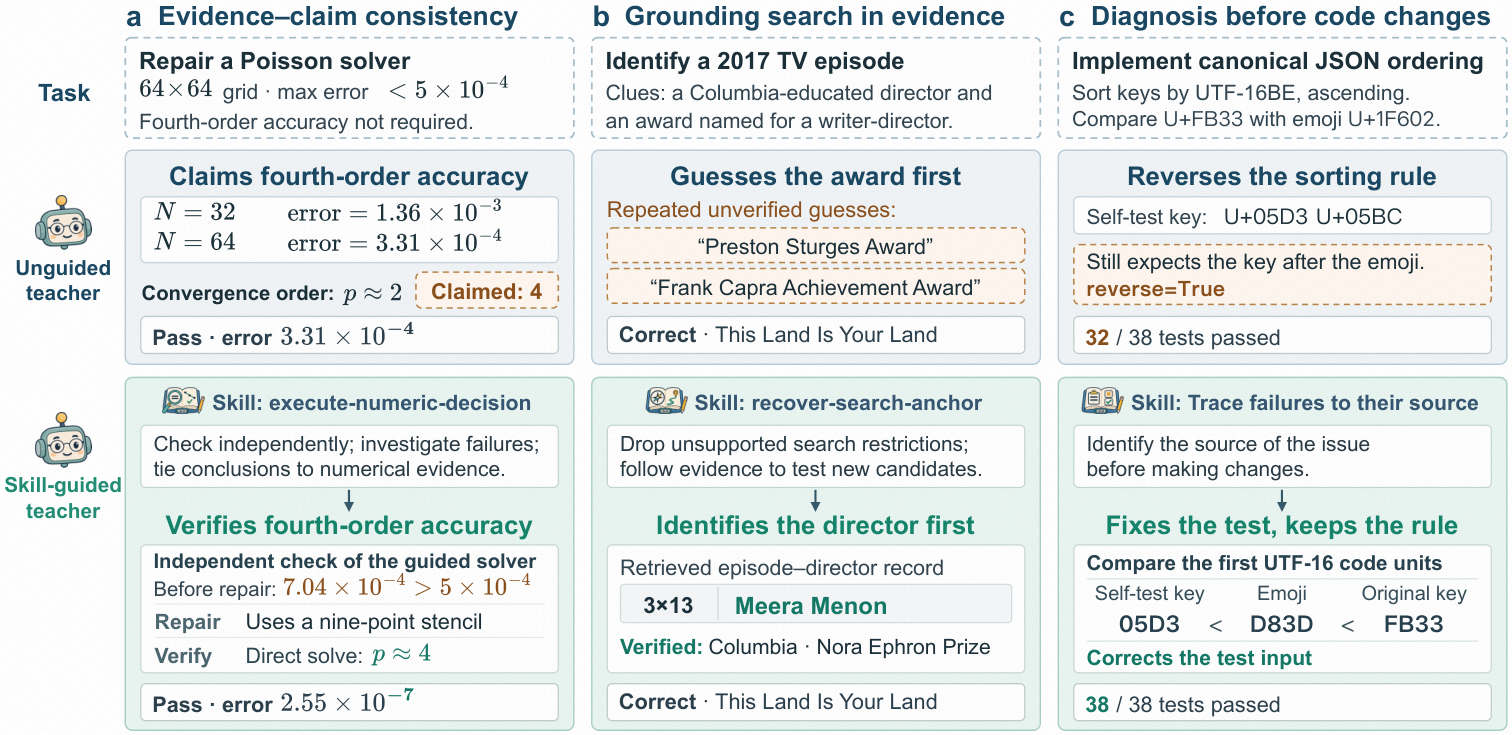
Crucially, these gains were achieved while keeping the teacher model, the task pool, the training set size, and the SFT recipe constant. This suggests that the headroom for model improvement is not always limited by the teacher's inherent intelligence, but rather by the quality of the behaviors the teacher chooses to demonstrate. Figure 5 provides a comparison of these behaviors, showing how a skill-guided teacher can move from making incorrect claims about accuracy to using more rigorous verification methods, such as switching to a nine-point stencil to confirm convergence.
Does keeping skill instructions in training help?
The researchers also investigated whether the skill instructions used to guide the teacher should be included in the training data for the student. They found that retaining these skill instructions during SFT actually leads to higher mean performance, even though the skills are removed during the final evaluation stage.
This finding suggests that preserving the "skill context" helps the student model better internalize behavioral rules. When the skill instructions are present in the training examples, the correspondence between the input guidance and the resulting reasoning becomes more explicit. This likely helps the student model learn the underlying logic and the specific conditions under which certain reasoning patterns should be applied, rather than just memorizing a sequence of actions.
How can researchers explore these concepts?
While AutoMaster is a complex autonomous system for model development, the underlying concepts of analyzing complex reasoning trajectories and evaluating model outputs are highly relevant to anyone working with large language models. For researchers looking to dive deeper into the technical specifics of this paper, or for developers wanting to analyze similar AI research papers, Grafy Reader provides an environment to search, question, and interact with dense academic PDFs to extract key insights and mathematical proofs efficiently.
Source: Grafy Research Lab — AutoMaster: Autonomous Post-Training by Making the Same Model a Better Teacher
More news

Anthropic goes public on Nasdaq with $1.5 trillion valuation
Anthropic has officially begun trading on the Nasdaq under the ticker ANT. Learn about its massive valuation, financial losses, and safety commitments.

Apple recruits engineers to develop agentic AI assistants
Apple is seeking engineers to build AI agents capable of web browsing and app interaction. Discover what this means for the future of agentic AI.

DeepQuest AI framework identifies knowledge gaps in Alzheimer's research
Researchers have introduced DeepQuest, an AI framework that turns literature reviews into testable hypotheses for Alzheimer's disease discovery.