CascadeRec Cuts LLM Reranking Cost by 10% in Enterprise Recommendations
A two‑tier LLM reranking cascade deployed at a large FP&A SaaS provider reduces inference spend by about 10% without hurting recommendation quality.
 Source: Arxiv IR Recent
What is CascadeRec and why it matters?
CascadeRec is a production‑grade, two‑tier LLM reranking system that dynamically allocates inference compute for content recommendation in a multi‑tenant financial‑planning SaaS platform. According to the paper on arXiv, the system was launched at a large FP&A provider and runs behind an A/B experiment on AWS EKS and GKE. The core problem it tackles is simple: running an expensive LLM on every recommendation request inflates cost and can even degrade quality for users with sparse interaction histories. By routing only the requests that are likely to benefit from extra compute, CascadeRec saves resources while preserving, or even improving, the relevance of the surfaced content.
How does the two‑tier cascade work?
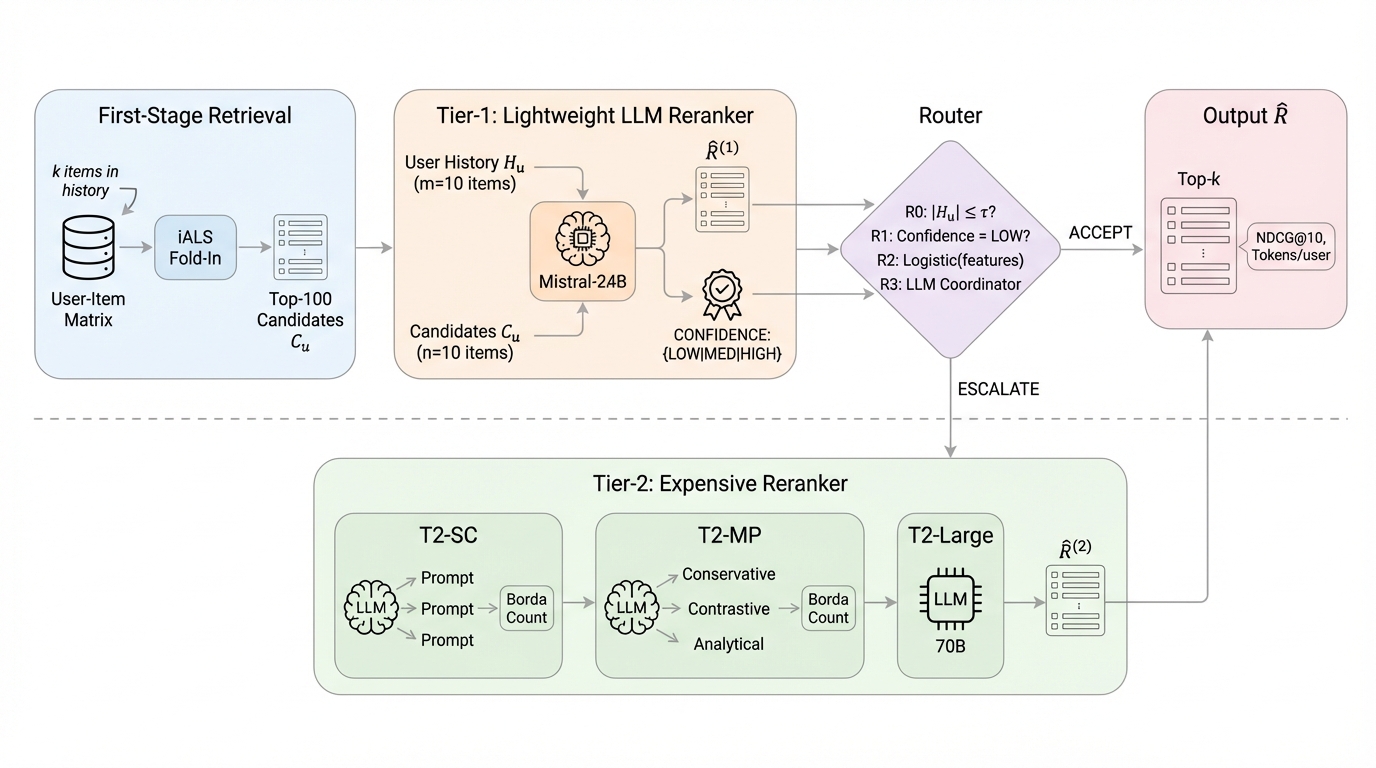
The architecture consists of three moving parts (see Figure 1). First, a Tier‑1 lightweight LLM processes every request, ingesting the user’s recent interactions and the top‑n retrieved candidates. It returns a ranked list plus a coarse confidence label (LOW, MEDIUM, HIGH). Second, a router evaluates the confidence signal and other cheap features to decide whether Tier‑1’s output is sufficient. In the production rollout the authors used a zero‑cost heuristic (R0) that escalates any request whose interaction history length is ≤ 5. Finally, the Tier‑2 reranker runs a larger model or applies self‑consistency sampling and multi‑path reasoning on the escalated subset, delivering a higher‑quality ranking when needed. All Tier‑1 results are cached per (user, model, seed) to keep costs predictable and to enable exact offline‑online comparisons.
What performance and cost gains were observed in production?
During a month‑long live A/B test, CascadeRec achieved roughly a 10 % reduction in inference cost compared with a baseline that applied the expensive Tier‑2 model to every request. The latency impact was described as minimal, and the authors reported no observable regression in recommendation quality (measured by NDCG@10) for any tenant segment. The cost savings stem from two factors: (1) the expensive Tier‑2 model costs 3–6 × more per token than Tier‑1, and (2) only a minority of requests—primarily those from users with very short histories—are escalated. By avoiding uniform spending on these low‑value queries, the system also alleviated GPU contention caused by heavy‑tenant traffic spikes.
What did offline experiments reveal about user history and LLM reranking?
Because tenant data cannot be released, the authors evaluated the cascade on public benchmarks—MovieLens‑1M and Amazon‑Electronics. Segment‑level analysis showed that uniform LLM reranking actually harms users with sparse histories, lowering NDCG@10 by up to 30 % on Amazon‑Electronics. Conversely, the only statistically significant gain appeared for the segment with the longest interaction histories, where NDCG@10 rose by about 27 % on MovieLens. Moreover, escalating cold users to Tier‑2 (using self‑consistency or multi‑path reasoning) sometimes amplified the loss, indicating that extra inference time cannot compensate for a lack of preference evidence. These findings underscore the importance of measuring domain‑specific escalation benefits rather than assuming a one‑size‑fits‑all approach.
Lessons learned for deploying LLM cascades in enterprise SaaS
The authors distilled several practical insights:
- Load imbalance is a routing problem: a few tenants generate the bulk of traffic, so a naïve uniform strategy overloads GPU resources during bursts.
- Output compliance must be treated as a first‑class failure mode: parsing errors from LLM outputs can cascade into downstream services, so graceful fallback to Tier‑1 is essential.
- Determinism aids experimentation: caching Tier‑1 outputs ensures that control and treatment arms see identical baseline rankings, simplifying statistical comparison.
- Escalation direction is domain‑dependent: the benefit of sending a request to Tier‑2 varies with content type and user history, so segment‑gated rollouts are recommended.
- Segment‑level evaluation should gate rollout: before exposing a new cascade to all tenants, evaluate its impact on distinct user groups to avoid hidden quality regressions.
How creators, developers, and researchers can explore CascadeRec ideas with Grafy
While Grafy does not host a built‑in cascade service, the Grafy Chat app lets you experiment with prompt design, confidence extraction, and lightweight vs. heavyweight model calls in a side‑by‑side fashion. You can simulate a Tier‑1 reranker using a small open‑source model and then, based on a simple heuristic (e.g., history length), invoke a larger model for the same input—mirroring the routing logic described in the paper. For deeper analysis of the original study, the Grafy Reader app can ingest the arXiv PDF, allowing you to search, annotate, and ask follow‑up questions about the methodology without leaving the workspace. Together, these tools provide a low‑friction sandbox for reproducing the cascade experiment on your own datasets.
Source: "CascadeRec: Deployed Adaptive LLM Compute Allocation for Multi‑Tenant Content Recommendation," arXiv preprint, 2026‑11‑09 (https://arxiv.org/abs/2611.08566).
Frequently asked questions
Does CascadeRec always improve recommendation quality?
No. The paper shows that uniform LLM reranking can hurt users with sparse interaction histories, and even targeted escalation may worsen quality in some domains. Gains were only statistically significant for users with long histories.
How much cost does the Tier‑2 model add compared to Tier‑1?
Tier‑2 inference costs roughly three to six times more per request in token usage and latency, according to the authors’ cost analysis.
Can the routing logic be replaced with a learned model?
The authors experimented with several router families, including a logistic classifier (R2) and an LLM coordinator (R3). In production they deployed the simplest zero‑cost heuristic (R0), but a learned router is feasible and may yield better escalation decisions if sufficient training data are available.
More news

Shopify launches SID-LLM, a unified generative model for search and recommendation
Shopify unveiled SID-LLM, a model that generates semantic IDs to power both product search and recommendation.

Monte Carlo Study Reveals Inconsistent LLM Performance on Data‑Science Tasks
A new benchmark (DS‑QA) shows that popular LLMs vary widely across repeated runs.

MINE introduces entropy-coded inference to speed up LLMs
Researchers unveiled MINE, a lossless entropy‑coding engine that speeds single‑stream LLM inference by reducing memory traffic.