Conflict‑Aware Multi‑Teacher Distillation Boosts Zero‑Shot Game Generalization
Researchers introduced CAMOPD, a conflict‑aware multi‑teacher on‑policy distillation framework that lets a single vision‑language model master unseen browser.
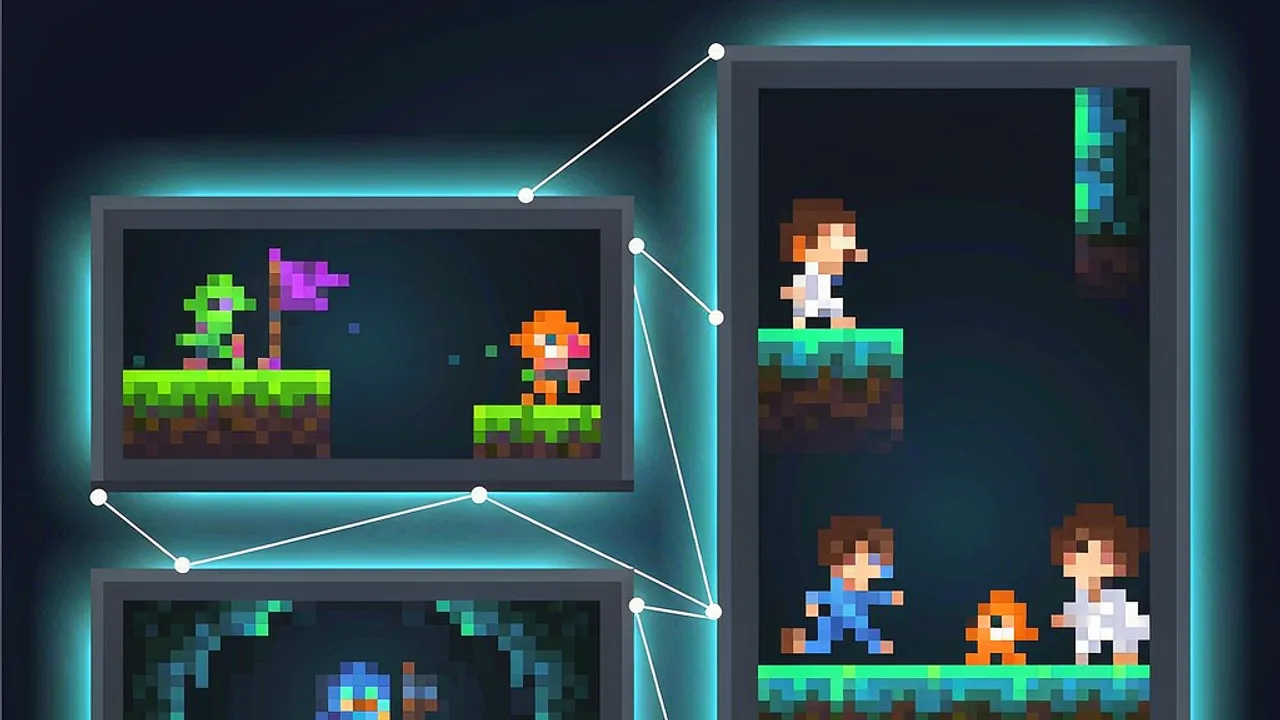 Source: Grafy Research Lab
What is CAMOPD and why does it matter?
Zero‑shot cross‑game generalization aims to merge several expert agents—each trained on a specific source game—into one vision‑language model (VLM) that can play brand‑new games directly from screenshots. According to the authors, existing multi‑teacher on‑policy distillation (MOPD) reduces offline exposure bias but hits two roadblocks when applied to autoregressive VLMs: token‑to‑action misalignment and multi‑teacher policy conflict. Their proposed framework, CAMOPD (Conflict‑Aware Multi‑Teacher On‑Policy Distillation), tackles both issues, delivering a single pixel‑only policy that succeeds on unseen titles like GeoDash and Doodle Jump without any target‑game parameter updates.
How does token‑to‑action misalignment affect VLM game agents?
Autoregressive VLMs generate actions as sequences of subword tokens. Because subwords vary in length, the raw likelihood of shorter strings is artificially inflated—a phenomenon the paper calls subword length bias. This bias skews the estimated probability of each discrete game command, leading to unreliable uncertainty margins during decision‑making. CAMOPD introduces complete‑action alignment, which scores every legal command in a game’s action set after normalizing for token length. The result is a calibrated categorical policy where each action’s probability reflects its true suitability, not the quirks of the tokeniser.
What is multi‑teacher policy conflict and how is it resolved?
When several source‑game teachers are consulted during on‑policy distillation, they can issue contradictory corrections for visually similar states. For example, a teacher for a platformer may steer toward foreground geometry, while a teacher for an obstacle‑dodger may steer away from the same geometry. Uniformly blending these gradients, as prior work does, pulls the student policy in opposite directions and causes negative transfer.
CAMOPD solves this with conflict‑aware multi‑teacher consolidation. First, each privileged teacher is wrapped by a visual specialist—a pixel‑only proxy that mimics the teacher’s corrections using only screen data. The specialists are then cross‑evaluated across all source games, producing a disagreement matrix that captures both visual identifiability and inter‑teacher compatibility. Teachers that consistently agree receive higher weights, while conflicting ones are down‑weighted. The final loss combines an action‑level term with an anchor term to preserve stable behaviour:
No target‑game data are required; the consolidation relies solely on source‑game interactions.
What were the experimental results?
The authors evaluated CAMOPD on GameWorld’s two transfer suites—Suite A (temporal control) and Suite B (directional steering)—using a Qwen3.5‑4B backbone. On the unseen games GeoDash and Doodle Jump, the consolidated student achieved 86.7 % (26/30) and 80.0 % (24/30) Task‑1 zero‑shot success rates, respectively. These numbers surpass three strong baselines: (1) prompting a raw VLM, (2) weight‑merging of source models, and (3) a vanilla multi‑teacher OPD without conflict handling. Ablation studies confirmed that both complete‑action alignment and conflict‑aware consolidation contribute significantly to the gains.
How can creators and researchers explore these ideas with Grafy?
Grafy provides tools that let you dig into the paper and experiment with similar pipelines without writing low‑level code.
- Graf Reader (/reader) lets you upload the arXiv PDF and ask natural‑language questions about the methodology, equations, or experimental setup. You can retrieve the exact sections on complete‑action alignment or the disagreement matrix in seconds.
- Graf Chat (/chat) enables you to converse with multiple AI models side‑by‑side, asking one model to explain the token‑length bias while another suggests concrete prompts for building a visual specialist.
- If you wish to prototype a simplified version of the conflict‑aware weighting, the Graph app (/graph) can help you map out the teacher‑specialist evaluation flow as a branching diagram, then export the logic as pseudo‑code for further experimentation.
While Grafy does not yet host a ready‑made CAMOPD implementation, the combination of Reader, Chat, and Graph gives creators a low‑friction path to prototype the core ideas and test them on custom HTML5 mini‑games built with Game Studio (/game) if desired.
Source: Jing Yi, Cehao Yang, Hualei Zhang, Haitao Li, “Conflict‑Aware Multi‑Teacher On‑Policy Distillation in Aligned Action Spaces for Cross‑Game Generalization,” arXiv:2611.21094 [cs.AI], 2026‑11‑17.
Frequently asked questions
How does complete‑action alignment differ from standard token‑level scoring?
Complete‑action alignment scores whole legal commands after normalising for subword length, turning the VLM’s raw token probabilities into a calibrated categorical distribution over actions. This removes the bias that favours shorter token strings and yields reliable uncertainty margins for downstream selection.
Why is cross‑evaluation of visual specialists possible without target‑game data?
Visual specialists operate solely on pixel observations, not on privileged simulator variables. Because they can be run on any source game’s screenshots, the framework can measure how well a specialist’s corrections align with other teachers across games, building a disagreement matrix that reveals conflict without needing the unseen target environment.
Can CAMOPD be applied to non‑game domains such as robotics?
The core ideas—action‑space alignment to remove token bias and conflict‑aware weighting of multiple teachers—are domain‑agnostic. In principle, any setting where several expert policies are available but share a common perceptual input (e.g., camera images) could benefit, provided a suitable set of legal actions can be enumerated.
More news

Anthropic prices IPO at $83 a share, valuing the AI firm at $1.5 trillion
Anthropic filed its S‑1 on Nov 18, setting the IPO price at $83 per share and a $1.5 trillion valuation.

Learned Multigranular Memory Retrieval Boosts Small LLM QA Performance
A new paper introduces LMMR, a learned multigranular memory retrieval method that trims input to under 400 tokens while raising F1 scores on HotpotQA and other.

Just‑Enough Exploration Tuning Cuts Tool Calls in Code‑Repo QA Agents
Researchers introduce JET, a fine‑tuning approach that trims unnecessary tool calls in repository‑level QA agents while keeping answer quality high.