EvoDisco lets LLM agents discover how to reshape their own memory
Researchers introduce EvoDisco, a strategy‑discovery framework that lets large‑language‑model agents learn when and how to edit their memory graphs.
 Source: Grafy Research Lab
What is EvoDisco and why does it matter?
EvoDisco is a new framework that treats the evolution of an LLM‑based agent’s memory as a learnable strategy‑discovery problem, rather than a fixed sequence of edits. According to Liu et al. (2026), agents that can not only store experiences but also decide how to reorganize those experiences show measurable gains on long‑horizon tasks such as ALFWorld and WebShop. The ability to adapt memory structure on the fly addresses a long‑standing limitation of existing memory systems, which typically build a graph once and then leave it static.
How does the EvoDisco framework work?
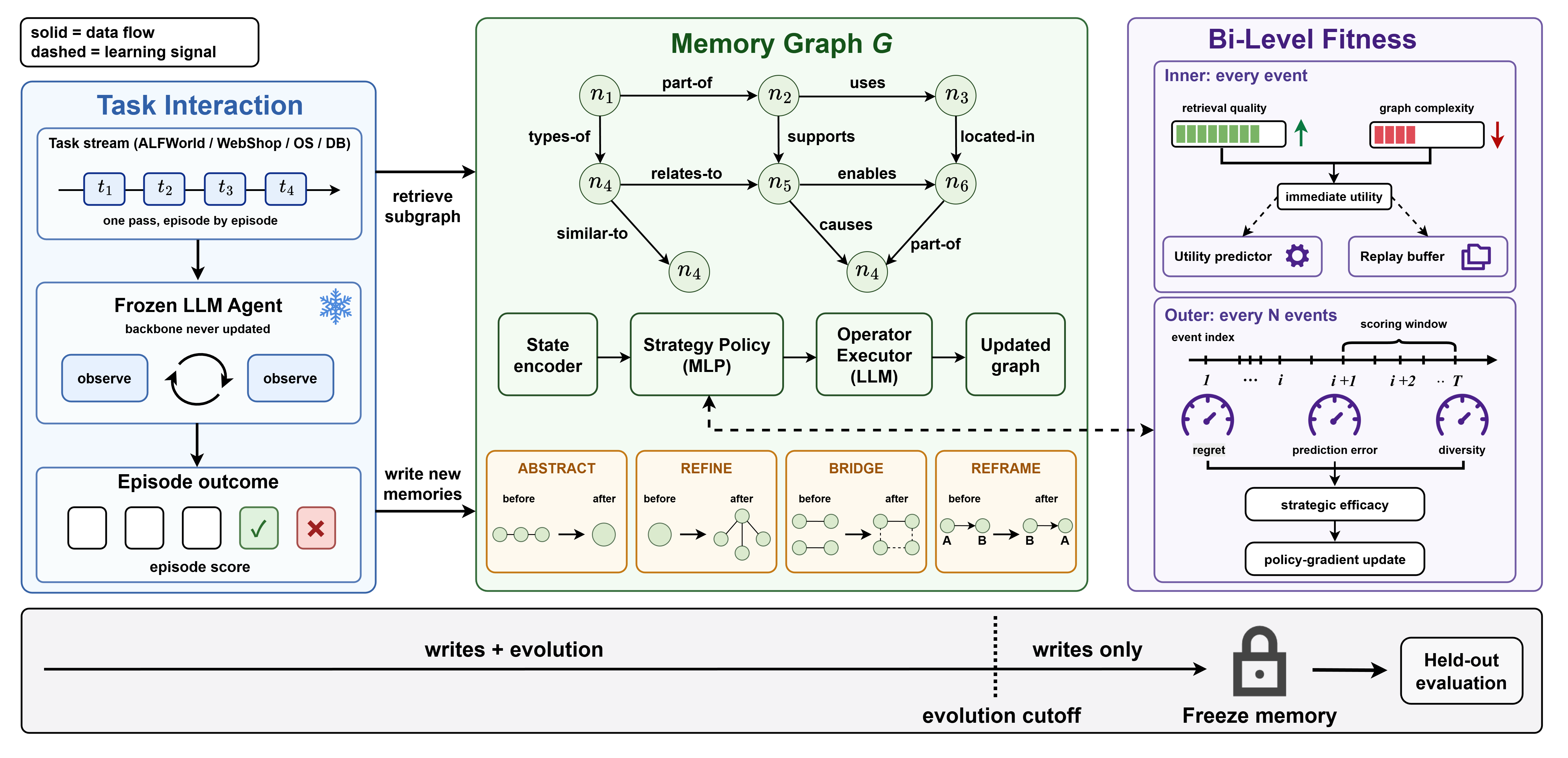
The core of EvoDisco consists of three components:
- Memory graph – a structured store of episodic notes, facts, and procedural snippets that the frozen LLM queries during each step.
- Cognitive operator library – a set of four high‑level transformations (Abstract, Refine, Bridge, Reframe) that can be applied to the graph.
- Strategy policy – a learnable module that receives a representation of the current graph state and recent task history, then selects an operator and its parameters.
The policy is trained with a bi‑level fitness signal. An inner utility score measures the immediate impact of a transformation on retrieval quality, regularized by the added complexity of the graph. An outer strategic‑efficacy score aggregates regret, utility‑prediction error, and selection diversity over a sliding window of decisions. This dual feedback loop encourages the policy to prefer operators that both improve short‑term recall and support long‑term reasoning.
Figure 1 shows the overall loop: the frozen language model interacts with a one‑pass task stream, retrieves a subgraph, writes new memories, and then the strategy policy reads the updated graph to decide the next edit.
What are the four cognitive operators?
EvoDisco’s operator library is deliberately small yet expressive:
- Abstract – merges a cluster of related notes into a higher‑level concept, reducing redundancy and creating a concise anchor for later retrieval.
- Refine – splits an overloaded or overly generic note into finer‑grained components, making details more accessible.
- Bridge – creates a new edge between two weakly linked memories, enabling multi‑hop reasoning that was previously impossible.
- Reframe – reorders or rewrites a chain of retrieved notes to better match the current query, effectively “re‑routing” reasoning pathways.
The authors provide prompt templates for each operator (see Appendix C of the paper) and demonstrate that the policy learns to apply them at different stages of a task. For example, Abstract is most common early in ALFWorld episodes, while Reframe dominates later when the agent must adjust its reasoning path.
How does EvoDisco perform compared to existing memory systems?
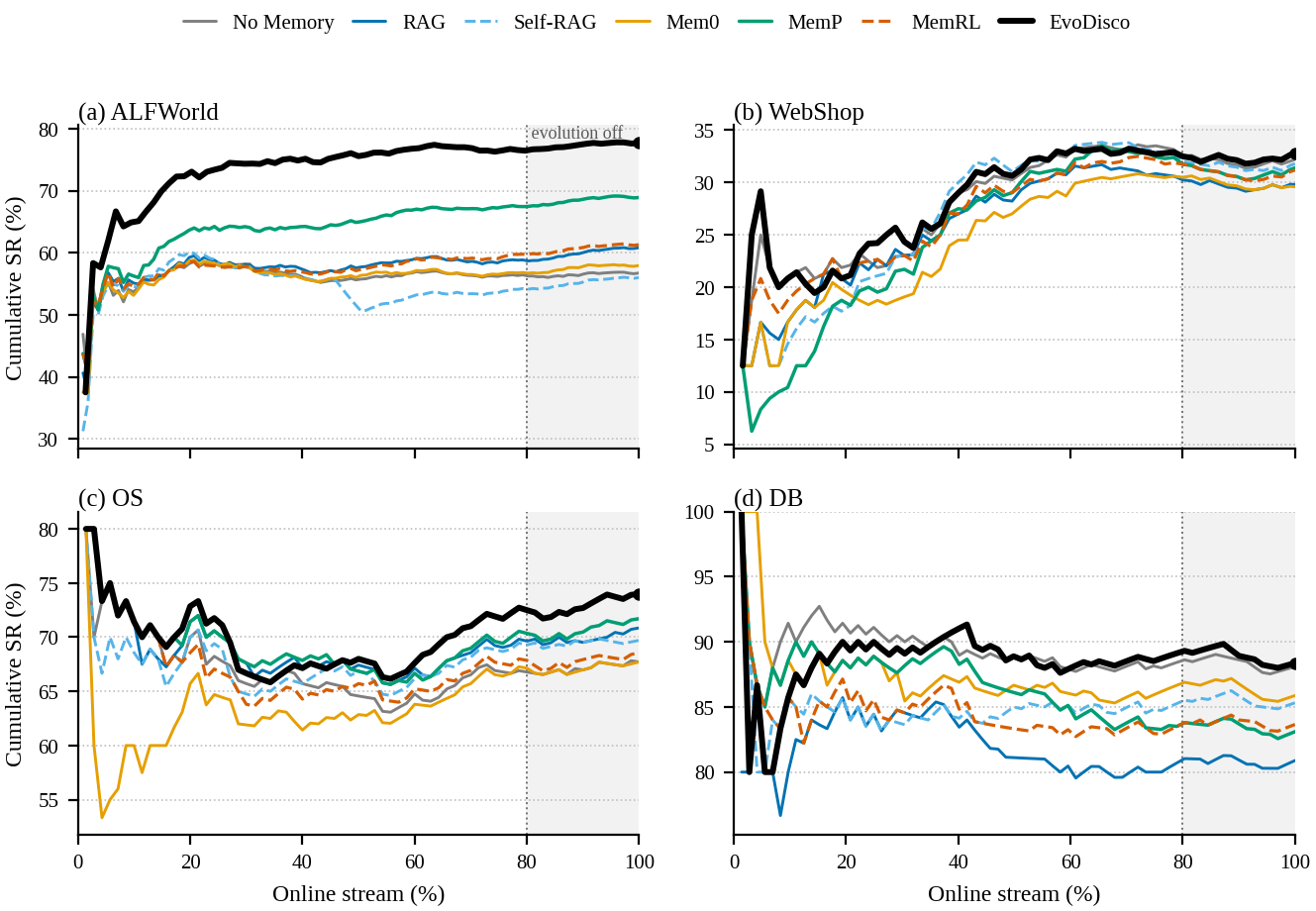
The authors evaluated EvoDisco on three lifelong benchmarks – ALFWorld, WebShop, and LifelongAgentBench (OS and DB variants). Using a one‑pass online protocol plus a frozen‑transfer phase, EvoDisco consistently outperformed strong baselines such as MemP and MemRL.
- On ALFWorld, EvoDisco added +8.8 points in the online setting and +12.9 points in frozen‑transfer, beating MemP; against MemRL the gains were +16.4 and +17.9 respectively.
- Gains on WebShop and the DB benchmark were smaller but still statistically significant, with the curves overlapping only early in the stream before diverging as the policy accumulated experience.
Figure 2 plots cumulative online success rates across the training stream, illustrating how EvoDisco separates from every baseline on ALFWorld and finishes highest on all four benchmarks. Ablation studies in the paper confirm that both the bi‑level fitness and the operator library are necessary for the observed improvements.
Applying EvoDisco concepts with Grafy
While Grafy does not yet ship an automated memory‑evolution engine, the ideas behind EvoDisco can be explored with existing tools:
- Grafy Graph – the Graph app lets you build and edit branching structures of prompts, outputs, and notes. You can manually experiment with the four operators by creating abstraction nodes, splitting notes, adding bridge edges, or re‑ordering retrieval paths.
- Grafy Reader – upload the EvoDisco paper (PDF) and ask the Reader to extract the operator definitions, fitness equations, or experimental tables. This is a quick way to prototype the bi‑level fitness calculations on your own data.
- Grafy Chat – use the multi‑model chat to discuss strategy‑policy design, or to generate prompt templates for each operator based on the paper’s Appendix C.
By combining Graph and Reader, creators can prototype a lightweight version of EvoDisco: store episodic notes in a graph, run a simple rule‑based selector that chooses an operator based on node degree or retrieval score, and observe how performance changes on a downstream task. The Grafy ecosystem makes it easy to iterate on such prototypes without writing extensive code.
Source: https://arxiv.org/abs/2611.22102
Frequently asked questions
How does EvoDisco differ from prior memory‑evolution methods like MemEvolve?
EvoDisco replaces the fixed evolutionary operators used in MemEvolve with a learnable policy that selects among four semantic operators based on the current graph state. This makes the evolution process adaptive rather than predetermined.
What does the bi‑level fitness function measure?
The inner level scores the immediate change in retrieval quality after an edit, penalized by added graph complexity. The outer level aggregates regret, utility‑prediction error, and operator‑selection diversity over a window of past decisions, guiding the long‑term strategy of the policy.
Can I use EvoDisco directly in Grafy without custom coding?
Grafy does not provide an out‑of‑the‑box EvoDisco implementation. However, you can manually recreate its core ideas using the Graph app to edit memory structures and the Reader app to analyze the impact of each edit on retrieval performance.
Source: Grafy Research Lab — EvoDisco: Strategy Discovery for Evolving Agent Memory
More news

Just‑Enough Exploration Tuning Cuts Tool Calls in Code‑Repo QA Agents
Researchers introduce JET, a fine‑tuning approach that trims unnecessary tool calls in repository‑level QA agents while keeping answer quality high.

RAW Method Reveals How Refusals Push Users Away from Deployed LLMs
A new causal measurement technique called RAW quantifies the drop‑off caused by LLM refusals, finding a 3‑to‑17‑point loss in re‑engagement for many models.
Study Finds Confidence Scores Don't Guarantee Better LLM Answers
Researchers show that confidence signals can rank correct responses but often fail to improve outcomes.