Grafy Unveils WorkflowArena Benchmark for AI Agent Orchestration
Grafy launched WorkflowArena, a benchmark for executable workflow orchestration in LLM multi-agent systems.
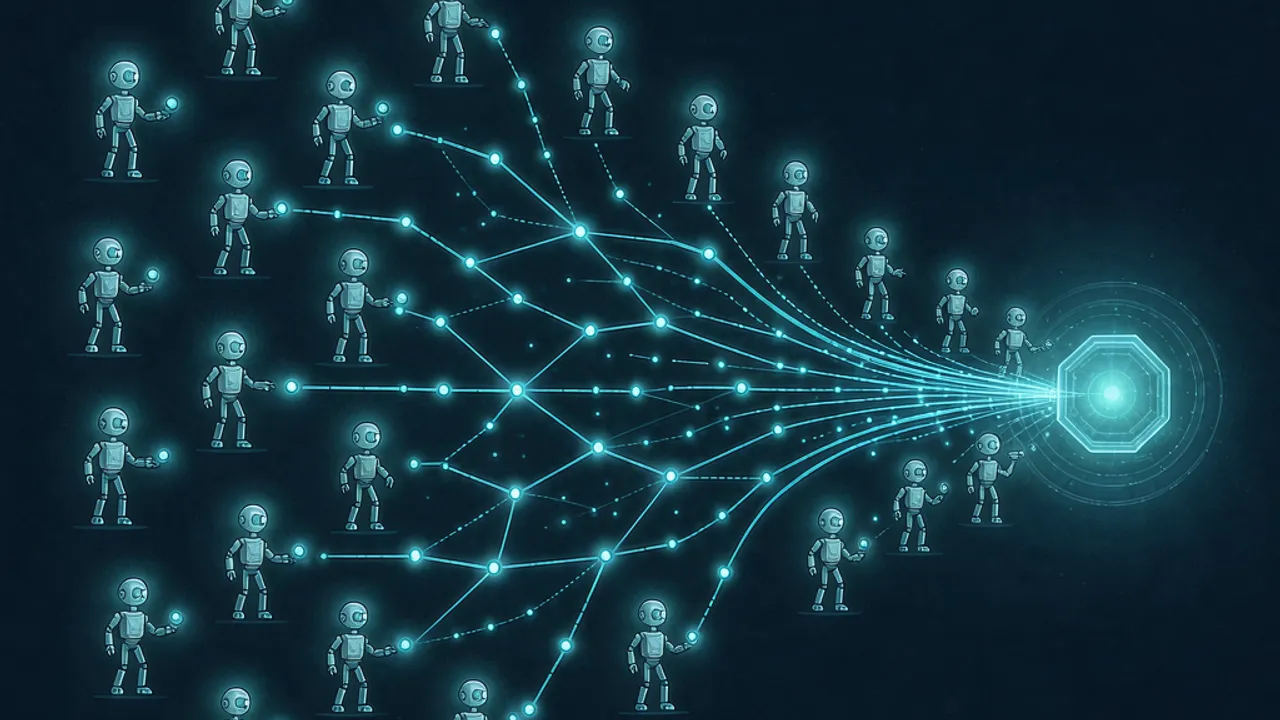 Source: Grafy Research Lab
Grafy Research Lab has introduced WorkflowArena, a benchmark for executable workflow orchestration in LLM-based multi-agent systems. According to the source, the announcement matters because LLM agents are increasingly used as multi-agent systems rather than as standalone models in a single context. Recent agent harnesses are said to allow the model to instantiate worker agents and author the executable workflow that coordinates them. The lab argues that the quality of this organization is a distinct capability, and that is why a benchmark focused on orchestration may be significant. The source describes a move from standalone models to multi-agent systems, and from developer-specified coordination to model-authored workflows. That combination is why the benchmark has attracted attention in the AI research community.
What is WorkflowArena?
WorkflowArena is the name of the benchmark from Grafy Research Lab. According to the source, it focuses on executable workflow orchestration in LLM-based multi-agent systems. The source describes orchestration as the coordination of multiple agents through an executable workflow. The benchmark is about how that coordination is handled, rather than only measuring whether a final task succeeds. The source presents this as a formal capability that may be distinct from other measures. The source does not list the full set of agent tasks or evaluation metrics used in WorkflowArena. The retrieved material focuses on the formalization of the capability, so the public description is still early. The benchmark name suggests it is designed to test orchestration as an executable process.
Why does executable workflow orchestration matter?
The source notes that large language model agents are increasingly deployed as multi-agent systems. Recent agent harnesses allow the model to instantiate worker agents and author the executable workflow coordinating them. According to the source, this shifts the design of system structure from developers to the model at run time. The source says the quality of that organization is therefore a distinct capability. That helps explain why WorkflowArena is focused on orchestration. The source says the quality of organization constitutes a distinct capability. This is important because a system may complete a task while still having weak or inappropriate coordination behind the scenes. The source frames WorkflowArena as a way to study that aspect.
How is WorkflowArena different?
According to the source, existing benchmarks either measure end-to-end task completion or evaluate coordination under structures specified in advance. WorkflowArena is positioned around executable workflow orchestration. The source formalizes this capability, which distinguishes it from benchmarks that test final outcomes or pre-specified coordination. The source does not provide full methodological detail in the retrieved material, but the benchmark's stated focus is clear. The source says existing benchmarks either measure end-to-end task completion or evaluate coordination under structures specified in advance. WorkflowArena is positioned around executable workflow orchestration. The source formalizes this capability, which means it may provide a new benchmark for a previously less clearly bounded problem. The source does not provide full methodological detail in the retrieved material.
What does it mean for AI builders?
For developers, researchers and creators, the story suggests that multi-agent evaluation may need to account for how an agent organizes its own workflow. The source says the quality of organization is a distinct capability, and that agent harnesses can shift structure design to the model at run time. The source does not claim that orchestration is the only factor in multi-agent performance, but it frames the benchmark as relevant to that capability. The source also notes that recent agent harnesses allow the model to instantiate worker agents and author the executable workflow coordinating them. For AI builders, this raises questions about how orchestration should be tested, compared with final output quality, and improved when the workflow is model-authored rather than developer-authored.
How can Grafy users relate to WorkflowArena?
Grafy Research Lab is the source of WorkflowArena, so the benchmark is connected to Grafy's research output. For users interested in experimenting with prompts, outputs and model history, Grafy Graph may be a relevant surface, though the source does not describe Graph as a WorkflowArena tool. Readers can open Grafy Graph to trace branching choices, or use Grafy Chat to compare model behavior while exploring agent workflows. The connection is genuine at the level of research origin, even if the benchmark is not described as a product feature. The source frames the capability as distinct, and the benchmark may help researchers study it. The source does not offer final results or broad claims.
Frequently asked questions
What does WorkflowArena measure?
According to the source, WorkflowArena measures executable workflow orchestration in LLM-based multi-agent systems. The source says it focuses on how a model organizes worker agents and authors the executable workflow coordinating them. It presents this as a distinct capability from end-to-end task completion, and the measurement concerns orchestration quality.
How does WorkflowArena differ from earlier benchmarks?
The source says earlier benchmarks either measure end-to-end task completion or evaluate coordination under structures specified in advance. WorkflowArena is described as benchmarking executable workflow orchestration. The difference is that WorkflowArena centers the executable workflow capability, while the older approaches focus on final task success or pre-specified coordination.
What should developers take from WorkflowArena?
The source frames WorkflowArena around a capability that may grow in importance as multi-agent systems become more common. For developers, the implication is that orchestration quality may need separate evaluation. The source does not report scores, deployment guidance or implementation details, so the benchmark should be read as a research contribution.
More news

LLM AutoML Framework Tackles Open-World Tuning
Proposed LLM AutoML would jointly tune architecture, hyperparameters and data ratios without fine-tuning, according to new arXiv paper. Why it matters.

CascadeRec Cuts LLM Reranking Cost by 10% in Enterprise Recommendations
A two‑tier LLM reranking cascade deployed at a large FP&A SaaS provider reduces inference spend by about 10% without hurting recommendation quality.

Monte Carlo Study Reveals Inconsistent LLM Performance on Data‑Science Tasks
A new benchmark (DS‑QA) shows that popular LLMs vary widely across repeated runs.