LLM Judges Exhibit Directional Label Bias in Evaluations
Researchers found that LLM judges suffer from a one-way bias where skewed prompts inflate accuracy scores. Learn how to avoid these evaluation errors.
 Source: Grafy Research Lab
Using large language models (LLMs) as automated judges has become a standard method for scoring open-ended AI outputs, but this practice may introduce significant errors in performance reporting. According to a study by Abdullah Ahmad, Ahmed J. O. Ahmed, and Luca Citi, these judges are susceptible to a specific type of "in-context label bias" that can artificially inflate accuracy scores without necessarily improving the quality of the judgment.
What is in-context label bias in LLM judges?
When an LLM is used as a judge, it is typically provided with a few-shot prompt containing examples of correct and incorrect answers to guide its decision-making. While these examples are intended to serve as neutral illustrations, research shows that models often absorb the label balance of these demonstrations. If a prompt contains significantly more "Yes" examples than "No" examples, the judge may become predisposed to favor the majority label.
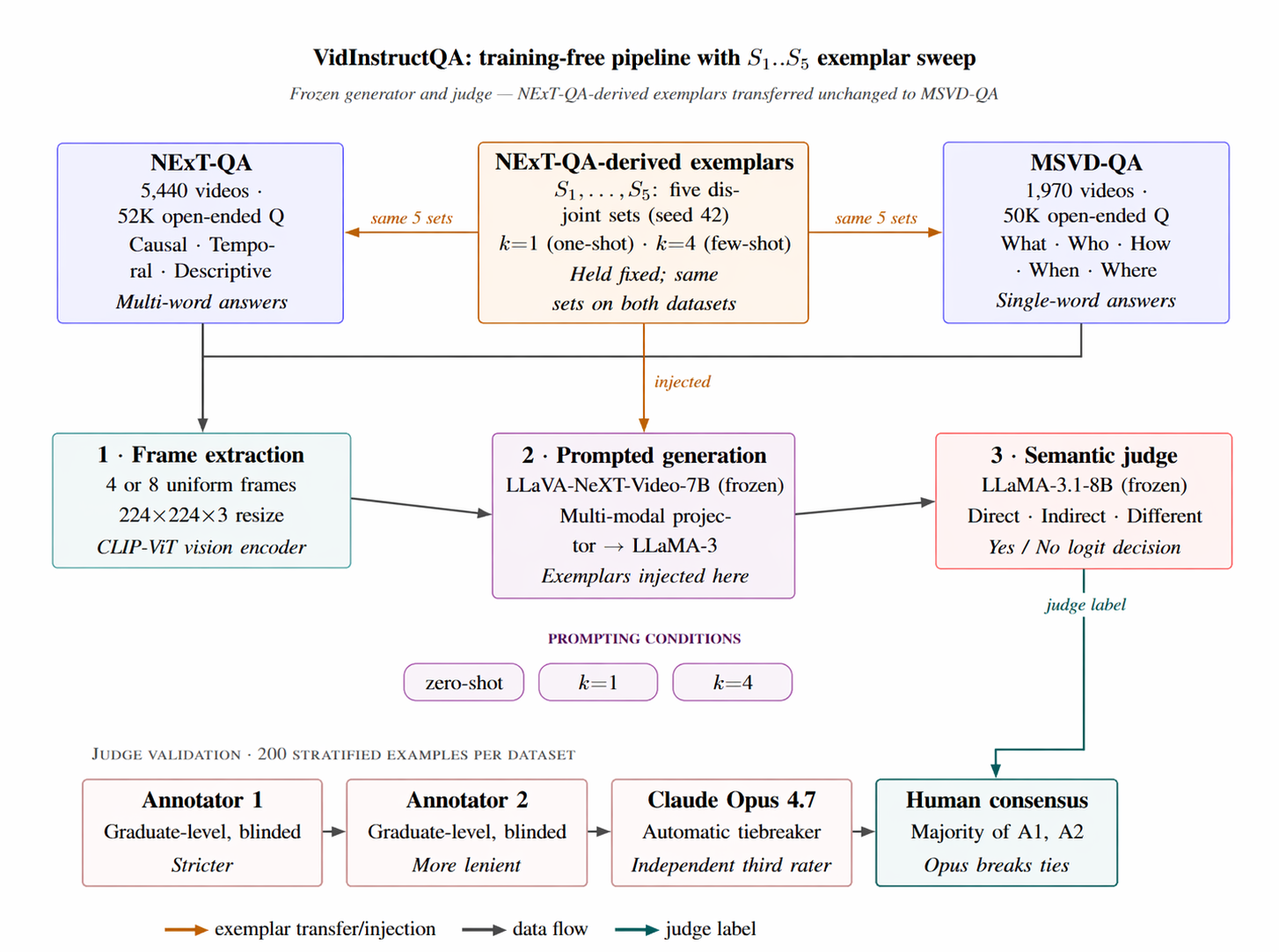
In the study conducted by Ahmad et al., the researchers examined this phenomenon within a multimodal pipeline used for video question answering. They utilized a fixed generator-judge setup where the generated answers remained constant, while only the ratio of Yes/No labels in the judge's few-shot examples was varied. Figure 1 shows the generic structure of this evaluation and validation pipeline, illustrating how the manipulated variable—the label balance of the judge's demonstrations—is isolated to test its effect on the final verdict.
Why is the bias considered directional?
Crucially, the researchers discovered that this bias does not act symmetrically. In a symmetric bias, a skew toward "Yes" would increase acceptance rates, while an equal skew toward "No" would decrease them. However, the study found that the bias is "inflation-only."
When the judge's examples were skewed toward acceptance (Yes), the acceptance rate jumped significantly—by approximately 30 points on the NExT-QA dataset and 20 points on MSVD-QA. Conversely, when the examples were skewed toward rejection (No), the judge's acceptance rate remained close to the human consensus. This suggests that the judge possesses an inherent tendency toward leniency, and providing more "Yes" examples amplifies this existing lean, whereas providing more "No" examples is insufficient to counteract it. Figure 2a illustrates these results, showing how the acceptance rate behaves across different demonstration sets.
How much does exemplar variance affect results?
Beyond the direction of the bias, the study highlights a significant issue regarding the reliability of single-shot or single-draw prompting. The researchers performed a five-draw analysis to see how much results vary based on which specific examples are chosen for the prompt.
They found that the variance caused by simply picking different examples can be larger than the effects caused by changing the label balance itself. In one instance, the difference between the best single-draw result and the mean of five draws was as high as 16.09 points. This indicates that reporting accuracy based on a single set of few-shot examples is highly unreliable and can lead to misleading conclusions about a model's true capabilities.
How can developers mitigate these biases?
Because the bias is driven by the in-context prompt rather than the model's underlying weights, it can be addressed through relatively simple procedural changes. The authors suggest two primary methods for researchers and developers to ensure more robust evaluations:
- Balance the demonstrations: Ensure that the few-shot examples provided to the judge contain an equal number of positive and negative labels to prevent the model from latching onto a majority prior.
- Report averaged results: Instead of relying on a single prompt, developers should report results averaged over multiple different draws of examples. This helps smooth out the high variance observed in single-draw prompting.
By implementing these steps, the risk of fabricating apparent benchmark gains through accidental prompt engineering is greatly reduced.
Applying these insights in research
For researchers working with complex datasets or trying to validate the outputs of multimodal models, understanding the pitfalls of automated evaluation is essential. If you are currently reviewing academic papers or technical documentation regarding model benchmarks, you can use Reader to perform deep research over PDFs and papers. This allows you to search for specific mentions of evaluation methodologies and cross-reference findings across multiple sources to ensure the benchmarks you are citing are not victims of the inflation-only bias described in this study.
Frequently asked questions
Does label bias always decrease a judge's accuracy?
No, the research indicates that the bias is directional and specifically causes an inflation-only failure mode. While a skew toward acceptance can sharply increase the acceptance rate and inflate measured accuracy, a corresponding skew toward rejection does not produce a matching drop in accuracy, meaning it typically pushes scores up rather than down.
Can a single prompt draw provide reliable evaluation metrics?
No, reporting results from a single example draw is considered unreliable according to the study. The researchers found that exemplar variance can cause accuracy to fluctuate by up to 18 points. Because this variance can exceed the differences between different prompting conditions, averaging results over several draws is necessary for stability.
Is the bias caused by the video content itself?
No, the bias is not a result of the multimodality of the video data. The study clarifies that the judge is a text-only model that compares generated text against reference text. The multimodality exists on the generator side; the bias itself arises from how the text-based judge processes its in-context instructions.
More news

New interpretable embeddings use decision columns for search
Researchers propose using decision columns as embeddings to create auditable, interpretable search and entity matching systems for business data.

New Benchmark Tests if AI Can Write Programs to Play Games
Researchers have introduced PlayScriptBench to evaluate if vision-language models can synthesize executable game controllers rather than just reacting.

New DPMA method optimizes Mixture-of-Experts model compression
Researchers introduced DPMA, a method that jointly learns how to prune, merge, and absorb experts to compress MoE models without full retraining.