LLMs are steered by irrelevant words despite claiming otherwise
Researchers have identified Phantom Context Influence, where semantically irrelevant words sway AI reasoning, even though models deny their impact.
 Source: Grafy Research Lab
Large language models (LLMs) are frequently influenced by words in a prompt that have nothing to do with the actual task, a phenomenon that can derail complex reasoning. According to a paper by Yanbei Jiang et al., this occurs even when the models themselves are asked to evaluate the context and claim that those specific words are irrelevant.
What is Phantom Context Influence?
The researchers identified a phenomenon they termed Phantom Context Influence (PCI). This happens when semantically irrelevant context words disproportionately steer the model's next-token distribution. In the context of Chain-of-Thought (CoT) prompting—where a model is encouraged to show its work through intermediate steps—these "phantom" words can alter the reasoning trajectory without any logical justification.
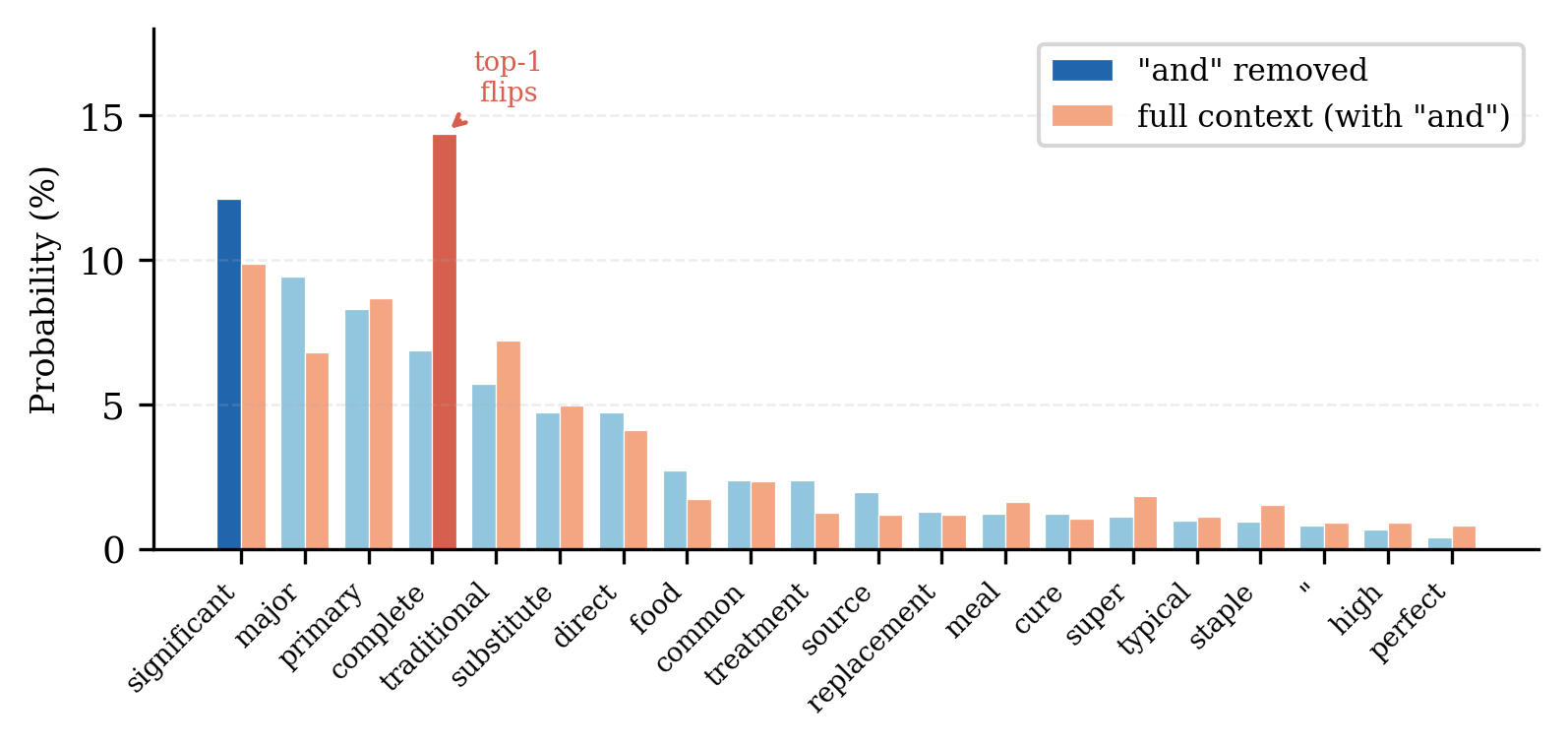
Figure 1 illustrates this effect by showing how removing a simple connector like "and" can fundamentally change a model's prediction. While "and" carries no domain-specific information for a factual question, its presence or absence can flip the top-1 prediction. Figure 6 further demonstrates this by showing how the probability distribution shifts when such a word is removed from the context.
Why do models fail to recognize their own bias?
The study highlights what the authors call the "Generation-Judgment Contradiction." To test this, the researchers used a "Leave-One-Out Word JSD" analysis. This method removes one word at a time from the context to see if its removal changes the model's predicted next token. If the removal flips the prediction, that word is labeled a "pivot word."
The researchers then passed these pivot words back to the same LLM, asking it to self-judge whether it recognized the predictive dependence on that word. The results across four models and three benchmarks showed that models largely do not know which words are steering them. They frequently classify these influential pivot words as irrelevant, creating a mismatch between how the model actually generates text and how it perceives its own reasoning process.
How can this influence be suppressed?
To address this, the authors proposed a method called Online KV Suppression. This is an inference-time intervention designed to mitigate PCI during the generation of a reasoning chain. Instead of checking every single token—which would be computationally expensive—the method evaluates the influence of each prompt word over the entire generated response in a single pass.
Once the most influential "spurious" words are identified (those that have high influence but are judged by the model to be inert), the system zeros out the corresponding Key-Value (KV) cache entries and redecodes the response. This intervention has shown significant promise; according to the researchers, this single-word suppression improved CoT accuracy across four models and five benchmarks, with gains of up to 8.9 percentage points on arithmetic reasoning tasks.
Is this different from other AI biases?
The authors clarify that PCI is distinct from other known issues like positional recency bias, which refers to the aggregate effect of where a token sits in a long sequence. It is also different from standard CoT unfaithfulness, which typically concerns whether a model's written rationale matches its final answer. PCI operates at a more granular level, focusing on how individual, semantically empty words manipulate the probability of the very next token produced.
For researchers and developers working with complex prompts, this suggests that the "noise" in a prompt—even seemingly harmless words—can act as a hidden lever that shifts the model's logic in unpredictable directions.
How to explore these concepts in Grafy
Understanding the nuances of how models process context and reasoning is essential for anyone performing deep research. While Grafy does not currently implement Online KV Suppression, users can explore the complexities of model behavior and paper analysis using Reader. By uploading academic papers on interpretability or LLM mechanics, you can use the integrated AI to query specific findings, summarize complex methodologies, and cross-reference how different models might respond to specific prompting constraints.
Frequently asked questions
What is Phantom Context Influence?
Phantom Context Influence is a phenomenon where semantically irrelevant words in a prompt significantly alter a language model's next-token predictions. These words steer the model's reasoning path even though they provide no useful information for solving the actual problem or answering the question provided in the context.
What is the Generation-Judgment Contradiction?
This contradiction refers to the discrepancy between a model's actual sensitivity to certain words and its self-assessment of those words. While certain "pivot words" might drastically change the model's output, the model often incorrectly judges those same words as being irrelevant to the prediction when asked to evaluate them.
Does Online KV Suppression improve model accuracy?
Yes, the proposed Online KV Suppression method improves reasoning accuracy by suppressing spurious dependencies during generation. In the researchers' experiments, this single-word intervention led to accuracy improvements across multiple models, including a gain of up to 8.9 percentage points on specific mathematical reasoning benchmarks.
Source: Yanbei Jiang, Chao Lei, Jey Han Lau, Krista A. Ehinger, Rena Gao Wei (https://arxiv.org/abs/2611.27317)
Source: Grafy Research Lab — Do Language Models Know Which Words Steer Their Reasoning?
More news

New compression framework reduces LLM reasoning tokens losslessly
Researchers have developed a method to compress intermediate reasoning steps using custom tokens, reducing latency without losing interpretability.

New LRSA method accelerates long-context AI inference
Researchers propose LongCat Recall Sparse Attention (LRSA) to solve retrieval bottlenecks in long-sequence models, significantly speeding up inference.

New DistDNA method identifies LLMs despite random decoding
Researchers have introduced DistDNA, a fingerprinting method that identifies specific AI models even when they use stochastic decoding settings.