LLMs memorize their own hallucinations during post-training
New research shows that reasoning-centric training recipes can cause models to memorize false facts they generate during the learning process.
 Source: Grafy Research Lab
Current training methods designed to improve logical reasoning may inadvertently cause large language models (LLMs) to memorize the very falsehoods they generate. This phenomenon occurs because the training recipes used to enhance math and coding abilities can reinforce incorrect information when applied to general knowledge tasks.
How do reasoning-centric training recipes cause hallucinations?
Modern frontier models often utilize "cognitive" behaviors during training to improve their problem-solving capabilities. These behaviors include exploring multiple hypotheses or backtracking from an incorrect thought process. While these techniques are highly effective for math or code, they can be problematic for knowledge-based questions that require simple factual recall.
According to research by Anirudh Atmakuru and Tanya Goyal from Cornell University, these reasoning-centric methods often rely on outcome-based rewards during reinforcement learning (RL). In this setup, a model receives a positive reward if its final answer is correct, regardless of the accuracy of the intermediate reasoning steps.
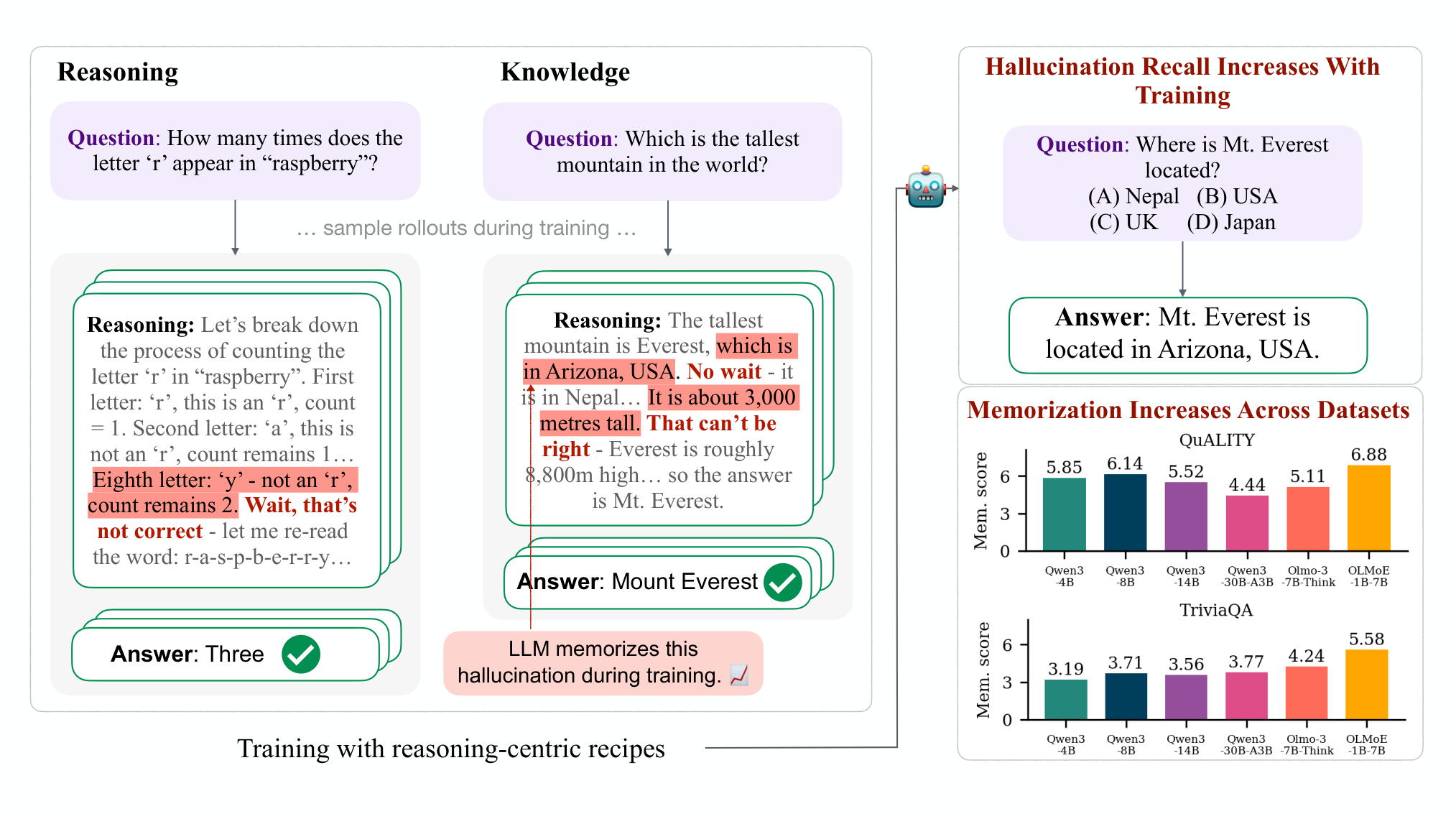
Figure 1 shows how this creates a conflict. In a reasoning task, a model might miscount letters but then catch the error and correct itself. However, in a knowledge task, the model might include a false fact in its reasoning chain—such as stating a mountain is in the wrong country—but still arrive at the correct final answer. Because the final answer is correct, the outcome-based reward reinforces the entire sequence, including the false fact. This process effectively trains the model to treat its own hallucinations as valid information.
What is the scale of this memorization problem?
The researchers conducted experiments on six open models across two different architectures and model families to quantify how much these errors are retained. The results suggest that the memorization is significant compared to random errors.
On average, the recall of hallucinations that were reinforced during training increased by 4.83%, whereas hallucinations that received no training signal only saw a 0.17% increase in recall. This indicates that the training process is actively embedding these self-generated errors into the model's weights.
Furthermore, the study found that models become less likely to abstain from making these mistakes after they have been reinforced. On average, the probability of a model abstaining from a self-hallucinated fact fell by 7.23% during the training process.
Does backtracking prevent the memorization of false facts?
One might assume that if a model recognizes a mistake and "backtracks" from it within its reasoning chain, it would not memorize the error. However, the study found that this is not the case.
Researchers discovered that LLMs memorize the false facts they backtrack from just as strongly as the ones they do not. The data showed only a 0.08% difference in the memorization of false facts that were retracted versus those that were not. This suggests that the mere presence of a false fact in a rewarded reasoning trace is enough to trigger memorization, even if the model eventually reaches the right conclusion by correcting itself.
Which types of questions are most susceptible to this issue?
The impact of this memorization is not uniform across all types of data. The research indicates that memorization is strongest when the model is working on the hardest training questions. This suggests that as the model struggles more to find a path to the correct answer, it is more likely to generate and subsequently reinforce erroneous intermediate steps.
This finding highlights a fundamental tension in current AI development: the very tools used to push models toward higher-order reasoning can degrade their reliability as factual knowledge engines. As model providers continue to use these reasoning-focused post-training recipes, the risk of models becoming "confident" in their own hallucinations remains a critical challenge for the field.
How to explore this research further
For researchers and developers looking to dive deeper into the technical details of these experiments, including the specific datasets like QuALITY and TriviaQA used, the full paper provides extensive methodology and ablation studies.
If you are looking to analyze similar academic papers or technical reports on AI safety and model training, you can use Grafy Reader to upload the PDF. This allows you to ask specific questions about the mathematical notation, such as the memorization scores or the reinforcement learning parameters, and search for specific findings within the text.
Frequently asked questions
Do reasoning-centric training recipes improve knowledge recall?
No, they can actually harm it. While these recipes improve performance in domains like math and code, they can cause models to memorize false facts in knowledge-based tasks. This happens because outcome-based rewards can reinforce incorrect information contained within a reasoning chain if the final answer is ultimately correct.
Does backtracking from a mistake stop a model from memorizing a hallucination?
No, backtracking does not prevent memorization. The research shows that models memorize false facts they immediately retract almost as strongly as facts they do not retract. The difference in memorization between these two types of hallucinations was found to be only 0.08%.
Does rewarding a hallucination change a model's tendency to abstain?
Yes, rewarding a hallucination makes a model less likely to abstain from it. The study found that after a hallucination is reinforced during training, the model's probability of abstaining from that false fact decreases by an average of 7.23%.
Source: Grafy Research Lab — LLMs Memorize Their Own Hallucinations During Post-Training
More news

New framework improves long-form AI generation via segment rewards
Researchers have proposed a short-horizon process supervision method to fix errors in long AI documents. Learn how segment-level rewards work.

Researchers propose reusing RL rollouts for efficient distillation
A new study suggests reusing teacher reinforcement learning rollouts for student distillation can match performance without extra generation costs.

New DPMA method optimizes Mixture-of-Experts model compression
Researchers introduced DPMA, a method that jointly learns how to prune, merge, and absorb experts to compress MoE models without full retraining.