MulCLIP improves vision-language alignment for long descriptions
Researchers have introduced MulCLIP, a framework that enables vision-language models to better understand long, detailed captions without extra cost.
 Source: Grafy Research Lab
Vision-language models are increasingly capable of understanding images, but they often struggle to process long, intricate descriptions due to their training on short captions. Researchers have developed a new framework called MulCLIP to bridge this gap by aligning visual content with multiple levels of textual detail.
What is the problem with current CLIP models?
Models like CLIP (Contrastive Language-Image Pre-training) are highly effective at matching images with short, general text. However, according to the research paper by Chau Truong et al., these models lack the ability to handle fine-grained details, such as specific attributes or complex relationships between objects, when presented with long-form descriptions.
While some existing solutions attempt to fix this, they often come with high computational costs. For instance, some methods use "region proposals" to match specific parts of an image to specific parts of a sentence, but this requires significant extra processing power during deployment. Other approaches, such as LongCLIP, extend the model's ability to read longer sequences but still operate at a global level, meaning they struggle to connect specific words to specific visual patches within a complex scene.
How does the MulCLIP framework work?
MulCLIP introduces an end-to-end, multi-level alignment framework that does not rely on external modules or expensive region proposals. Instead, it exploits the natural structure of long text by aligning different levels of granularity through compatible training signals.
As illustrated in Figure 2, the framework uses a multi-granularity logic. It applies batch-wise contrastive alignment for global descriptions and subcaptions, while using within-sample contrastive alignment for the relationship between individual words and image patches. This ensures that the model learns both the big picture and the minute details simultaneously.
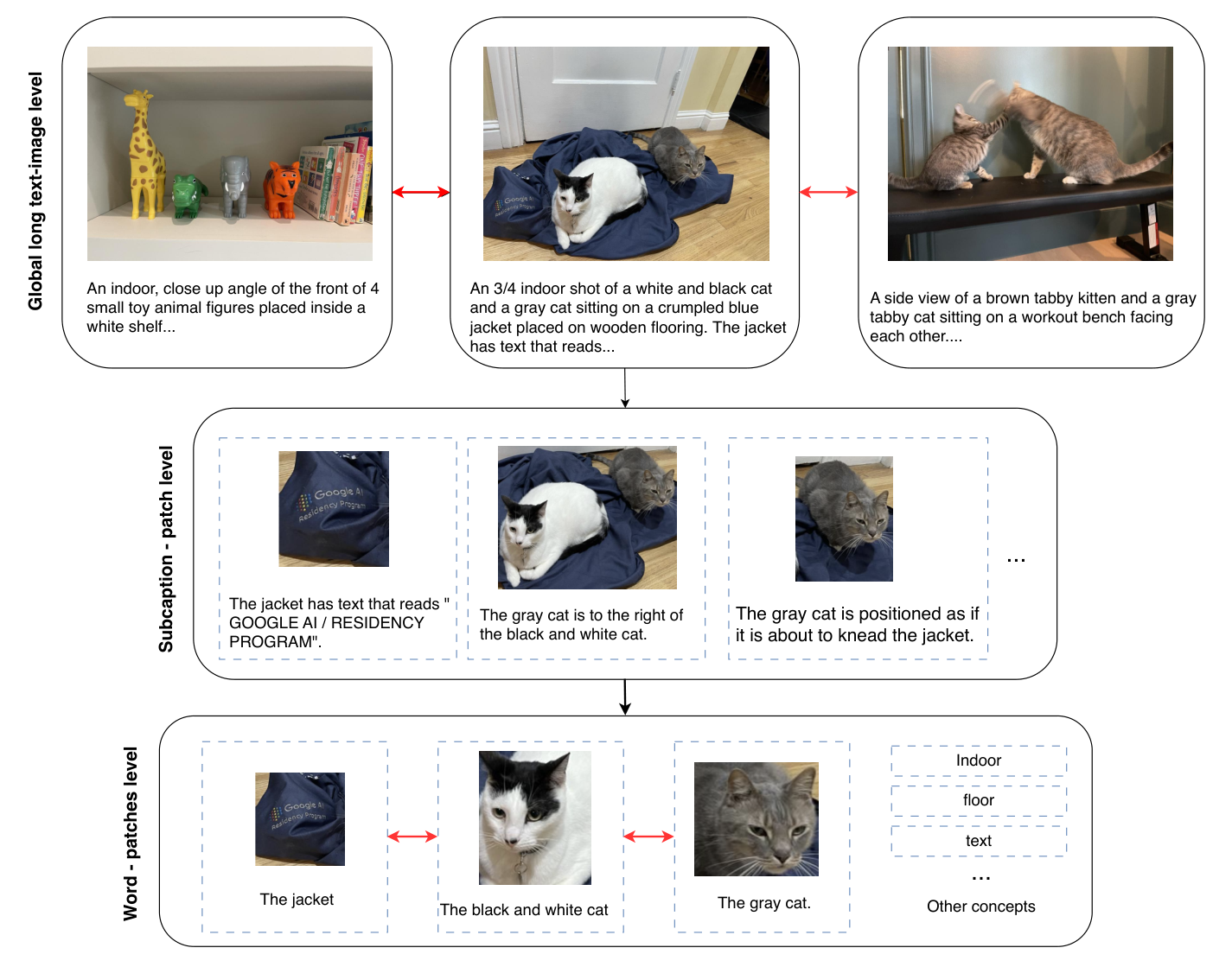
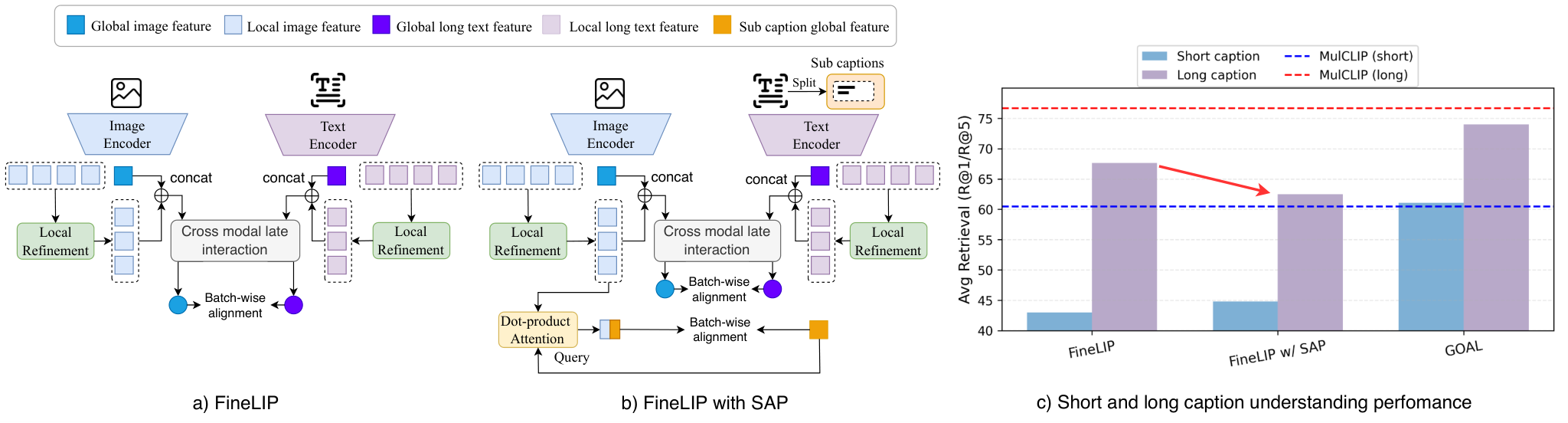
Figure 1 highlights a major challenge that MulCLIP addresses: the "compatibility issue." In previous designs, simply adding new objectives for subcaptions often caused the model to lose its ability to understand long captions. The authors found that these objectives often conflicted when optimized in the same token space. MulCLIP solves this by decoupling the alignment processes, using specific signals for different semantic units—words, subcaptions, and full captions.
What are the specific alignment levels used?
According to the authors, MulCLIP utilizes three distinct training signals to ensure comprehensive understanding:
- Global-level Alignment: This uses contrastive learning to match long captions and short summaries with the overall image.
- Subcaption–Aggregated Patch Alignment (SAP): This grounds subcaptions (which describe broader facts or groups of objects) to specific image patches using batch-wise contrastive signals.
- Word–Patch Reconstruction (WPR): This focuses on the most granular level, aligning individual words or phrases with specific visual features through within-sample contrastive learning.
By separating these tasks, the framework prevents the training signals from interfering with one another, allowing the model to improve its fine-grained understanding without degrading its performance on shorter, simpler texts.
What results did the researchers achieve?
Experiments conducted by the research team across various benchmarks showed that MulCLIP provides consistent improvements in long-caption retrieval. The model demonstrated an enhanced ability to locate specific details within an image when prompted with complex text.
Crucially, the framework also maintained or improved performance on short-caption retrieval, a common side effect when models are fine-tuned specifically for long-form content. The ablation studies conducted by the authors confirmed that the different objectives—global, subcaption, and word-level—are complementary, meaning they work together to improve the overall capability of the vision-language model.
How can researchers apply these findings?
For researchers working with dense datasets or complex multimodal tasks, the MulCLIP approach suggests that multi-granularity alignment is more effective than simply stacking objectives. The decoupling of word-level and subcaption-level training is a key takeaway for designing more robust vision-language systems.
If you are currently reviewing similar research papers or technical documentation regarding multimodal architectures, you can use Grafy Reader to perform deep research over the PDFs. This allows you to ask specific questions about the mathematical formulations or experimental setups found in papers like MulCLIP directly within your workspace.
Frequently asked questions
Does MulCLIP require region proposals to work?
No, MulCLIP is a proposal-free framework. Unlike previous methods that rely on expensive external modules to identify specific regions in an image to match with text, MulCLIP directly exploits the natural structure of long-form text to achieve fine-grained alignment without increasing deployment costs.
Why does MulCLIP perform better than previous late-interaction models?
MulCLIP performs better because it solves a compatibility issue found in existing designs. While previous models often saw a decline in long-text understanding when adding new objectives, MulCLIP decouples caption, subcaption, and word-level alignment through compatible objectives that do not interfere with each other.
Can MulCLIP handle both short and long text descriptions?
Yes, MulCLIP is designed to improve long-context understanding while preserving the model's ability to handle short-text transfer. The researchers demonstrated through experiments that the multi-level alignment approach allows the model to excel at detailed descriptions without losing its efficiency with generic, short captions.
More news

Study finds AI models struggle with partially covered questions
A new pilot evaluation shows AI models often add unsupported claims when reference material only partially answers a user's question. Learn more.

New LANTERN framework helps AI find tiny brain metastases
Researchers introduced LANTERN, a recursive learning framework designed to help multimodal models detect small medical lesions that they typically miss.

New MGMem framework enables efficient long-horizon agent memory
Researchers have introduced MGMem, a framework that provides deterministic and cost-effective memory for AI agents without using generative indexing.