New AnchorCredit method solves credit misassignment in AI training
Researchers have introduced AnchorCredit to prevent AI models from being penalized for correct reasoning when other parts of a response are wrong.
 Source: Grafy Research Lab
Researchers have identified a significant flaw in how large language models learn from structured tasks, where a single error can lead to the accidental punishment of correct reasoning. To solve this, a new method called AnchorCredit has been proposed to ensure that learning signals are precisely mapped to the specific parts of a response that earned them.
What is cross-component credit misassignment?
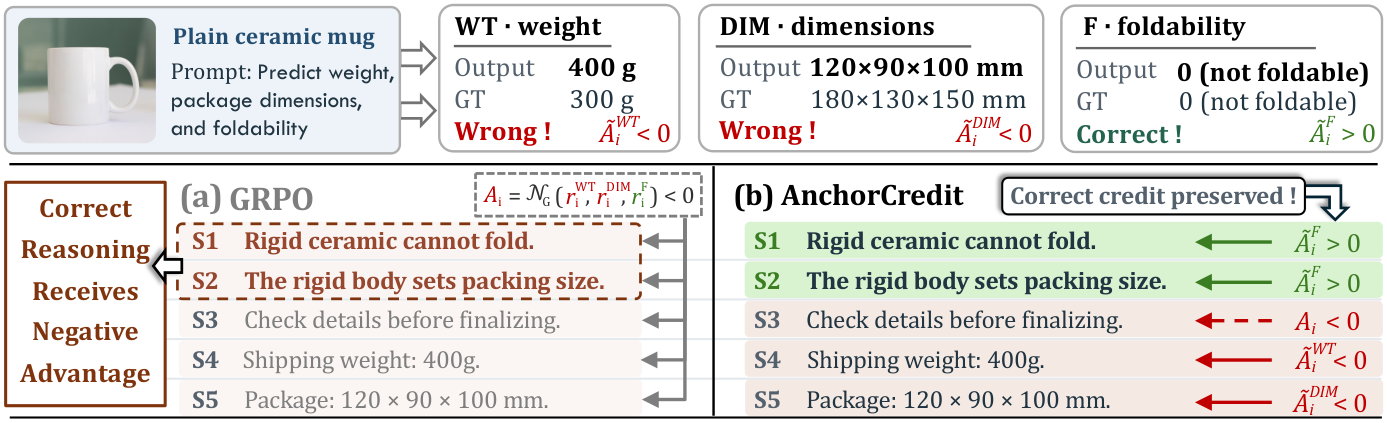
In modern Reinforcement Learning with Verifiable Rewards (RLVR), models are often trained to perform complex tasks that require multiple correct answers in a single response. For instance, a model might be asked to analyze a product image and output its weight, dimensions, and foldability.
According to the research by Gen Li and colleagues, standard training algorithms like Group Relative Policy Optimization (GRPO) typically calculate a single reward for the entire response. This reward is then applied to every token generated. This creates a systematic problem: if a model correctly predicts foldability but fails on weight and dimensions, the overall negative reward for the response is broadcast to all tokens. As Figure 1(a) illustrates, this causes the model to be penalized for the correct foldability reasoning, even though that specific component was accurate. This phenomenon is termed "cross-component credit misassignment."
How does AnchorCredit assign credit?
AnchorCredit acts as a plug-in module designed to decouple these rewards. Instead of applying a blanket advantage to the entire sequence, the method identifies which specific tokens in the reasoning chain are responsible for which output components.
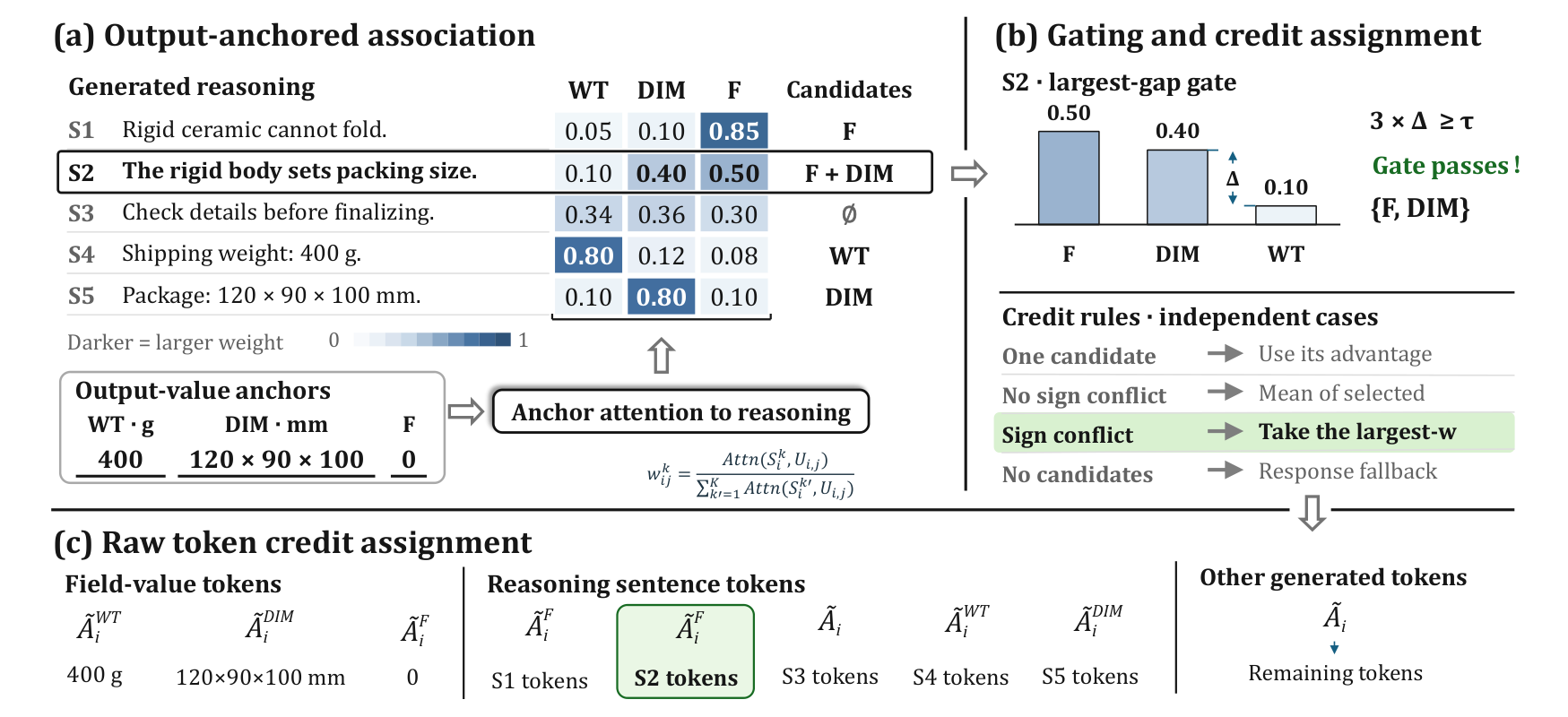
As shown in Figure 2(a), the researchers use the tokens of the generated output values as "anchors." By analyzing the policy model's internal attention mechanisms, the system can estimate the association between these output anchors and the preceding reasoning sentences. Figure 2(b) details how a gating mechanism selects candidate components, and Figure 2(c) explains how these component-specific advantages are assembled into a token-level credit signal. This allows the model to receive a positive signal for its correct reasoning steps and a negative signal only for the steps leading to errors.
Does this method require extra data?
One of the primary advantages of AnchorCredit is that it does not require additional human annotations or a separate, expensive relevance discriminator. Previous attempts to solve this problem, such as RTT, required training a separate model to map feedback to tokens, which necessitated extra training stages and labeled data.
In contrast, AnchorCredit leverages the existing attention weights within the policy model itself. Because the output components are structured and verifiable, the model already "knows" which values correspond to which attributes. By using these values as anchors, the researchers can estimate relevance without needing a separate training process or predefined reasoning blocks. This makes it a more efficient "plug-in" for existing reinforcement learning frameworks.
What are the performance results?
To test the effectiveness of the method, the researchers developed ProductAttr, a benchmark consisting of 7,200 real product image-text samples. They also tested the approach on the public Nutrition5k dataset.
The results indicated that AnchorCredit consistently outperforms existing baselines. On the ProductAttr benchmark, the method improved mean performance across three target attributes: weight RMAE increased by 5.74 percentage points, dimension RMAE by 2.80 percentage points, and foldability F1 by 1.76 percentage points.
The benefits were not limited to product attributes; the researchers also applied the method to dialogue state tracking on the Schema-Guided Dialogue (SGD) dataset. In that context, AnchorCredit improved Joint Goal Accuracy by 6.00 percentage points over standard GRPO. Furthermore, the study demonstrated that the improvements remain consistent across different model architectures, including larger dense models and Mixture-of-Experts (MoE) configurations.
How can researchers apply these findings?
For researchers working on structured generation, AnchorCredit offers a way to refine the training of models that must handle multi-attribute outputs. By moving away from response-level advantages toward component-specific advantages, models can learn more nuanced reasoning paths without being derailed by unrelated errors in a multi-part response.
If you are currently reviewing similar machine learning papers or exploring the technical implementation of reinforcement learning, you can use Grafy Reader to search through and question dense academic PDFs. This can help you quickly extract specific mathematical formulations or implementation details from the AnchorCredit paper or similar research.
Frequently asked questions
What problem does AnchorCredit solve?
AnchorCredit solves the problem of cross-component credit misassignment in reinforcement learning. This occurs when a model is penalized for correct reasoning because other, unrelated parts of its multi-attribute response were incorrect. By assigning specific credit to relevant reasoning steps, the method prevents the model from being unfairly discouraged during training.
How does the method use attention to assign credit?
The method uses the attention weights from the output tokens, which act as anchors, to the preceding reasoning sentences. By measuring how much attention the model pays to certain reasoning steps when generating a specific output component, the system can estimate the strength of the association between that sentence and that component.
Does AnchorCredit work with existing training algorithms?
Yes, AnchorCredit is designed as a plug-in module that can be integrated into existing training frameworks. The researchers demonstrated its compatibility with several algorithms, including GRPO, DAPO, and GDPO. This allows developers to improve the precision of credit assignment without needing to overhaul their entire reinforcement learning pipeline.
Source: Gen Li et al., "AnchorCredit: Output-Anchored Credit Assignment for Structured Generation with Multiple Verifiable Rewards"
More news

New Method Optimizes LLM Updates via Sequential Labeling
Researchers propose the SOLD framework to efficiently evaluate LLM updates using a mix of cheap AI judges and costly human labels. Learn how it works.

New Research Proposes Draft Calibration for Faster LLM Inference
Researchers propose a draft calibration method to accelerate speculative decoding by reducing the distribution gap between draft and target models.

Zarc achieves exact billion-vector search in seconds
A new system called Zarc enables exact k-nearest-neighbor vector search over a billion vectors in seconds, solving a major bottleneck for LLM efficiency.