New approach uses confidence scores to gate AI agent decisions
Researchers have developed a method to predict LLM correctness via confidence scores, allowing agents to automate tasks or route errors to humans.
 Source: Grafy Research Lab
Large language model (LLM) agents are increasingly tasked with high-stakes decision-making in sectors like finance and healthcare, yet their tendency to produce incorrect answers with high confidence remains a critical barrier to full autonomy. According to a paper by Luiz G. A. Alves and Aaron Vermeersch, a new method for generating reliable confidence scores can serve as a "gate," allowing systems to automatically act on certain responses while routing uncertain ones to human reviewers.
How does confidence gating work for AI agents?
As AI agents move beyond simple chat interactions into multi-step reasoning and action execution, the risk of unchecked errors grows. Figure 1 illustrates the difference between two primary operational modes. An ungated agent either executes every command—risking errors—or sends every task to a human, which limits the system's speed and scalability.
In contrast, a confidence-gated approach uses a scoring mechanism to set a threshold. If an agent's confidence score for a specific answer exceeds this threshold, the system acts on it automatically. If the score falls below the threshold, the task is flagged for human intervention. This allows for high-throughput automation without sacrificing the safety provided by human oversight.
What are the limitations of current confidence methods?
Existing methods for estimating whether an LLM is correct often lack the precision required for effective gating. Many systems rely on aggregating token log-probabilities or using "self-assessment" prompts, where the model is asked to rate its own certainty. However, the authors note that these self-assessment mechanisms can be biased or over-confident.
Other approaches, such as "LLM-as-Judge," involve using a second model to evaluate the first. While useful, these methods inherit the biases of the judging model. Furthermore, while prompted confidence scores might appear well-calibrated in general, they often lack the fine-grained resolution necessary to set strict operational thresholds for automated tasks.
How does the proposed confidence score head function?
To address these issues, the researchers propose a supervised learning approach. For models where the internal architecture is accessible, they implement a "confidence score head." This is a linear classifier attached to the frozen backbone of the LLM. It functions by reading the final-layer hidden state at the last token to predict the probability that the entire generated answer is correct.
For proprietary or "closed" models where internal states are hidden, the researchers developed text-only metamodels. These metamodels predict correctness by analyzing the semantic relationship between the input prompt and the generated output text using sentence embeddings.
How does this method compare to existing baselines?
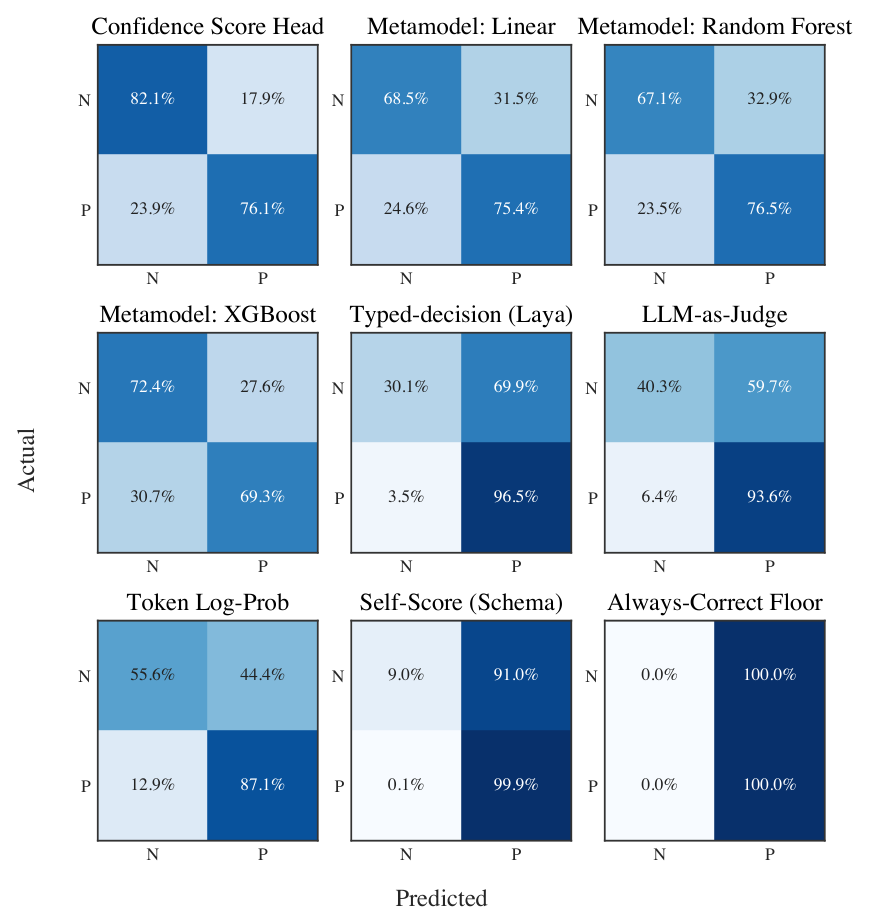
In testing conducted on a 2B-parameter backbone using datasets such as SQuAD and TruthfulQA, the confidence score head outperformed several common baselines. This included token log-probabilities, self-scores, and the LLM-as-Judge method. The study found that the confidence score head was able to automate the largest fraction of the workload while maintaining high accuracy targets.
While the researchers noted that the ability of these scores to transfer to entirely unseen datasets was modest, the confidence score head remained the most robust approach tested. This suggests that even if a model's accuracy fluctuates across different domains, the internal signal it provides about its own certainty is a more reliable indicator for gating than external prompting or simple probability averages.
Can this framework be applied to other AI safety concerns?
The authors suggest that the proposed framework is not limited to simple correctness. The mechanism of using a scoring head to gate outputs could potentially be adapted to monitor other critical properties, such as whether an agent's response complies with specific safety guidelines or regulatory requirements. By setting thresholds for compliance scores, organizations could more safely deploy autonomous agents in highly regulated environments.
For researchers looking to dive deeper into the technical specifics of how LLMs process information or to analyze similar academic papers on agentic workflows, Grafy's Reader provides an environment to conduct research over PDFs and scientific papers using AI.
Frequently asked questions
What is a confidence score head?
A confidence score head is a linear classifier that is attached to the final layer of a frozen large language model. It works by analyzing the model's internal hidden states at the final token to predict the likelihood that the model's generated answer is actually correct, providing a more precise metric than simple text prompts.
Why is confidence gating important for AI agents?
Confidence gating is essential because it allows AI agents to operate autonomously in high-stakes environments without constant human supervision. By setting a threshold, a system can automatically process high-confidence answers to save time while ensuring that low-confidence or potentially incorrect answers are diverted to a human for review, maintaining safety and accuracy.
How do metamodels differ from confidence score heads?
A confidence score head requires access to the internal hidden states of a language model, making it suitable for open-weight models. Metamodels are designed for closed-source or proprietary models where internal states are unavailable; they predict correctness by analyzing the text of the input and output using sentence embeddings instead of internal architecture signals.
Source: Grafy Research Lab — Confidence scores for gated automation of large language models
More news

New FBQ Method Optimizes LLM Cache Selection
Researchers have introduced Faster and Better Query (FBQ) to improve how large language models manage prompt memory. Learn how it predicts future needs.

Can Open-Weight Models Run Frontier-Level Scientific Agents?
Researchers evaluated whether open-weight models can execute complex scientific workflows designed for frontier models. Discover the performance gaps.

Code Mode vs Tool Calling: New Benchmark Finds 16-Tool Crossover
Research shows Code Mode is significantly cheaper and faster for large fan-outs but less reliable for single lookups than traditional tool calling.