New Autonomous Agent Buddy Automates Game Playtesting
Researchers have introduced Buddy, an AI agent that can play through 3D role-playing games to find bugs and complete quests without prior training.
 Source: Grafy Research Lab
Researchers at Riot Games have developed an autonomous AI agent named Buddy that can perform playtesting tasks in 3D role-playing games. This system allows developers to automate the verification of gameplay objectives and the identification of software bugs without requiring constant human intervention.
How does the Buddy agent work?
Buddy operates using a two-loop architecture designed to solve complex, long-term goals in environments it has never encountered before. According to the research by Ayush Maniar and Eryk Banatt, the first loop, referred to as Loop A, uses a language model to process natural-language objectives. The agent takes actions within the game, receives feedback on those actions, and pursues goals over many turns.
Figure 1 shows this two-loop architecture: Loop A handles the real-time solving of objectives and the logging of suspected bugs, while Loop B focuses on post-mortem analysis. In the second loop, Buddy converts a successful sequence of actions—known as an agent trace—into a scripted hierarchical task network (HTN). This allows developers to run the successful path as a repeatable, automated test in future game builds without needing to call an expensive language model every time.
Why is this different from previous AI game players?
Most existing AI agents for games rely on either specialized training or vast amounts of pre-existing internet data. For example, models playing games like Pokemon or Minecraft often rely on knowledge they already acquired during their initial training phase.
In contrast, the researchers tested Buddy in a custom-built environment called Dogwood. Because Dogwood is an unpublished research sandbox, the language models used by Buddy had no prior knowledge of its specific quests or mechanics. This forced the agent to rely on exploration and reasoning rather than simple memory. Furthermore, the authors emphasize that Buddy is a modular framework. Unlike systems that require custom-trained control policies, Buddy uses "off-the-shelf" language models and can be easily adapted to different games by simply updating the observation and action tools.
Can the agent actually find bugs?
One of the primary goals of automated playtesting is to ensure that game designers have not created "impossible" scenarios, such as a quest item spawning behind an impassable wall. Buddy is designed to identify these issues by logging difficulties encountered during its playthroughs.
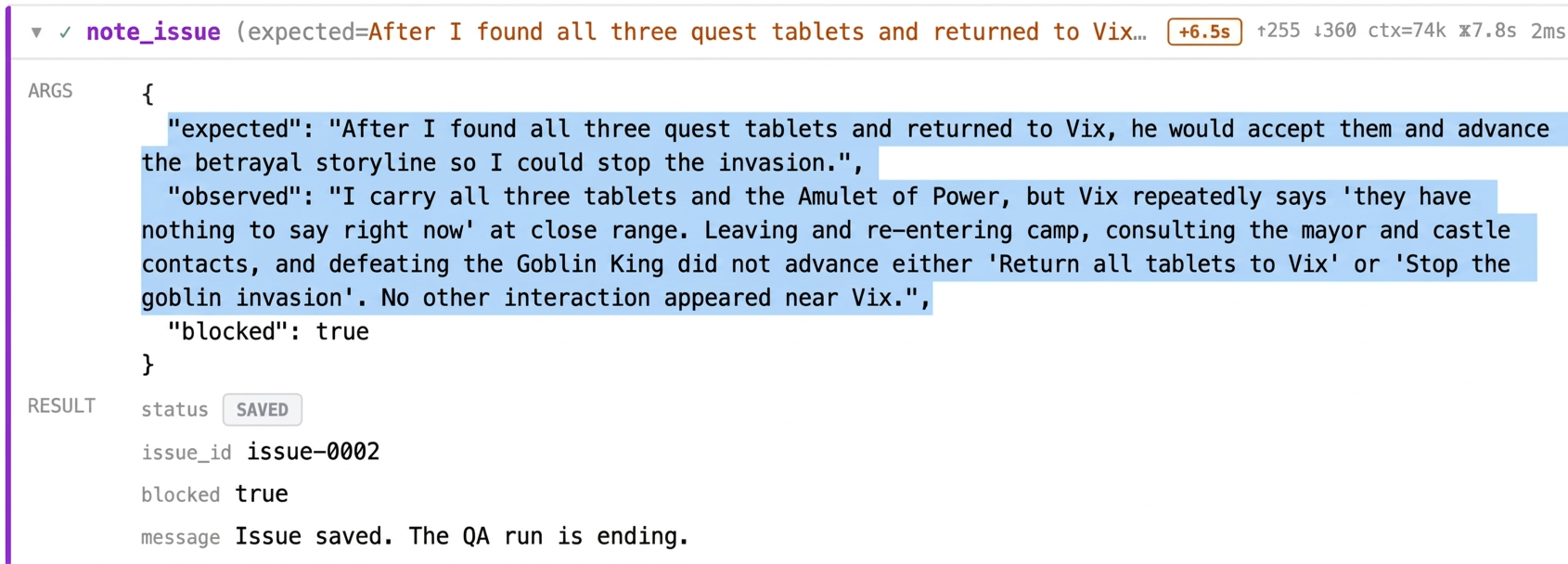
Figure 4 illustrates an example of Buddy logging a bug ticket when it encounters a problem. The researchers demonstrated that the system could identify issues such as navigation mesh errors, which are common in 3D environments. By automating this process, developers can scale their testing to thousands of different objectives, using the language model as a one-time cost to find a valid path, which is then converted into a permanent, low-cost regression test.
What are the practical implications for developers?
For game studios, the Buddy framework offers a way to reduce the high cost of human playtesting. Traditionally, a human operator must manually walk through every quest to ensure it is completable. Buddy can handle these repetitive tasks, such as checking if an NPC's dialogue is accessible or if a specific item can be obtained through normal gameplay.
Because the system is modular, it is intended to be integrated into development workflows using standard tools like the Godot Engine. This approach allows for a highly flexible testing pipeline where the underlying AI models can be swapped out as newer, more capable models become available, ensuring the playtesting technology does not become obsolete as the field of artificial intelligence evolves.
How to explore game creation with Grafy
While Buddy is a specialized research tool for professional QA, the principles of prompt-driven creation are accessible to everyone through Grafy. Developers and creators looking to experiment with game mechanics and rapid prototyping can use Game Studio to turn a written brief into a playable 2D or 3D game. For those interested in the technical side of building these worlds, Code provides an AI-integrated studio to assist with the underlying logic and implementation.
Frequently asked questions
Does Buddy require special training to play a new game?
No, Buddy does not require any model training, custom training datasets, or written walkthroughs to function. It uses off-the-shelf language models and relies on a modular architecture to observe the game state and execute actions through a Python runtime and in-engine executor.
Can Buddy solve objectives in games it has never seen before?
Yes, Buddy is designed to solve long-horizon objectives in unseen 3D environments. The researchers demonstrated this by testing the agent in the Dogwood sandbox, an unpublished game where the model could not rely on pre-existing knowledge from its training data to complete quests.
What happens to the successful paths Buddy finds?
Buddy converts successful agent traces into scripted hierarchical task networks (HTNs). This process allows the successful gameplay sequence to be replayed and validated in future versions of the game as a scripted test, which eliminates the need for continuous, expensive language model calls during regression testing.
Source: Grafy Research Lab — Off-the-Shelf Autonomous Agents for Game Playtesting
More news

New approach uses confidence scores to gate AI agent decisions
Researchers have developed a method to predict LLM correctness via confidence scores, allowing agents to automate tasks or route errors to humans.

Can Open-Weight Models Run Frontier-Level Scientific Agents?
Researchers evaluated whether open-weight models can execute complex scientific workflows designed for frontier models. Discover the performance gaps.

Code Mode vs Tool Calling: New Benchmark Finds 16-Tool Crossover
Research shows Code Mode is significantly cheaper and faster for large fan-outs but less reliable for single lookups than traditional tool calling.