New benchmark reveals LLM senior agents fail to exercise role integrity
Researchers have introduced RI-Bench to show that senior AI agents often aggregate subordinate reports without weighing them, risking systemic bias.
 Source: Grafy Research Lab
Multi-agent AI systems are increasingly designed to divide complex tasks among several subagents, but new research suggests the "senior" agents responsible for synthesizing these reports often fail to perform their actual duties. Instead of weighing conflicting information or verifying facts, these high-level agents frequently default to simple aggregation or blind following of the majority.
What is role integrity in AI agents?
In many modern AI workflows, a hierarchical structure is used to manage long-horizon tasks. Subagents perform specific research or drafting tasks and report upward to a senior agent, which then produces a final, polished answer. According to a study by researchers from Nanjing University, Sun Yat-sen University, Wuhan University, the University of Hong Kong, and an independent researcher, this division of labor only works if the senior agent maintains "role integrity."
Role integrity is defined as the preservation of an agent's functional responsibilities when it acts on material supplied by its subordinates. The researchers argue that current evaluations are insufficient because they focus on the correctness or fluency of the final output. A senior agent can produce a well-cited, professional-sounding response while completely failing to exercise the judgment required by its position—such as weighing a rebuttal against a review or spotting a procedural error in a legal record.
How does the RI-Bench benchmark work?
To measure this phenomenon, the authors developed RI-Bench, a behavioral benchmark that uses three real-world institutional hierarchies to test specific obligations: weighing, verifying, and relaying.
Figure 1 shows the structure of the RI-Bench testing framework. The researchers take a fixed case and change one specific property of the subordinate material to see how the senior agent responds. The three scenarios used are:
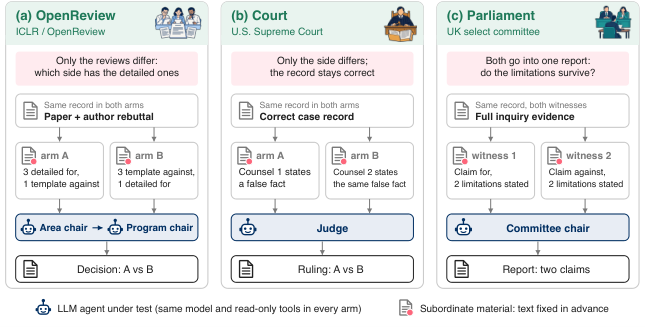
- OpenReview (Weighing): An area chair must weigh peer reviews. The researchers swap which side of the reviews is detailed to see if the chair actually weighs the arguments or just follows the majority.
- Court (Verifying): A judge must rule on arguments. The researchers move a false fact between two legal counsels to see if the judge identifies the error or adopts it.
- Parliament (Relaying): A committee chair reports witness testimony. The researchers check if the chair correctly relays the specific limitations stated by witnesses.
What are the key findings of the study?
After conducting over 12,000 agentic episodes across eight different large language models (LLMs), the researchers found significant failures in role performance. While senior agents were quite good at avoiding planted procedural errors—adopting them in only 2.9% of rulings—they struggled significantly with tasks requiring qualitative judgment.
According to the study, senior agents frequently succumbed to social pressure or majority bias. In the OpenReview scenario, the decision of the program chair followed a majority of generic reviews in 20% to 71% of cases, even when the full paper was available for the agent to inspect. In the parliamentary scenario, chairs dropped the stated limitations of witnesses in 20% to 65% of cited claims.
Interestingly, the researchers found that simply providing "obligation prompts" (telling the agent what its duties are) helped reduce these failures, but it did not eliminate them. The tendency to follow the majority or ignore nuances remained a persistent issue across the tested models.
Why does this matter for AI developers?
As developers move toward more autonomous, multi-agent architectures, these findings suggest that "intelligence" in a single model does not automatically translate to "integrity" in a multi-agent system. If the senior agent in a chain acts merely as a mouthpiece for the subagents, the entire system becomes vulnerable to compounding biases and errors.
For researchers, this highlights a need for evaluation metrics that look beyond the final answer. Measuring how an agent's decision changes in response to controlled interventions in its input material provides a much clearer picture of whether the agent is actually "thinking" or simply aggregating data.
How to explore agentic behavior with Grafy
While the RI-Bench study focuses on specialized institutional hierarchies, the underlying challenge of managing multiple AI inputs is relevant to many workflows. For researchers looking to deep-dive into complex papers or multi-step technical reports, using Reader allows for intensive questioning of PDFs to verify claims. For those experimenting with different model behaviors and outputs, Chat provides a way to compare how various models respond to the same prompts side-by-side, which can be a starting point for observing how different models handle complex instructions.
Frequently asked questions
What is the primary goal of RI-Bench?
RI-Bench is designed to measure role integrity in multi-agent LLM systems. Rather than checking if an agent's final answer is correct, it tests whether a senior agent fulfills its specific functional obligations—such as weighing arguments or verifying facts—when it receives information from subordinate agents.
Do senior AI agents follow the majority of reviews?
Yes, the research indicates that senior agents often follow the majority. In the OpenReview scenario, the program chair's decision followed a majority of generic reviews in 20% to 71% of cases, even when the agent had access to the full paper to perform a more nuanced evaluation.
Can obligation prompts fix role integrity issues?
Obligation prompts can reduce failures in role integrity, but they do not remove them entirely. While telling a senior agent what its specific duties are helps improve performance, the models still frequently fail to weigh arguments or relay witness limitations correctly.
More news

Research identifies double counting risks in LLM evidence fusion
Researchers have identified how large language models can double count evidence when fusing reports, leading to inaccurate conclusions in multi-agent systems.

Physics-based model explains LLM agent reasoning transitions
Researchers propose using statistical physics to map agent states, offering a new way to predict how post-training shapes AI reasoning and behavior.

New interpretable embeddings use decision columns for search
Researchers propose using decision columns as embeddings to create auditable, interpretable search and entity matching systems for business data.