New CANDID framework improves local computer-use agents
Researchers have introduced CANDID, a framework that uses candidate-driven interventions to prevent local AI agents from looping or terminating early.
 Source: Grafy Research Lab
Researchers have developed a new execution-control framework called CANDID to address reliability issues in local computer-use agents (CUAs). This approach aims to prevent these agents from getting stuck in repetitive action loops or declaring a task finished before it is actually complete.
Why do local AI agents fail at desktop tasks?
Local computer-use agents are designed to interact with graphical user interfaces (GUIs) by observing screenshots and executing actions like clicking or typing. However, unlike massive cloud-based models, local agents often operate with smaller model sizes and more limited multimodal reasoning capabilities. According to the research by Woongkyu Lee and Jungwook Choi, these resource-constrained agents suffer from two primary, coupled failure modes.
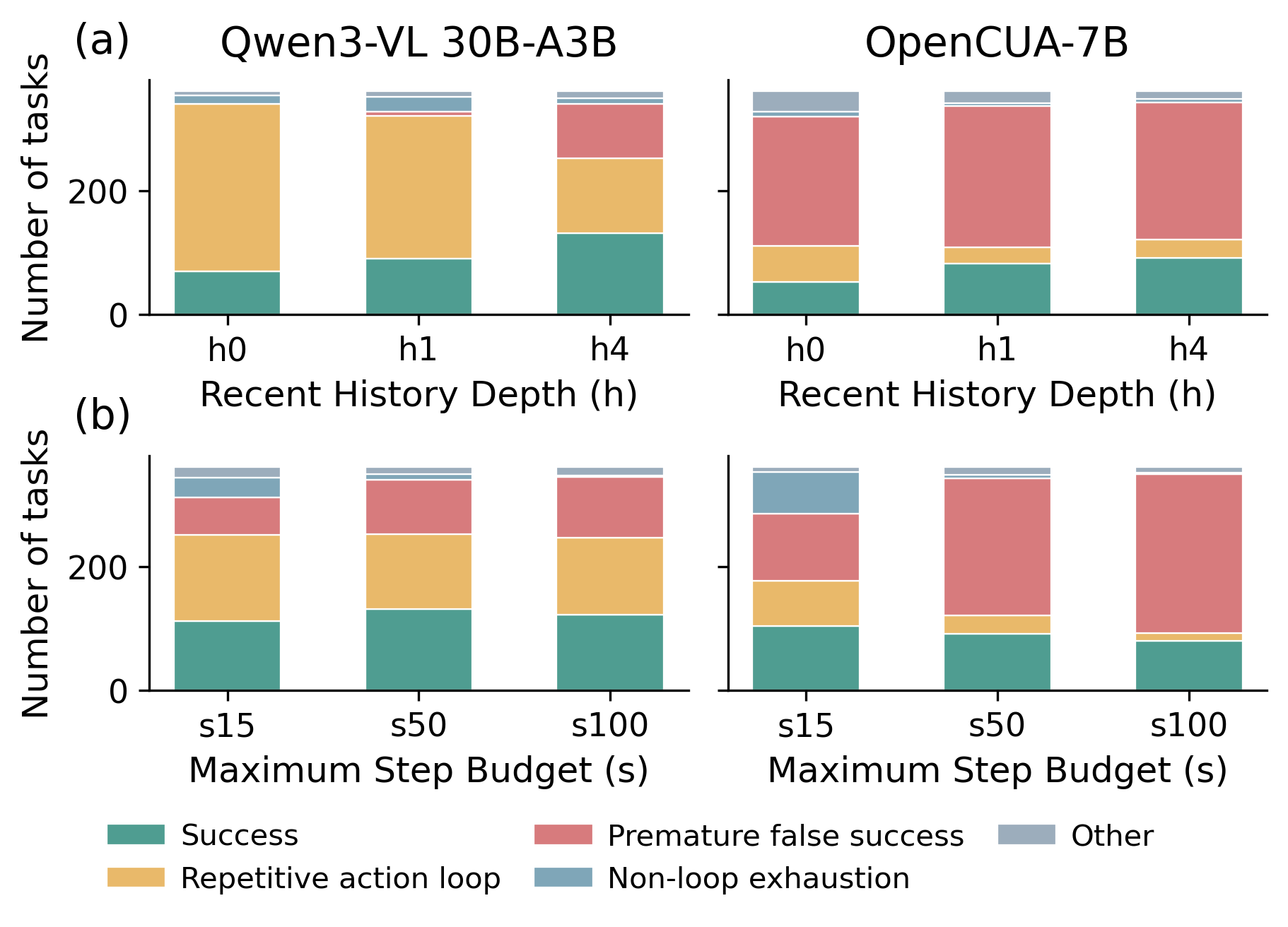
First, they frequently fall into repetitive action loops, where the agent performs the same unsuccessful action repeatedly. Second, they often suffer from premature false success, where the agent incorrectly decides it has finished the task. Figure 2 illustrates these failure modes on the OSWorld benchmark, showing that simply increasing the history depth or the step budget often fails to fix these issues; instead, it frequently just shifts the failure from exhaustion to premature termination.
How does the CANDID framework work?
Rather than asking a small model to engage in complex, text-based self-reflection—which the authors argue local models often lack the reasoning power to perform effectively—CANDID uses a method called candidate-driven intervention. The framework leverages the fact that even if a model cannot explain why it is failing, it can still generate several different possible next actions, or "candidates," from the same screen state.
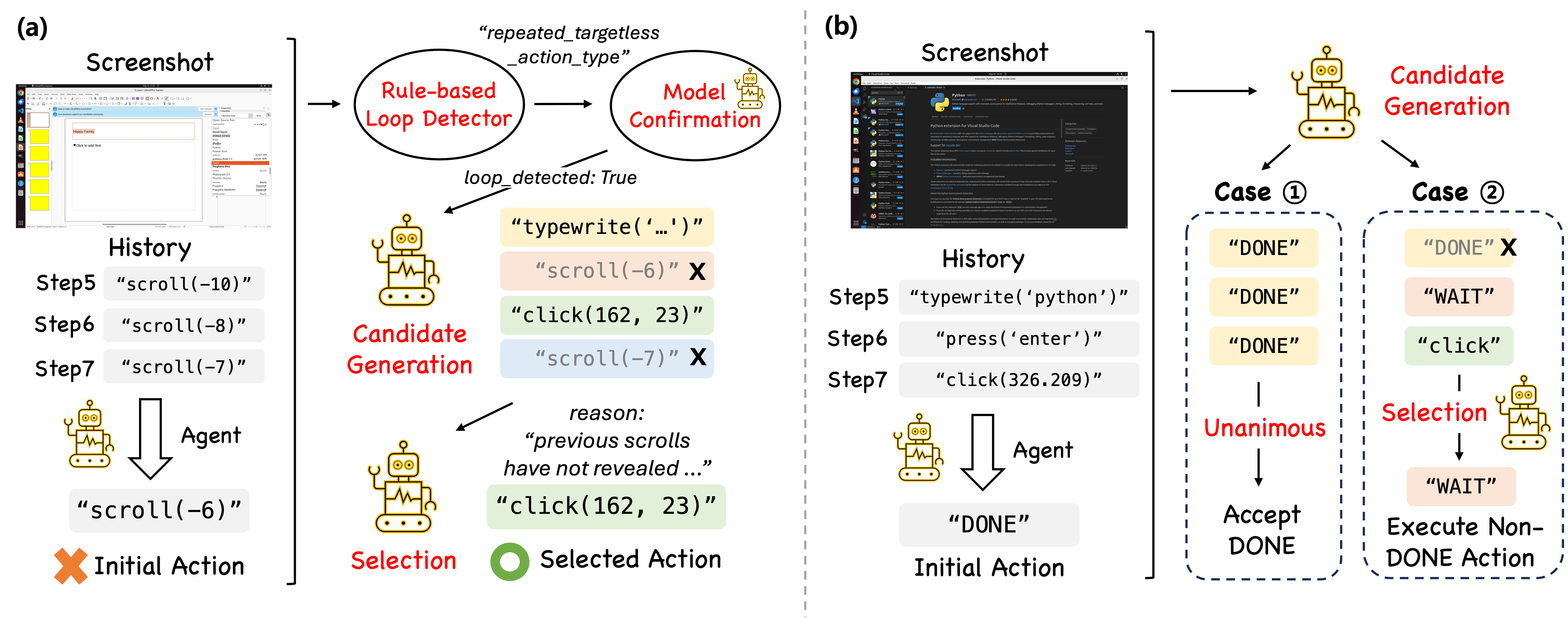
Figure 4 provides an overview of how CANDID operates by intervening at two specific high-risk points. The first is the Loop Recovery module. This module uses rule-based detection to identify when an agent is repeating itself and then selects an alternative candidate to break the cycle. The second is the Unanimous DONE Gating module. Instead of allowing the agent to stop as soon as it suggests a "DONE" signal, this module requires all sampled candidates to agree that the task is complete before the agent is allowed to terminate.
Does this method improve agent performance?
In evaluations conducted on the OSWorld benchmark using models such as Qwen3-VL and OpenCUA, the CANDID framework demonstrated significant improvements. The researchers found that the two modules address complementary problems: the loop-recovery mechanism specifically targets repetitive behaviors, while the unanimous gating policy reduces premature task completion.
According to the study, applying these interventions sparsely—only at the points where failure is most likely—allows the system to improve success rates without incurring the heavy computational overhead that would come from applying such checks at every single step of the execution. The results showed that CANDID outperformed both standard feedback-based methods and basic test-time scaling approaches.
Can local agents be made more reliable?
The research suggests that the bottleneck for local agents is not necessarily a lack of potential actions, but rather a lack of discipline in choosing and committing to them. By treating disagreement among multiple candidate actions as a signal for intervention, CANDID provides a structural way to guide lightweight models through complex, long-horizon tasks. This move toward execution-level control rather than purely cognitive-level reflection offers a more efficient path for deploying autonomous agents in environments where computing power is limited.
Applying agentic concepts in Grafy
While CANDID is a research framework for local agent execution, the concept of using agents to navigate digital environments is central to modern workflows. For users looking to experience the practical application of autonomous browsing and task execution, Grafy's Operator serves as a browsing agent designed to perform web-based tasks. While Operator utilizes advanced models to ensure reliability, the core goal of navigating complex interfaces autonomously remains the same as the agents studied in the CANDID research.
Frequently asked questions
What are the main failure modes of local computer-use agents?
Local computer-use agents primarily fail in two ways: they enter repetitive action loops where they perform the same incorrect step multiple times, or they experience premature false success, where they incorrectly signal that a task is finished before the objective has been met. These failures are common in models with limited reasoning capabilities.
How does CANDID differ from textual reflection methods?
Textual reflection requires an agent to generate natural language feedback about its own mistakes to guide its next move. CANDID instead uses candidate-driven intervention, which focuses on generating multiple possible actions and using their disagreement as a signal to intervene, avoiding the heavy cognitive load required for meaningful textual self-correction.
Does the CANDID framework increase computational overhead?
CANDID is designed to be efficient by using sparse intervention. Instead of checking every single step, the framework only triggers its control modules at specific, failure-prone points such as detected loops or proposed terminations. This targeted approach allows for improved task success rates with minimal impact on runtime and token usage.
Source: https://arxiv.org/abs/2611.24977
More news

New Review Warns of Hallucination Cascades in Medical AI Agents
Researchers identify a dangerous 'hallucination cascade' in multi-agent clinical systems where early reasoning errors are amplified across workflows.

New game-theoretic method optimizes AI expert specialization
Researchers introduce InflEns, a method using game theory to allocate training data, making AI expert routing more predictable and inspectable.

New BuggyMLE Framework Scales AI Machine Learning Engineering
Researchers introduced BuggyMLE to test AI agents on complex, multi-file machine learning repositories by injecting controlled bugs into real codebases.