New DART method mines better reasoning traces for math models
Researchers have introduced DART, a technique that recovers failed reasoning attempts to improve LLM math performance. Learn how it works here.
 Source: Grafy Research Lab
Researchers have developed a new method to improve how large language models (LLMs) solve complex mathematics by revisiting and correcting their failed attempts. This technique, called Diverse Alternative Reasoning Traces (DART), addresses a major bottleneck in training reasoning models: the difficulty of finding successful logic paths for very hard problems.
Why is mathematical reasoning difficult for LLMs?
Training LLMs to excel at math often involves a process called post-training, where models are fine-tuned on "traces"—sequences of reasoning steps that lead to a correct answer. A common way to collect these traces is through Monte Carlo (MC) sampling, where a model generates multiple independent attempts at a problem and only the ones that pass a verifier (matching a known answer) are kept.
However, according to the research paper by Lukas Aichberger et al., this approach struggles with difficult problems. For highly complex math, the probability of a model randomly stumbling upon the correct sequence of steps is extremely low. Consequently, standard sampling often fails to produce any successful traces for the hardest problems, leaving them out of the training data and preventing the model from ever learning how to solve them. Furthermore, repeated sampling often results in very similar reasoning paths, which limits the diversity of the training data.
How does the DART method work?
Instead of starting every attempt from scratch, DART takes a failed (rejected) reasoning trace and attempts to repair it. As illustrated in Figure 1, the process involves several distinct stages. First, the method decomposes the failed trace into individual, self-contained reasoning steps.
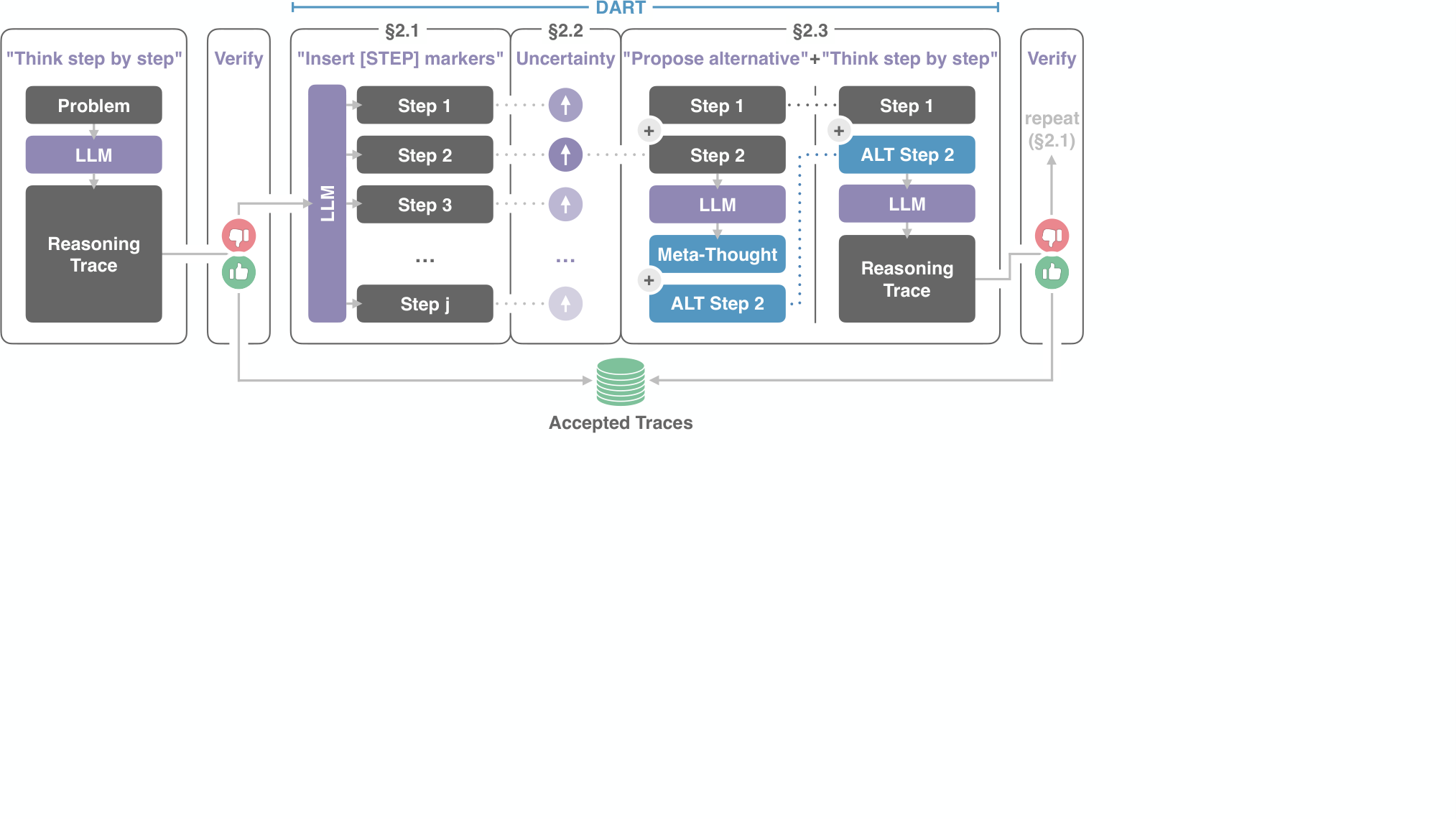
Next, the system identifies which step in the sequence is most likely responsible for the error. It does this by ranking steps based on "position-weighted uncertainty." Once a problematic step is selected, DART uses the model's own reasoning capabilities—guided by the correct reference answer and a "meta-thought" instruction—to generate a deliberately different alternative for that specific step. Finally, the model greedily completes the rest of the reasoning path from this new, corrected starting point. By reusing the successful prefix of the original attempt and only changing the uncertain parts, the method explores new logical directions more efficiently than random sampling.
What are the performance benefits of DART?
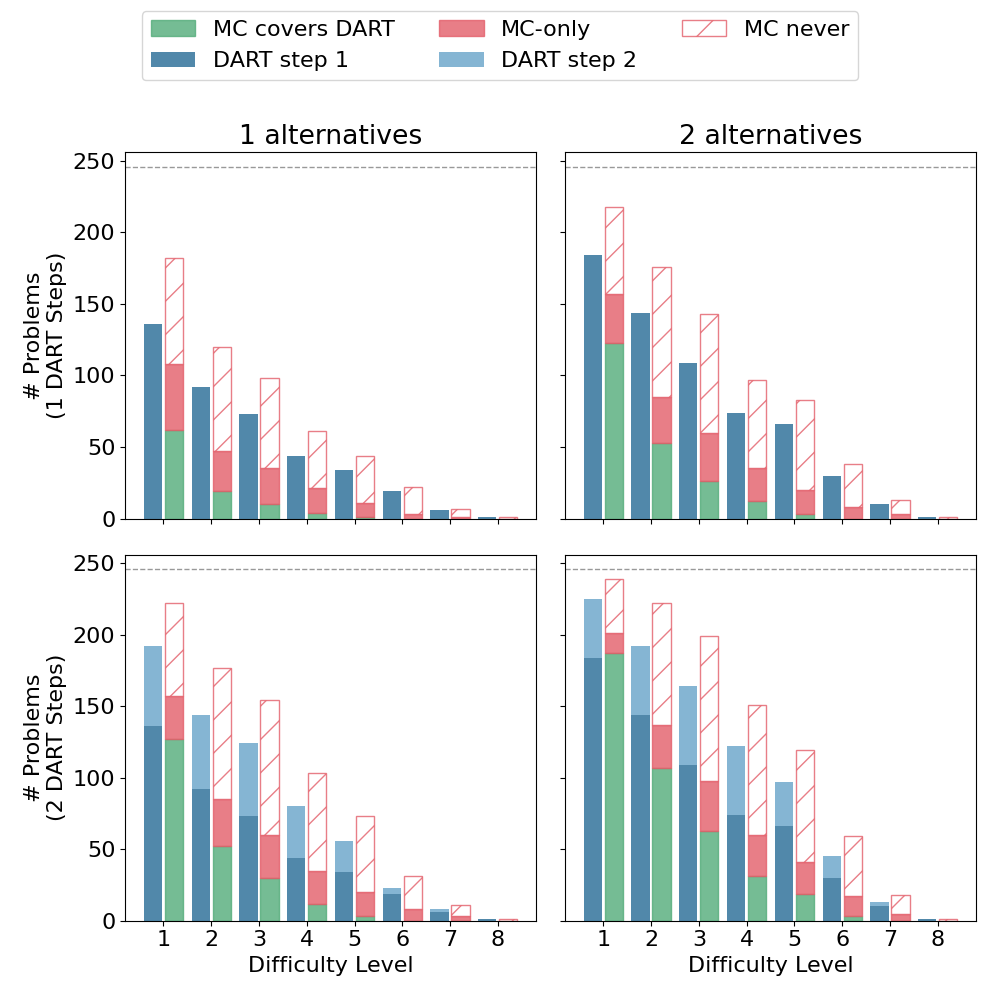
way of exploring the problem space proves significantly more efficient than traditional methods. On datasets of problems that were previously unsolved by standard greedy decoding, DART recovered 37% more problems than MC sampling when the number of generated traces was matched, according to the authors.
Figure 4 demonstrates that these gains are most pronounced on the hardest problems, where DART can achieve up to twice the problem coverage of MC sampling. The researchers also noted that while DART has a higher cost per attempted problem due to the extra computation required for decomposition and diversity sampling, it is more efficient in terms of successful outcomes. Specifically, the estimated generation cost per accepted trace was 30% lower than that of MC sampling.
Beyond data collection, the quality of the resulting training data is high. The authors found that performing supervised fine-tuning on Llama-3.1-8B-Instruct using traces mined via DART led to superior performance on major benchmarks like MATH-500 and AIME, outperforming models trained on standard MC sampling traces in five out of six evaluations.
Can this method be applied to other AI tasks?
The core principle of DART—identifying specific points of failure in a multi-step process and using guidance to branch into new possibilities—is highly applicable to any domain requiring structured, multi-step reasoning. This includes computer programming, legal analysis, or complex scientific workflows where a single logical error invalidates the entire output.
While DART is currently optimized for verifiable mathematical truths, the concept of "targeted exploration of rejected traces" could be adapted for any task where a verifier (such as a code compiler or a formal logic checker) can provide a clear signal of success or failure.
How to explore reasoning research with Grafy
For researchers and developers looking to dive deeper into the technical specifics of this paper, such as the mathematical formulations of position-weighted uncertainty or the specific prompts used for meta-thoughts, Grafy Reader provides an ideal environment. You can upload the full PDF of the research paper to Reader to ask specific questions about the ablation studies, the generation-cost analysis, or the specific implementation details of the reasoning step decomposition.
Frequently asked questions
Does DART require a known correct answer to work?
Yes, the DART method relies on reference-answer guidance. The process uses the correct answer to help guide the model when it generates alternative candidates for uncertain reasoning steps. This guidance ensures that the new, diverse reasoning paths are being steered toward the correct logical conclusion rather than just generating random alternatives.
Is DART more expensive than Monte Carlo sampling?
It depends on how you measure cost. DART has a higher generation cost per attempted problem because it involves decomposing traces and sampling diverse candidates. However, the researchers found that the cost per accepted trace is actually 30% lower than MC sampling, making it a more efficient way to acquire high-quality training data.
Does DART improve the diversity of reasoning traces?
Yes, DART is specifically designed to increase diversity. Unlike standard sampling, which may repeatedly produce similar failed attempts, DART identifies uncertain steps and uses meta-thoughts to prompt the model to propose conceptually distinct alternative candidates. This allows the model to explore different logical strategies for solving the same problem.
Source: Grafy Research Lab — Diverse Alternative Reasoning Traces for Hard Math Problems
More news

How much is a mathematical theory worth to an LLM solver?
Researchers found that providing specific mathematical theories to LLMs significantly improves problem-solving accuracy and efficiency in complex tasks.

New MINE method defends RAG against indirect prompt injection
Researchers have proposed MINE, a training-free defense mechanism that uses mutual information to protect RAG systems from indirect prompt injection.

PersonaFactory addresses stylistic flatness in synthetic user prompts
Researchers have introduced PersonaFactory, a pipeline to generate diverse synthetic personas that fix the stylistic monotony of AI-generated prompts.