New Edge Triage Architecture Cuts Clinical AI Latency by 14x
Researchers have developed a multi-tier edge triage system that uses local classifiers to secure clinical AI agents, significantly reducing latency.
 Source: Grafy Research Lab
Deploying generative AI agents in medical environments requires strict adherence to safety and privacy policies without compromising the speed of interaction. According to a research paper by Joshua Broyde and Sarita A. Joshi, current methods of using cloud-based Large Language Model (LLM) judges to verify every response introduce significant delays, often adding between 0.57 and 1.61 seconds to the response path.
How does Multi-Tier Edge Triage work?
The researchers propose an architecture called Multi-Tier Edge Triage to resolve this bottleneck. Instead of sending every single query to a remote cloud model for safety checking, this system co-locates a small, efficient Tier-1 sequence classifier directly on the application server where the clinical agent lives. This "edge" deployment allows the system to resolve clear, unambiguous queries locally in milliseconds without any network round-trip.
Only when the local Tier-1 model identifies a query as ambiguous or high-risk does the system escalate the task to a Tier-2 cloud LLM judge for deeper semantic analysis. This creates a tiered defense that balances speed with the high-level reasoning capabilities of larger models.
Can local models match cloud accuracy?
A primary concern with using smaller, local models is whether they can maintain the high safety standards required by healthcare regulations, such as HIPAA. The authors tested several candidate encoders against four specialized benchmarks designed to prevent models from using simple lexical shortcuts, such as merely looking for specific words or measuring text length.
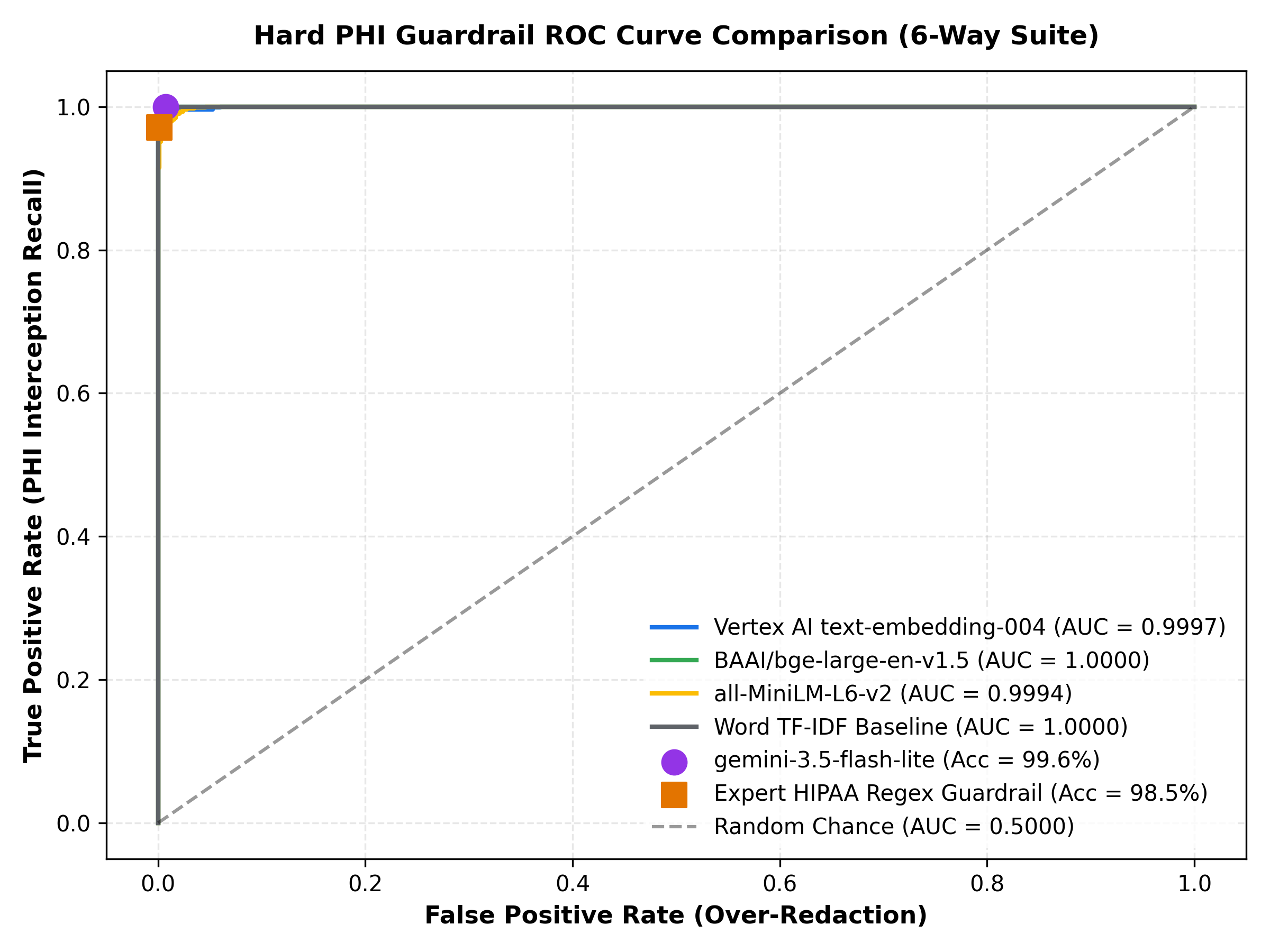
Figure 7 illustrates the performance of these models on the length-balanced ASQ-PHI guardrail dataset, showing that local encoders can achieve near-ceiling detection for structured HIPAA identifiers. The study found that while off-the-shelf, frozen encoders struggle with complex semantic safety, end-to-end fine-tuning significantly closes the gap. Specifically, a fine-tuned 335M-parameter BGE-Large classifier achieved a 98.90% out-of-fold accuracy, which was statistically comparable to a zero-shot cloud LLM judge that achieved 99.20% accuracy (as indicated by a McNemar p-value of 0.648).
What are the latency benefits?
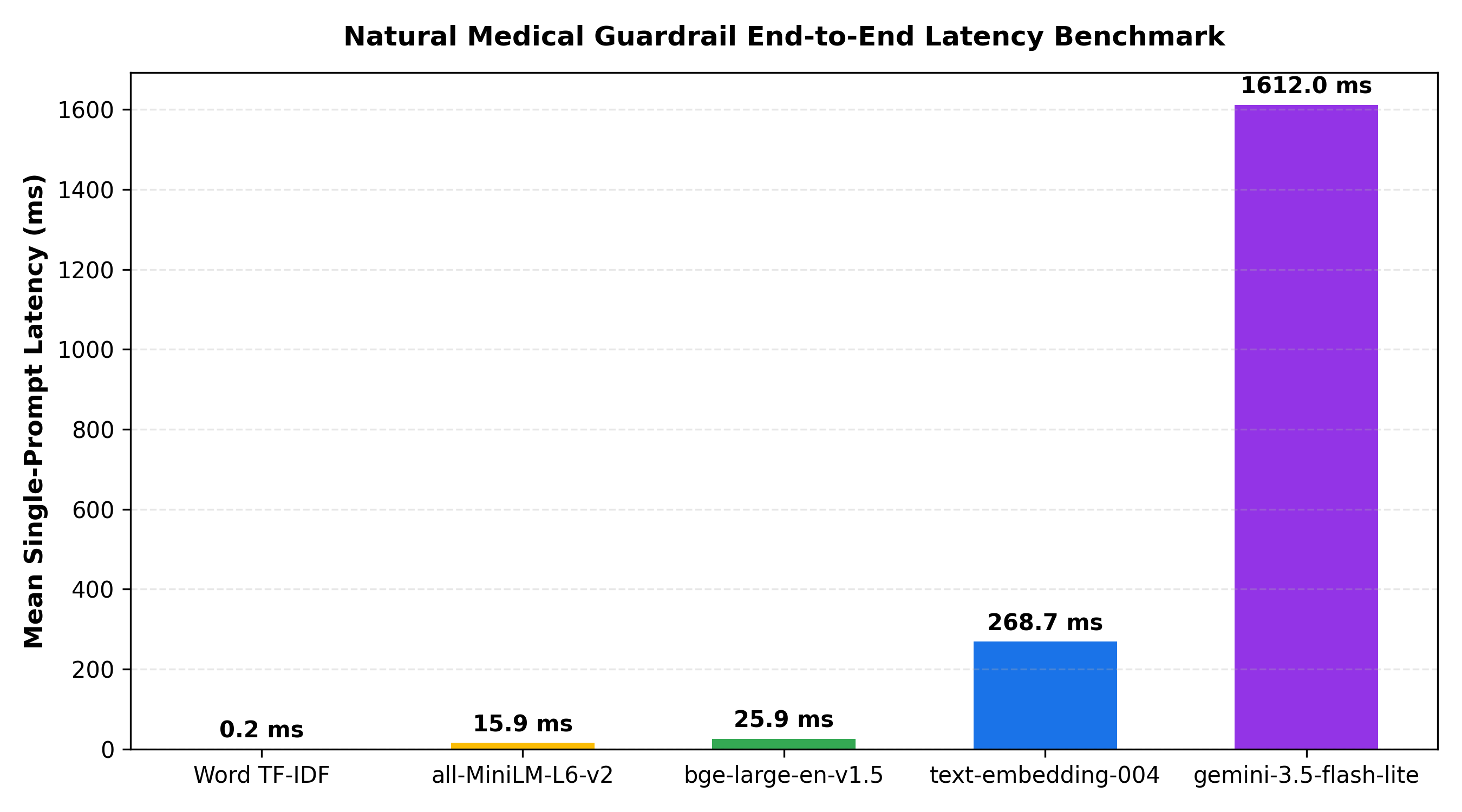
The most significant advantage of this architecture is the reduction in time spent waiting for safety checks. By handling the majority of routine interactions locally, the system avoids the network and decoding overhead associated with cloud APIs.
Figure 5 compares the latency of cloud-based evaluation against local baselines. The researchers demonstrated that the fine-tuned local encoder could execute in just 39.0 ms, which is more than 14 times faster than the 568.8 ms required for synchronous cloud LLM evaluation. In even more extreme cases, a much smaller 22.7M-parameter encoder was able to reach 94.40% accuracy with a latency of only 5.2 ms, representing a 109x speedup over cloud-based methods.
Where do the remaining errors occur?
Even with highly optimized fine-tuned models, some residual errors persist. The researchers conducted a per-policy error analysis to see where the local Tier-1 models might fail. They found that the models reached near-perfect recall (between 98.7% and 100.0%) for protecting Protected Health Information (PHI), maintaining brand integrity, and staying within clinical scope-of-practice boundaries.
The remaining errors were almost exclusively isolated to stylistic checks, such as ensuring the reading level of the text was appropriate for the patient. This finding validates the multi-tier approach: the system can handle the most critical safety and privacy mandates locally with high speed, while delegating nuanced stylistic or highly ambiguous cases to the more capable Tier-2 cloud models.
Applying these insights to research
For researchers working with complex medical datasets or attempting to implement safety guardrails in their own agentic workflows, understanding the trade-offs between model size, latency, and semantic accuracy is vital. While Grafy does not currently implement this specific multi-tier edge architecture, researchers can use Reader to analyze similar technical papers or use Chat to experiment with different model sizes and observe how their reasoning capabilities vary across various safety-critical prompts.
Frequently asked questions
What is the main problem with current AI safety guardrails?
Current guardrail systems often rely on synchronous calls to large cloud-based models to judge whether a prompt or response is safe. This process introduces significant network and decoding latency, which can make interactive applications, especially in clinical settings, feel slow and unresponsive to the user.
How does the proposed architecture reduce latency?
The architecture uses a Tier-1 classifier that is co-located on the same server as the clinical agent. Because this small model runs locally in-process, it can resolve many queries instantly without needing to send data over the internet to a cloud provider, thus bypassing the network round-trip delay.
Does using a smaller local model decrease safety?
Not necessarily, provided the model is properly fine-tuned. The research shows that while "frozen" or off-the-shelf small models might be tricked by simple patterns, a 335M-parameter model that has undergone end-to-end representation fine-tuning can achieve accuracy levels nearly identical to much larger cloud-based LLM judges.
Source: Joshua Broyde and Sarita A. Joshi, arXiv:2611.26914
Source: Grafy Research Lab — Multi-Tier Edge Triage: Optimizing Latency for Safe Clinical Agents
More news
ShellBench evaluates AI agents on real-world everyday tasks
Researchers introduced ShellBench to test how AI agents handle messy, real-world files and tasks, revealing that model choice is more critical than harness.

Anthropic develops Siren honeypot to test AI agent temptation
Anthropic researchers created Siren, a honeypot system to see if AI agents will break rules when tempted. Learn why agentic safety is a growing concern.

Architect Labs Unveils Frostbite, an AI-Designed Interaction Net CPU
Architect Labs has introduced Frostbite, an AI-designed CPU utilizing interaction nets. Learn how this hardware could redefine computational efficiency.