New FLUID framework enables flexible AI task guidance
Researchers introduced FLUID, a framework that allows multimodal AI agents to decide when to speak and when to remain silent during real-time tasks.
 Source: Grafy Research Lab
Researchers have introduced a new framework designed to make multimodal AI assistants more natural by teaching them when to intervene and when to stay silent during real-time tasks. This approach, called FLUID (Flexible, Evidence-Grounded Situated Task Guidance), addresses a core limitation in current AI models: the tendency to treat dialogue as a rigid script rather than a fluid interaction.
Why is real-time AI guidance difficult?
As wearable devices like smart glasses become more common, the demand for "situated" assistance—AI that understands what a user is seeing and doing in real-time—is increasing. According to the research paper by Yunqi Zhao et al., an effective assistant must coordinate visual perception, task understanding, and communication.
However, existing evaluation methods often fail because they compare AI responses to fixed human transcripts. This assumes there is only one "correct" time to speak. In reality, human guidance is highly adaptive. Some moments, like a user making a safety error, require immediate intervention. Other moments, such as providing a simple acknowledgment, allow for a wide range of appropriate timing. If an AI agent speaks too much or at the wrong time, it becomes intrusive rather than helpful.
How does the FLUID framework work?
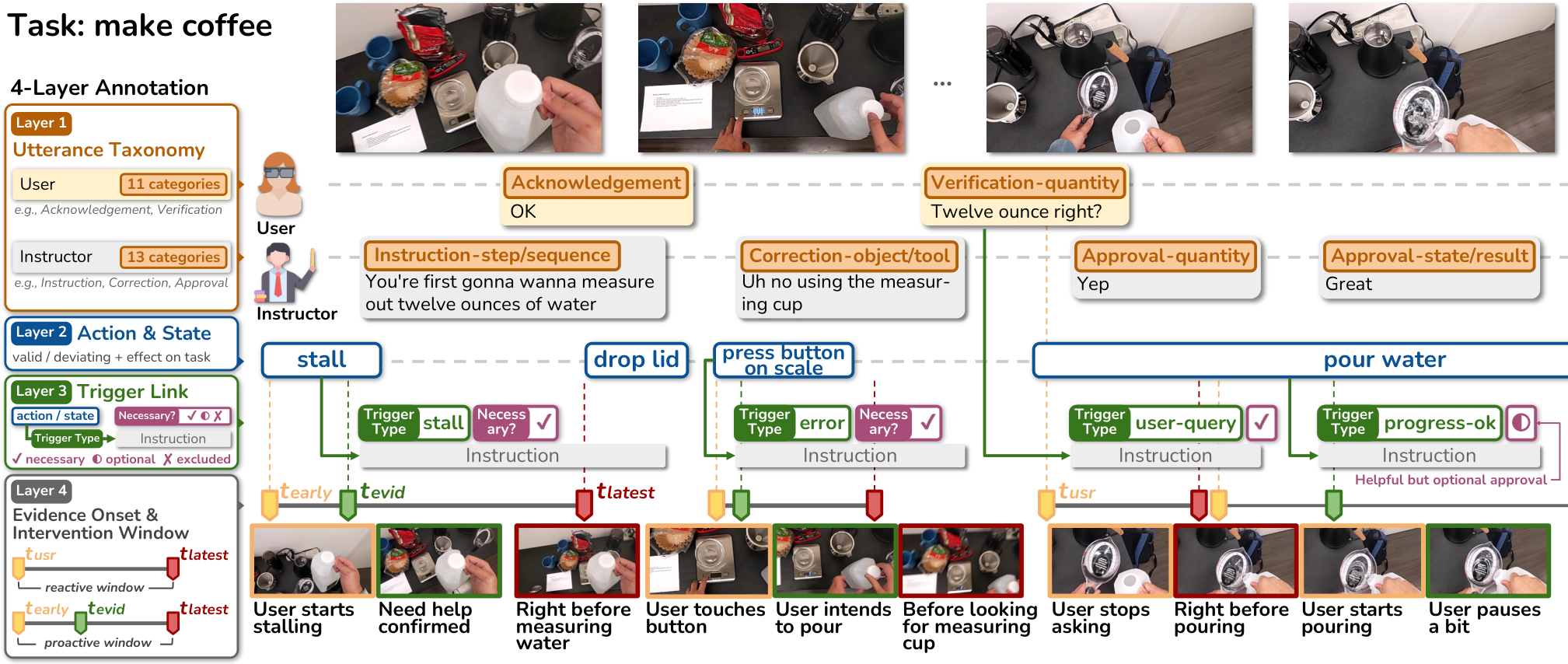
To solve this, the authors developed a multi-layered approach to model how guidance should function. Instead of just looking at what is said, FLUID looks at the evidence behind the speech.
Figure 2 illustrates this four-layer annotation process used to ground guidance in reality. The framework categorizes interactions based on utterance taxonomy, the state of the task, the specific trigger that caused the response, and the "intervention window"—the period during which a response is considered appropriate. By using this structure, the system can distinguish between a necessary correction and an optional helpful tip.
What makes the FLUID-Agent different?
Most current agents are purely reactive, meaning they only respond when spoken to, or they are overly proactive, interrupting the user constantly. The FLUID-Agent architecture seeks a middle ground by explicitly modeling interaction dynamics.
Figure 3 shows the high-level architecture of this agent, which integrates perception, task memory, and user utterance understanding. This allows the agent to make "evidence-conditioned" decisions. For example, the agent can decide to remain silent if the user is performing a task correctly, or it can provide proactive guidance if it perceives a mistake is about to happen. This ability to handle asynchronous execution and decide on the necessity of an intervention is what allows for more human-like turn-taking.
What were the results of the experiments?
In testing, the FLUID-Agent was compared against several existing systems, including models like Gemini and various VideoLLM approaches. The researchers found that by using an evidence-grounded evaluation rather than simple reference matching, they could more accurately capture the quality of an agent's interventions.
The results indicated that the FLUID-Agent achieved the best overall balance between response correctness, intervention precision, and response latency. While the system showed significant improvements in being a timely guide, the authors noted that there is still room for improvement in reducing speech overlap, where the AI and the human might accidentally speak at the same time.
How can researchers apply these findings?
For developers working on embodied AI or wearable interfaces, the FLUID framework provides a roadmap for moving beyond simple chatbots toward true situational assistants. The transition from rigid, transcript-matching evaluation to evidence-based evaluation allows for much more nuanced testing of agentic behavior.
If you are currently researching complex multimodal papers or technical documentation regarding agentic architectures, you can use Reader to analyze these types of academic PDFs. It allows you to ask specific questions about methodology, such as how specific intervention windows are calculated or how the taxonomy layers are structured, making the digestion of dense research more efficient.
Frequently asked questions
What is the primary goal of the FLUID framework?
The primary goal of FLUID is to enable multimodal AI agents to provide flexible, evidence-grounded task guidance. It moves away from rigid, fixed-target dialogue models and instead focuses on teaching agents when it is appropriate to intervene, when to provide specific information, and when the most helpful action is to remain silent during a task.
How does FLUID improve upon existing evaluation methods?
FLUID improves upon existing methods by moving beyond strict reference matching, which treats human dialogues as the only correct way to interact. Instead, it uses an evidence-grounded approach that evaluates whether an intervention was necessary, whether the timing was appropriate within a specific window, and whether the content was grounded in the actual visual or verbal evidence provided by the user.
Does the FLUID-Agent always intervene when a user makes a mistake?
Yes, the framework is designed to recognize necessary interventions. According to the research, certain situations like incorrect actions or safety risks require immediate, necessary intervention. The agent uses its perception and task memory to identify these triggers, ensuring that it provides timely guidance when the evidence suggests that a user's error or a potential hazard requires a response.
Source: Grafy Research Lab — FLUID: Flexible, Evidence-Grounded Situated Task Guidance
More news

SpecLook framework accelerates agentic multimodal models
Researchers have introduced SpecLook, a new framework that speeds up multimodal AI agents by speculating their next visual observation instead of answers.

New DEO Method Fixes AI Retrieval Failures in Negation Queries
Researchers have introduced Direct Embedding Optimization (DEO) to solve how AI fails at exclusion queries. Learn how this training-free approach works.

New Client Exits mechanism aims to increase LLM transparency
Researchers have introduced Client Exits, a method to separate AI semantic intent from presentation. Learn how this could improve multimodal responses.