New Framework Evolves Evaluation for Computer-Use Agents
Researchers have introduced CUA-SEE, a closed-loop system that automatically creates harder tasks and verifiers to keep pace with improving AI agents.
 Source: Grafy Research Lab
As computer-use agents (CUAs) become increasingly capable, the static benchmarks used to measure them are struggling to keep pace. A new research paper introduces CUA-SEE, a closed-loop evaluation environment designed to automatically evolve tasks and verification methods alongside the agents it tests.
Why do current AI benchmarks fail to keep up?
Traditional evaluation methods for CUAs often rely on human-authored, one-shot task construction. According to the authors, this creates a "difficulty ceiling" where agents eventually master all available tasks, causing performance scores to saturate and lose their ability to distinguish between different levels of progress.
Furthermore, the researchers found that existing benchmarks often suffer from limited feature coverage. In an audit of core OSWorld applications, they noted that current tasks exercise less than 20% of the available software-feature taxonomy. Because these benchmarks are static, they cannot track moving capability boundaries or actively search for emerging weaknesses and generalization gaps in new models.
How does the CUA-SEE framework work?
CUA-SEE reconceptualizes evaluation as a dynamic process where tasks, verifiers, and agent performance evidence continuously inform one another. Figure 3 shows the system overview, illustrating how CUA-SEE forms a closed loop consisting of task evolution, verifier evolution, and agent-environment rollouts.
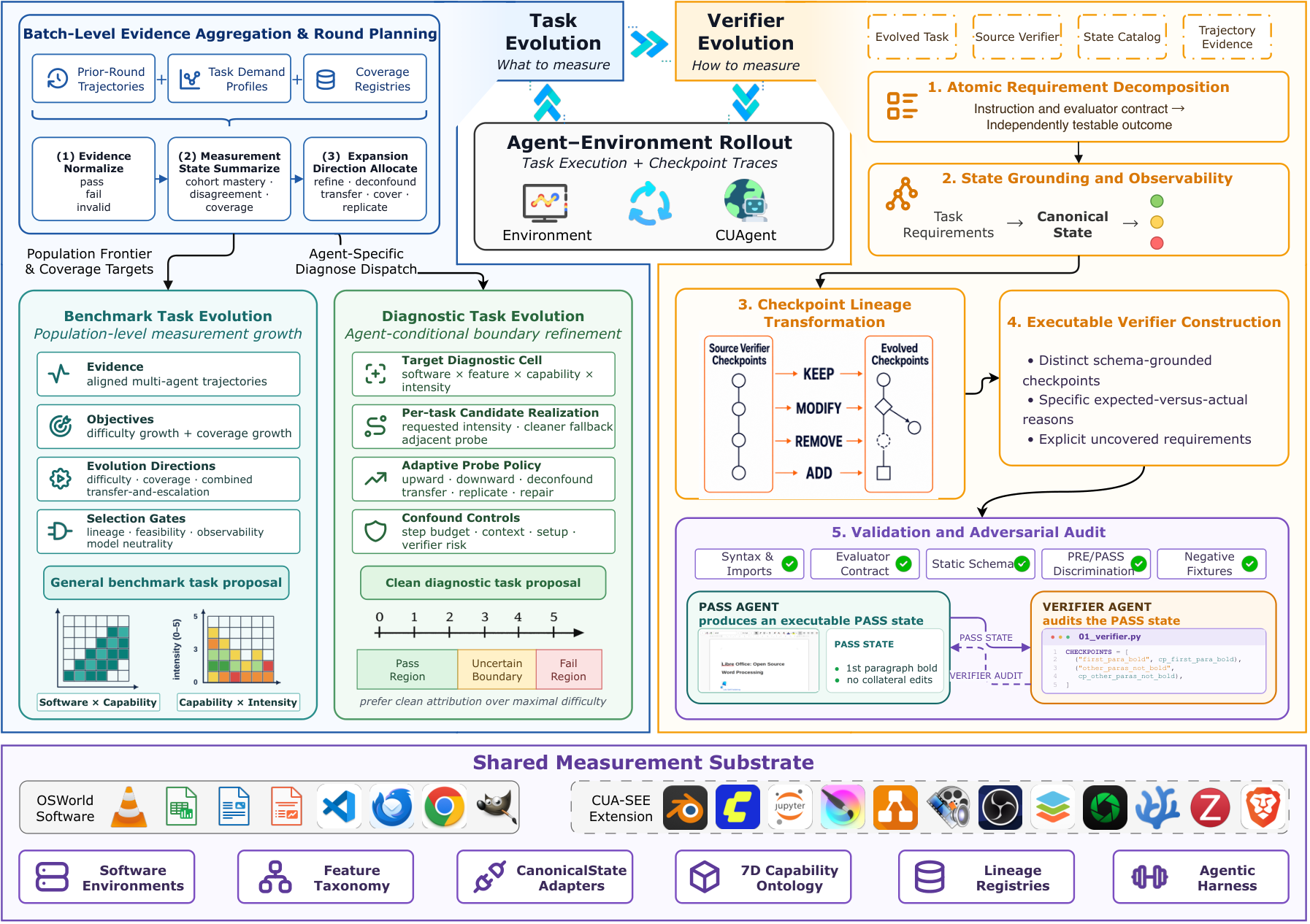
To address these issues, the framework operates through three distinct dimensions: scope, resolution, and precision.
For scope, the "Benchmark Task Evolution" operator constructs a shared, model-neutral benchmark from the trajectories of a diverse group of agents. This process advances the measurable difficulty frontier and expands coverage across software features and operations. For resolution, the "Diagnostic Task Evolution" operator focuses on an agent's specific capability boundaries. Instead of just making tasks harder, it uses adaptive probes to find exactly where an agent succeeds or fails, turning coarse scores into detailed capability profiles.
Finally, for precision, the "Verifier Evolution" component ensures that as tasks change, the methods used to check for success remain accurate. This involves using software adapters to normalize states into a shared schema and employing an adversarial cross-review process between a verifier agent and a pass agent to ensure high-quality measurement.
What are the results of the evolution rounds?
Testing the framework across several state-of-the-art agents showed that CUA-SEE successfully restores the informativeness of evaluations. Figure 1 illustrates the comparison between static benchmarks and the CUA-SEE approach, highlighting how the latter progressively creates more complex interactions and broader coverage.
Over four rounds of evolution, the researchers observed that the macro-average agent score decreased from 60.6 to 47.5. This drop is not necessarily a sign of agent regression, but rather evidence that the tasks are becoming significantly more challenging. During this same period, the average trajectory length increased from 27.4 to 39.3 steps, and exact feature coverage expanded by a factor of 3.65.
The researchers also found that the evolved checkpoint verifiers achieved 84.0% agreement with human judgments regarding task trajectories, suggesting that the automated verification process is highly reliable.
How does this impact the future of AI agents?
This research suggests that for AI agents to continue improving, the "yardsticks" used to measure them must also be capable of growth. By automating the creation of difficult, high-coverage, and precisely verifiable tasks, CUA-SEE provides a scalable way to track the development of agents that can navigate complex software environments.
As agents move from simple text generation to performing complex multi-step actions within operating systems, the ability to diagnose specific software-feature or capability-intensity weaknesses will be critical for developers. CUA-SEE moves the field away from aggregate, coarse scores toward a more granular understanding of what an agent can and cannot do.
For researchers looking to dive deeper into the technical specifics of this paper, including the mathematical frameworks for capability-intensity rubrics and the implementation of the CanonicalState schema, the full study provides extensive experimental details and taxonomies.
If you are interested in exploring how current AI models handle complex reasoning or how they interpret technical documentation, you can use Grafy Reader to upload and query academic papers or technical manuals directly.
Frequently asked questions
What is CUA-SEE?
CUA-SEE is a self-evolving evaluation environment designed for computer-use agents. It uses a closed-loop system to automatically generate increasingly difficult tasks, targeted diagnostic probes, and precise verifiers based on the performance evidence gathered from previous rounds of agent interactions.
Why is task evolution necessary for AI agents?
Task evolution is necessary because static benchmarks eventually reach a difficulty ceiling. Once agents master the fixed set of tasks in a traditional benchmark, the scores saturate and can no longer distinguish between different levels of agent intelligence or identify new weaknesses in the models.
How does the framework improve measurement precision?
The framework improves precision through Verifier Evolution. This process uses task-agnostic software adapters to create a standardized state schema and employs an adversarial cross-review between a verifier agent and a pass agent to ensure that task requirements are met accurately and reliably.
Source: Grafy Research Lab — Self-Evolving Evaluation Environments for Computer-Use Agents
More news

New Research Identifies Bias in LLM Agent Evaluations
Researchers have identified how LLM judges can produce biased success rates for AI agents due to trajectory-dependent errors, affecting rankings.
New RoFE method fixes multimodal tabular learning errors
Researchers have introduced RoFE to prevent data geometry collapse in multimodal learning, improving performance when labeled data is scarce.
Research finds Doc-to-LoRA struggles with document interference
A new study reveals that converting documents into LoRA adapters can lead to factual errors and interference, limiting its use as a memory replacement.