New GUARD Method Enables Safe Post‑Hoc Fixes for Frozen Multimodal Models Missing Inputs
Researchers unveil GUARD, a risk‑controlled post‑hoc correction that improves frozen multimodal predictors when some modalities disappear.
 Source: arXiv Statistics
What problem does the paper address?
Deployments of multimodal predictors often encounter situations where one or more input streams are unavailable – for example, a medical model trained on a 12‑lead ECG may receive only a few leads, or an activity recognizer may lose a sensor. When the model's weights are frozen – either because the vendor does not expose them or because regulatory constraints forbid changes – the usual training‑time repair techniques cannot be applied. The authors of the arXiv paper "Risk‑Controlled Correction for Frozen Multimodal Models under Missing Modalities" ask a different question: what portion of the error that appears after a modality drops can still be fixed using only the remaining data? (arXiv:2611.23886).
How do the authors define correctable error?
The paper introduces the concept of the Bayes gap – the difference between the frozen model’s prediction and the optimal Bayes prediction that could be made given the observed modalities. Formally, if is the model’s output and is the Bayes optimal conditional expectation, the gap is . For loss functions such as cross‑entropy and squared error, the excess risk directly measures this gap in the geometry of the loss surface. Crucially, the authors prove that ambiguity – the fact that several true outcomes can be compatible with the same observed modalities – cannot be eliminated after the model is frozen. Therefore, only the portion of error represented by is correctable; the rest is an irreducible ambiguity floor.
What is the GUARD method and how does it work?
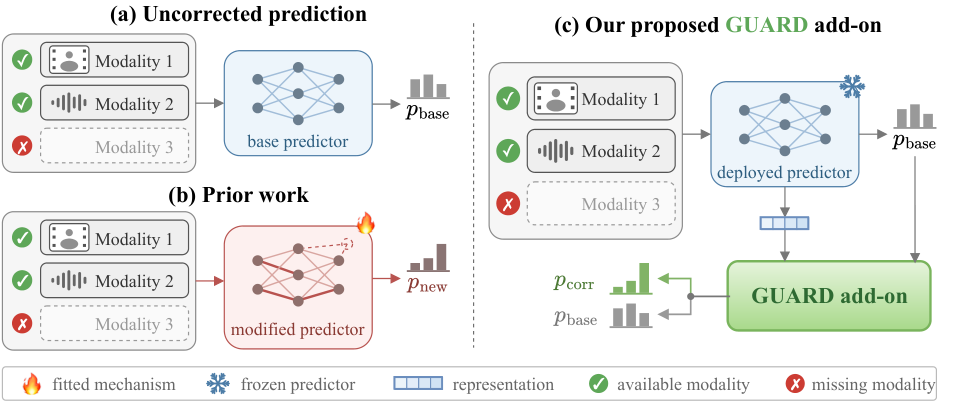
GUARD (Gated Utility‑Aware Recalibration for Deployment) is a two‑stage pipeline designed for the frozen‑model setting.
- Recalibrate – The system builds a candidate correction by retrieving neighboring instances from a deployment‑matched database, averaging their outputs, and blending the result with the original prediction. When a richer‑view model (one that sees more modalities) is conditionally correct, its outputs can replace explicit labels: averaging the richer model’s predictions conditional on the remaining modalities recovers the poorer‑view Bayes target without needing labeled retrieval data.
- Certify – Not every candidate correction is safe. GUARD learns an action score that predicts the utility of applying the correction. Using a held‑out calibration split, it applies conformal risk control to set a threshold such that the probability of a harmful intervention (i.e., a loss increase beyond a user‑specified tolerance) stays below a preset level . This guarantee holds under exchangeability, regardless of the learned score.
Figure 1 illustrates the distinction: the uncorrected prediction under missing modalities (left), prior methods that embed a fixer into the pipeline before deployment (center), and GUARD’s approach that leaves the original predictor untouched and selectively overrides its output (right).
How does GUARD compare to existing approaches?
Previous strategies for missing modalities either reconstruct the missing input (e.g., generative completion), distill a complete‑modality teacher, align partial and full representations, or insert a reliability‑aware routing module before deployment. All of these require modifying the original prediction pipeline or retraining parts of the model. By contrast, GUARD operates entirely post‑hoc: it never touches the frozen weights and only intervenes when the expected gain outweighs the risk.
Empirical results across nine frozen model–dataset pairs spanning six domains (speech‑visual, sensor‑fusion, medical imaging, etc.) show that blanket correction – applying the same recalibration to every prediction – can yield large average gains but often exceeds a predefined harm budget. GUARD retains most of that gain while keeping the proportion of harmful interventions under the allowed level. Moreover, the experiments confirm the authors’ theoretical claim that correction benefit follows the correctable headroom (the Bayes gap) rather than the raw error observed after modality loss.
Practical implications for developers and researchers
For teams that already have a deployed multimodal system whose weights are immutable, GUARD offers a pragmatic path to improve performance without a costly re‑deployment. The method requires:
- Access to the model’s predictions and internal representations (query‑only access is sufficient).
- A modest set of labeled examples collected under the same missing‑modality condition to train the correction blend and calibrate the risk threshold.
- A retrieval database that can provide nearest‑neighbor samples based on the observed modalities.
Because GUARD’s certification step is model‑agnostic, it can be layered on top of any frozen predictor, whether it is a large transformer, a convolutional multimodal network, or a lightweight sensor‑fusion model. The risk‑control guarantee is especially valuable in regulated domains such as healthcare or automotive systems, where unintended loss spikes can have legal consequences.
Using Grafy to explore the paper
Grafy users can dive deeper into the technical details without leaving the workspace. The Reader app lets you upload the PDF, ask natural‑language questions about the Bayes gap, or request a summary of the conformal risk‑control procedure. If you want to prototype the retrieval‑based correction, the Code studio can run a small Python notebook that implements the GUARD recalibration pipeline using open‑source libraries. For quick brainstorming on how GUARD could integrate with your own product, the Chat interface can simulate a conversation with the authors’ methodology, helping you map the required data flows. These tools let creators, developers, and researchers experiment with the ideas from the paper while staying within the Grafy ecosystem.
Frequently asked questions
Does GUARD modify the original frozen model?
No. GUARD leaves the deployed predictor unchanged and only overrides its output when a calibrated risk‑control test deems the correction safe.
What kind of data is needed to train GUARD’s correction module?
A small labeled set collected under the same missing‑modality condition is required to learn the blend weight and to calibrate the risk threshold. Retrieval of unlabeled neighboring samples is also used but does not need additional labels.
Can GUARD be applied to any loss function?
The theoretical analysis in the paper covers cross‑entropy and squared error (Brier) losses. These are the most common for classification and regression tasks, and the authors’ experiments focus on them. Extending GUARD to other losses would require re‑deriving the excess‑risk geometry.
Source: arXiv Statistics — Risk-Controlled Correction for Frozen Multimodal Models under Missing Modalities
More news

MOSAIC Sets New Standard for Multimodal Molecular Generation
A new transformer model, MOSAIC, can generate any combination of 3D structures, UV.

Google DeepMind releases Genie 4 for real‑time interactive world creation
Google DeepMind rolled out Genie 4 to Google AI Ultra users, adding live text‑driven world edits.

Google DeepMind launches Genie 4 for interactive world creation
Google DeepMind rolled out Genie 4 to Google AI Ultra subscribers, adding real‑time text‑driven world editing.