New Imitation Bootstrapped MARL Method Beats Demonstrations on Benchmarks
Researchers introduce IBMARL, a multi‑agent reinforcement learning framework that leverages single‑human demonstrations and outperforms prior demo‑based.
 Source: Grafy Research Lab
What is Imitation Bootstrapped MARL and why it matters?
The paper Imitation Bootstrapped Multi‑Agent Reinforcement Learning (IBMARL) was posted to arXiv on 13 Nov 2026 by Tony H. Zhang, Connor Mattson, and Daniel S. Brown of the University of Utah. According to the authors, the work tackles a long‑standing obstacle in multi‑agent reinforcement learning (MARL): learning from demonstrations when a single human cannot simultaneously control every agent in a team. Existing approaches either require joint demonstrations—impractical for most real‑world teams—or suffer from the performance ceiling of pure behavior cloning. By extending the Imitation Bootstrapped Reinforcement Learning (IBRL) paradigm to cooperative Dec‑POMDPs, IBMARL promises faster learning, higher final scores, and deployment without centralized critics.
How does the new IBMARL framework work?
IBMARL builds on two ideas. First, it adopts Round‑Robin Behavior Cloning (R2BC), where a human operator teleoperates one agent at a time while the remaining agents follow their current policies. This produces a set of decentralized imitation‑learning (IL) policies, one per robot, without requiring the demonstrator to manage the full joint action space.
Second, during training each agent proposes two actions at every timestep: one from its IL policy and one from its reinforcement‑learning (RL) actor. A centralized ensemble of critics evaluates all per‑agent combinations and selects, for each robot, the action it deems better. The same choice is used in the TD target, so the critics learn the value of the executed joint action rather than the RL actor alone.
A novel "gated imitation penalty" then pulls each RL actor toward the IL action proportionally to how much the critics prefer that IL action. When the critics favor the RL proposal, the penalty fades, allowing the RL policy to diverge and improve. Once training finishes, the RL actors have learned to replicate the centralized decision‑making, enabling fully decentralized execution without any critic or IL policy at test time.
Figure 1 illustrates the three‑phase pipeline: (1) Teach – R2BC creates frozen IL policies; (2) Act – IL and RL proposals compete under the critic arbiter; (3) Learn – critics are updated and RL actors receive the gated imitation loss.
How does it perform compared to existing methods?
The authors evaluated IBMARL on four cooperative tasks from the VMAS benchmark suite, using both synthetic and real human demonstrations. On the synthetic suite, IBMARL surpassed its own IL policies by a factor of 2.6 – 4.2× on the Navigation task and 2.8× on the physically coupled Buzzwire task. It was also the only approach that outperformed the IL baseline on the Balance and Transport tasks, and it exceeded the demonstrator’s score on Buzzwire and Balance.
When a real human operator supplied demonstrations via the R2BC interface (see Figure 3, bottom panel), IBMARL still outperformed pure imitation learning and did so more than twice as fast as the strongest baseline. These results suggest that the gains observed with synthetic data transfer to realistic human‑in‑the‑loop settings.
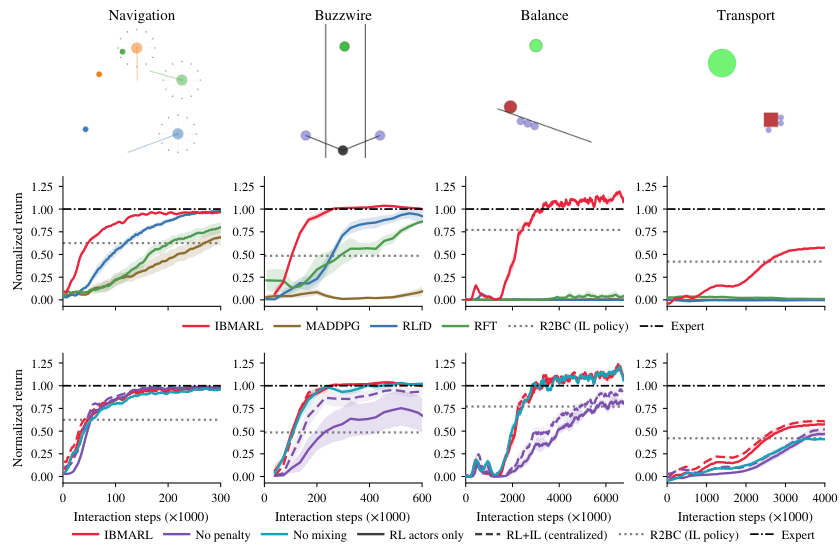
The paper compares IBMARL against several recent MARL‑from‑demonstration methods, including synthetic‑expert takeover, PRIMAL, and hybrid MADDPG variants. Across all four environments, IBMARL achieved higher final returns and steeper learning curves, confirming the authors’ hypothesis that keeping the IL policy in the loop during exploration mitigates covariate shift while still allowing the RL actor to improve beyond the demonstrator.
What are the implications for developers and researchers?
For developers building cooperative robot teams, IBMARL offers a practical pathway to leverage a single operator’s expertise without the need for complex multi‑controller setups. The round‑robin data collection can be implemented with off‑the‑shelf teleoperation tools, and the training pipeline integrates standard centralized critics that are later discarded, keeping the deployed agents lightweight and fully decentralized.
Researchers gain a new benchmark for studying imitation‑bootstrapped learning in multi‑agent settings. The gated imitation loss provides a soft, state‑wise Q‑filter that could be adapted to other MARL algorithms beyond the authors’ specific critic ensemble. Moreover, the public code, rollout videos, and results hosted at https://zhanghutony.github.io/ibmarl/ enable reproducibility and extension.
Using Grafy to explore the paper
Grafy’s Reader app lets you upload the arXiv PDF and ask follow‑up questions about the method, the experimental setup, or the mathematical details without leaving the workspace. If you want to prototype a simplified version of the R2BC data‑collection loop, you can sketch the workflow in Graph to visualize the sequence of IL and RL proposals, then export the diagram for documentation. For a quick sanity check, you could use Chat to run a small‑scale simulation of a two‑agent cooperative task and compare a vanilla RL baseline with a mock‑up of the IBMARL arbitration logic.
Frequently asked questions
Does IBMARL require a centralized critic at deployment time?
No. The training process uses a centralized critic ensemble to choose between IL and RL actions, but the gated imitation penalty forces the RL actors to converge to the same decisions. After training, each agent runs its RL policy independently, without any critic or IL policy.
Can IBMARL be applied when only a few demonstrations are available?
Yes. The method is designed to overcome the limited demonstration quality typical of behavior cloning. The gated imitation loss only pulls the RL actor toward the IL action when the critic judges it beneficial, allowing the RL component to improve even with sparse demo data.
How does IBMARL differ from earlier multi‑agent imitation approaches?
Earlier MARL‑from‑demonstration work often assumes joint demonstrations or treats demos as static offline data. IBMARL uniquely (1) uses R2BC to collect realistic single‑human demonstrations for each agent, and (2) keeps the IL policy in the loop during exploration, letting a centralized arbiter dynamically select the better action at every step.
Source: Grafy Research Lab — Imitation Bootstrapped Multi-Agent Reinforcement Learning
More news

ARCHER Boosts Small Language Models with Executable Reasoning
Researchers unveil ARCHER, a two‑stage framework that turns free‑form rationales into executable traces, raising small model math accuracy by up to 9 points.

Local Agent Harnesses Scale From 0.75B to 4.7B, New Study Finds Mingbird Leads
A Grafy Research Lab paper maps five locally‑run agent harnesses across four open‑weight models, showing the Mingbird harness outperforms others at every size.
CARE Introduces Retrieval‑Aligned Semantic IDs for Generative Retrieval
Grafy Research Lab unveils CARE, a new SID tokenizer that quantizes in a retrieval‑aligned space.