New pretraining method teaches models to search from the start
Researchers have developed Search-Native Pretraining to teach language models how to use search tools during their initial training phase, not just later.
 Source: Grafy Research Lab
Researchers have proposed a new method called Search-Native Pretraining that integrates search capabilities directly into the initial training phase of language models. This approach aims to move beyond the current standard, where models are first trained to predict static text and only later taught to use search tools during post-training.
How does Search-Native Pretraining work?
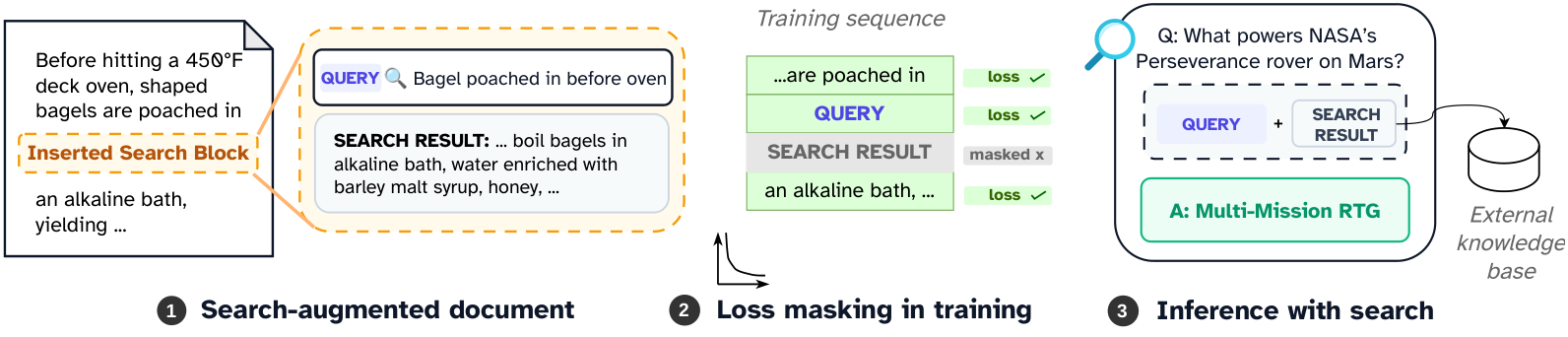
According to the paper by Kaustubh Ponkshe and colleagues, the process involves augmenting standard pretraining corpora with web-search queries and the corresponding responses retrieved from a local index. Instead of simply learning to predict the next word in a document, the model is trained on data that includes inline tool calls and the evidence needed to complete a thought.
Figure 2 illustrates this pipeline: the training documents are augmented with search queries and retrieved results. During the training process, the model calculates loss only on the original document tokens and the search queries, while the actual search results are masked. This teaches the model when it needs to seek external information and how to integrate that retrieved evidence to predict the continuation of the text.
Why is searching during pretraining better than post-training?
Most modern language models are equipped with search tools during inference, but they lack a foundational understanding of how to use them because they were pretrained on static data. The authors argue that teaching search capability during pretraining helps models overcome the finite capacity of their internal parameters to store factual knowledge.
By learning to search from the start, models become more efficient at handling knowledge-intensive tasks. The researchers found that this early exposure provides advantages that cannot be fully recovered through standard supervised fine-tuning (SFT) alone. This suggests that the ability to use tools is a fundamental capability that is more effectively developed during the base training phase rather than as an afterthought.
What are the performance benefits of QueryLM?
The models produced by this method, referred to as "QueryLM," showed significant improvements in accuracy for tasks requiring heavy factual knowledge. One of the most striking findings reported by the authors is the efficiency of the smaller models. For example, a 400M parameter QueryLM model outperformed the average question-answering performance of the SmolLM3-3B model, even though the latter used approximately 6,700 times more pretraining compute.
Figure 1 shows that a 1.4B parameter QueryLM consistently matches or exceeds the performance of a 3.3B parameter baseline model that was matched for total floating-point operations (FLOPs). Additionally, QueryLM demonstrated higher steerability; when presented with retrieved evidence that contradicted its internal training data, the model was more likely to follow the new, provided context rather than sticking to its outdated internal weights.
Can this method scale to larger datasets?
The researchers tested their approach using the Wikipedia corpus and the DCLM-Edu corpus, the latter of which represents a more realistic pretraining environment. The augmented DCLM-Edu corpus included over 100B tokens consisting of document text, queries, and responses.
Experiments were conducted across various model scales, ranging from 360M to 3.3B parameters. The results suggest that Search-Native Pretraining is a scalable route for developing foundational search capabilities. While the method introduces additional complexity during the data preparation and training stages, the resulting models are significantly more capable of handling evolving real-world information.
How does this affect the future of AI development?
This research suggests a shift in how foundational models might be built. If models are trained to be "search-native," they may become less reliant on massive parameter counts to store every possible fact, instead becoming expert navigators of external information. This could lead to smaller, more efficient models that perform at the level of much larger counterparts by leveraging external tools more effectively.
For researchers and developers, this highlights the importance of data composition. Rather than just collecting more text, the focus may shift toward creating more functional, interactive datasets that teach models how to interact with the world around them.
For those looking to interact with models that perform deep research and information synthesis, tools like Reader allow you to apply these concepts of retrieval-augmented reasoning by questioning complex PDFs and research papers directly.
Frequently asked questions
What is the main difference between QueryLM and standard models?
Standard models are typically pretrained on static text and only learn to use search tools during a later fine-tuning stage. QueryLM is trained from the beginning to generate search queries and use retrieved evidence as part of its core language modeling objective, making the search capability a fundamental part of its training.
Does Search-Native Pretraining make models larger?
No, the method does not inherently require larger models. In fact, the research demonstrated that smaller QueryLM models can outperform much larger models that were trained conventionally. The benefit comes from how the model is trained to use information, rather than simply increasing the number of parameters used to store facts.
Can QueryLM handle information that contradicts its training data?
Yes, QueryLM shows a higher ability to follow counterfactual evidence. Because the model was trained to incorporate retrieved context during pretraining, it is more steerable and more likely to update its answers based on the specific evidence provided during a search, even if that evidence contradicts facts it previously learned.
Source: Kaustubh Ponkshe, Gyung Hyun Je, Stefan Taga, Colin Raffel, Martin Jaggi (arXiv:2611.26809)
Source: Grafy Research Lab — Search From the Start: Search-Native Pretraining for Language Models
More news

New interpretable embeddings use decision columns for search
Researchers propose using decision columns as embeddings to create auditable, interpretable search and entity matching systems for business data.

New Benchmark Tests if AI Can Write Programs to Play Games
Researchers have introduced PlayScriptBench to evaluate if vision-language models can synthesize executable game controllers rather than just reacting.

New DPMA method optimizes Mixture-of-Experts model compression
Researchers introduced DPMA, a method that jointly learns how to prune, merge, and absorb experts to compress MoE models without full retraining.