New SCAN model enables scalable high-order interaction selection
Researchers have introduced SCAN, a new neural additive network that identifies complex feature interactions without manual specification or high costs.
 Source: Grafy Research Lab
Researchers have developed a new neural architecture called Scalable Component Additive Networks (SCAN) that can automatically identify complex interactions between input features. This development addresses a long-standing bottleneck in interpretable machine learning where models often struggle to balance the discovery of high-order relationships with computational efficiency.
What are the limitations of current neural ANOVA models?
Functional ANOVA (Analysis of Variance) models are designed to decompose high-dimensional predictions into a sum of main effects and interactions. This makes the model's decision-making process more transparent by showing how specific groups of features work together. However, according to the research paper by Seokhun Park, Kunwoong Kim, and Yongdai Kim, existing neural versions of these models face a significant trade-off.
To capture high-order interactions (where three or more features interact), current models typically require researchers to specify those interactions in advance. If a researcher tries to enumerate every possible interaction in a high-dimensional dataset, the computational cost becomes astronomical. For instance, a dataset with 700 features contains approximately 245,000 possible second-order interactions, and the number of higher-order combinations grows exponentially. Consequently, most existing models are limited to only first-order (main effects) or second-order interactions.
How does the SCAN architecture work?
SCAN introduces a data-adaptive approach to component selection. Instead of predefining which features should interact, the model learns which features each basis function combines during the training process.
Figure 1 illustrates the SCAN architecture, showing how each basis function combines univariate unit functions through learnable, sparse component-selection weights. The prediction is then generated as a weighted sum of these basis functions. By using a global component-selection parameter that shares information across different basis functions, the model can effectively prune negligible weights. This allows the network to focus on a small, meaningful collection of feature sets that actually drive the prediction.
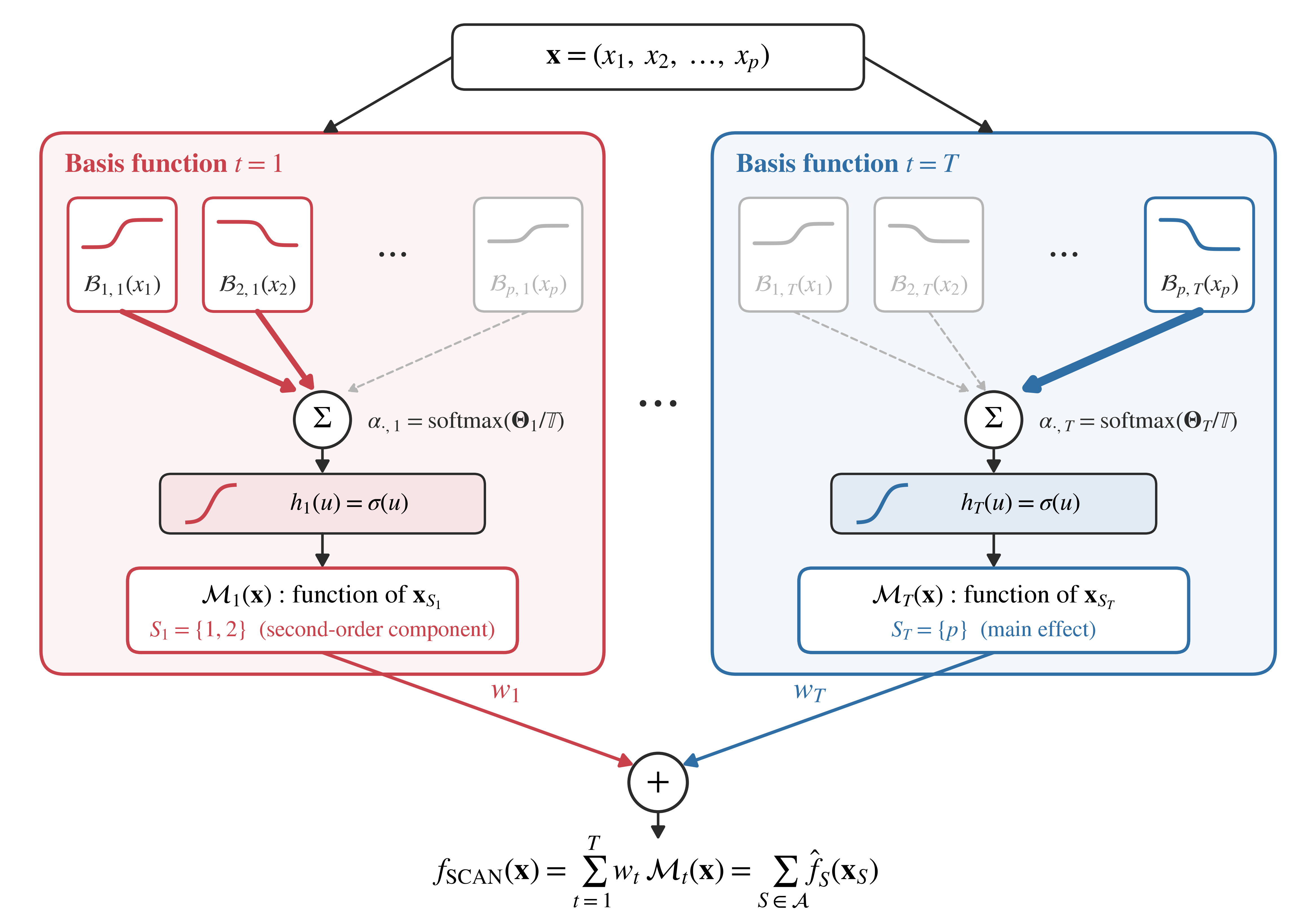
This mechanism allows SCAN to be trained using standard mini-batch gradient descent, making it more scalable than previous Bayesian approaches that relied on expensive MCMC algorithms which could not easily support mini-batch learning.
What are the theoretical and empirical benefits?
The authors provide several mathematical guarantees for the SCAN method. According to the paper, the model achieves universal approximation for Hölder continuous functions and reaches a minimax optimal convergence rate, up to a logarithmic factor, for the least squares estimator. Furthermore, the researchers established component selection consistency, meaning the probability that the discovered components include all true components approaches one as the sample size increases.
In practical testing, SCAN demonstrated several advantages:
- Higher-order discovery: In synthetic experiments, SCAN successfully learned components with a maximum order close to the actual ground truth.
- Efficiency: Post-hoc identification of the learned components was highly efficient, taking only a few seconds for 100 inputs.
- Performance: SCAN outperformed most existing neural functional ANOVA models in predictive accuracy while maintaining much lower training costs than exhaustive second-order models.
How was SCAN applied to real-world data?
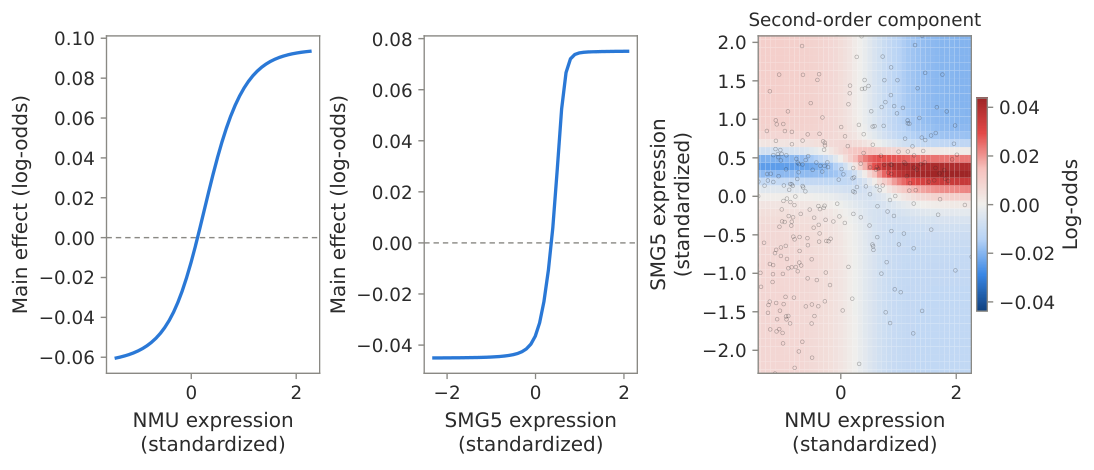
The researchers tested the model's utility on a high-dimensional gene-expression dataset containing 12,502 variables to predict treatment responses in breast cancer. This application demonstrates the model's ability to handle extremely high-dimensional spaces where manual interaction specification would be impossible.
Figure 3 shows the results of this application, specifically highlighting the identified components for pCR (pathologic complete response) prediction. The visualization displays the largest main effects and the specific second-order and third-order interactions between genes that the model identified as significant. This level of interpretability allows researchers to see not just that a prediction was made, but exactly which biological markers are interacting to influence the outcome.
How can researchers explore these concepts in Grafy?
For researchers and developers looking to dive deeper into the technical specifics of the SCAN paper or similar machine learning literature, Grafy's Reader provides an environment to interact with complex PDFs. You can use the AI-powered tools within Reader to summarize the mathematical proofs, query specific experimental results, or clarify the notation used in the functional ANOVA decomposition. This allows for a more efficient way to parse dense academic findings like the minimax optimality proofs presented in this study.
Frequently asked questions
Does SCAN require manual interaction specification?
No, SCAN does not require users to specify interactions in advance. Unlike previous neural functional ANOVA models that rely on predefined sets of interactions, SCAN uses a data-adaptive approach where the model learns which features to combine through learnable and sparse component-selection weights during training.
Is SCAN compatible with mini-batch training?
Yes, SCAN is designed to be compatible with standard mini-batch gradient descent. This is a significant improvement over some Bayesian neural functional ANOVA models that utilize MCMC algorithms, which are difficult to scale because they struggle with mini-batch learning and expensive sample storage.
Can SCAN identify third-order interactions?
Yes, SCAN can identify higher-order interactions. In the gene-expression application described by the authors, the model successfully identified both second-order and third-order components, demonstrating its ability to move beyond the simple main effects or second-order limitations found in many other interpretable models.
More news

New RoFE method fixes multimodal tabular learning errors
Researchers have introduced RoFE to prevent data geometry collapse in multimodal learning, improving performance when labeled data is scarce.

New Method Optimizes LLM Updates via Sequential Labeling
Researchers propose the SOLD framework to efficiently evaluate LLM updates using a mix of cheap AI judges and costly human labels. Learn how it works.

Seldon TFM family achieves top rankings in tabular benchmarks
Researchers have introduced Seldon, a new family of tabular foundation models that rank first on several major classification benchmarks.