New Study Maps AI Agent Cost Cuts
A new AI agent harness study found system-level optimizations can cut execution costs up to 35% without changing the model. Here’s what it means for builders.
 Source: Grafy Research Lab
Researchers behind a new preprint from Grafy Research Lab say they examined how AI agent harnesses spend money and tokens during real-world tasks. According to the paper, agent harnesses are the layer that gives LLMs access to computing environments through prompts, tools and loops. The team reported that task-execution accuracy depends mostly on the LLM used, while harness-side choices such as system prompts or tools had minimal impact on accuracy. Harness-side variances, however, appeared to matter more for cost, with the same model and task able to see cost reductions of up to 2.6 times.
What the Paper Found About Agent Costs
The preprint, titled System Optimizations for Cost-Efficient Agent Harnesses, described a study of agent traces and benchmarks. According to the source, the researchers looked at cost accumulation patterns across various agent traces. They identified five opportunities to reduce token use and LLM calls without changing the model or task accuracy. The paper is dated November 10, 2026, and lists authors from several universities.
The authors argue that while the LLM remains the main factor for task accuracy, the harness still shapes how efficiently that model can be used. They examined existing techniques, including starting a new session on a new task, delegating to a cheaper LLM, and training models to remove unused context. The authors say many such approaches depend on user decisions or unpredictable model behavior, so they pursued system solutions that are transparent and deterministic.
The paper notes that long-context training and attention improvements allow state-of-the-art models to reach context lengths up to one million tokens, making long-horizon agentic executions accessible. The cost issue appears when sessions reach 10 to 100 times the cost of shorter sessions. The researchers present the five opportunities as a way to reduce token use and LLM calls without modifying the model or affecting task accuracy.
Why Context and Tool Use Drive Agent Costs
According to the paper, reading existing context was the largest source of agent cost in real-world executions, even with caching, and took up to 73% of total cost. Tool calls also incurred significant cost without increasing token count, causing up to a 26 times cost increase at the same token count. The authors noted tool call outputs were often information sparse, and agents used only 27% of tool outputs on average.
The study also found that filesystem exploration could consume up to 89% of agent turns in retrieval-heavy tasks. In addition, agent traces contained a large number of parallel subtasks, with an average of 1.3 to 2.7 independent subtasks that could run concurrently to reduce context sharing across subtasks.
The authors say these patterns matter because even small inefficiencies can compound across long agent runs. The cost calculations in the paper break LLM calls into cache reads, cache writes, uncached input and output, which means harness decisions about context handling can change the final bill.
How the Agency Platform Aimed to Reduce Costs
The researchers designed Agency, a harness interposition platform that provides a unified abstraction for monitoring and manipulating context, tools and environments. According to the paper, Agency allows optimizations to be implemented once and reused across harnesses and models. The team used Agency to build proof-of-concept techniques for context compression and agent turn reduction, including tool output compaction, context garbage collection, subtask stack machine, metadata-assisted search and tool call batching.
The reported end-to-end result was cost reductions up to 35% across real-world benchmarks on existing harnesses, with the paper describing the accuracy impact as marginal.
Agency is described as a harness interposition platform. The team implemented proof-of-concept optimization techniques on Agency and reported up to 35% end-to-end cost reduction on real-world benchmarks with marginal accuracy loss. The techniques were not presented as a replacement for model improvements but as system-side savings.
What the Figures Show
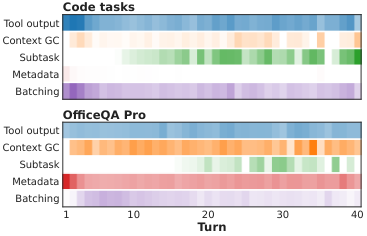
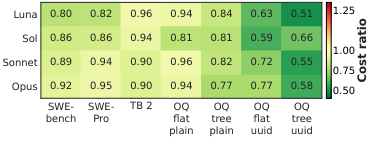
Figure 9 shows the cost ratio of combined techniques compared with baseline runs, averaged across harnesses. Figure 12 shows the turn count when each technique fired on Basic-full, using the share of runs that reached the turn where the technique acted. The figures are from the paper and help illustrate where the cost savings came from in the Agency experiments.
How Grafy Relates to the Research
Grafy's Code app is the closest surface in the product lineup for developers interested in AI coding agents, though it is not the paper's Agency platform. Readers who want to explore agent behavior, model comparisons or research papers can use Grafy Chat or Grafy Code. The work may inform how coding assistants manage context and tools, but Grafy has not implemented Agency as described in the preprint.
For teams using off-the-shelf coding agents, the practical lesson may be to audit context and tool use before switching models. Grafy Code could be a place to test such workflows, though the specific optimizations remain a research proposal.
Frequently asked questions
Does task accuracy depend mostly on the LLM rather than the agent harness?
According to the preprint, recent studies it cites indicate that agent task-execution accuracy depends mostly on the LLM used, while harness-side variances such as system prompts or tools had minimal impact. The authors also reported that newer agentic models were capable enough that harness choices did not broadly change accuracy. The study therefore focused on cost rather than accuracy.
Can harness optimizations reduce agent cost without changing task accuracy?
Yes, according to the preprint. The Agency proof-of-concept techniques achieved cost reductions up to 35% across real-world benchmarks on existing harnesses, and the authors said the approach did not compromise accuracy. The paper also noted marginal accuracy loss in some ablation reporting, so the practical trade-offs are described carefully.
What does the Subtask Stack Machine do?
The Subtask Stack Machine is listed in the paper as one context-compression technique explored through Agency. It was part of the effort to manage independent subtasks and reduce context sharing. The source says traces contained an average of 1.3 to 2.7 independent subtasks that could run concurrently.
Source: Grafy Research Lab — System Optimizations for Cost-Efficient Agent Harnesses
More news

United Won't Let AI Agents Book Flights on Its Site
United says AI assistants can browse its flights but can't complete bookings, citing privacy and regulatory worries. Here's what it means for agents.

Pomerado Turns Websites Into Agent APIs, Claims 7x Speedups
Pomerado launched on Hacker News with an open-source MCP server that turns any website into an API for agents.
DocFS Turns Complex Documents Into File Systems for AI Agents
A research framework called DocFS rebuilds long, image-heavy documents as file systems so AI agents navigate them faster and with far fewer tokens.