New Training Method Boosts Instruction Following in World Action Models
Researchers have introduced Linear Decodability Supervision to help World Action Models better follow language instructions during robotic manipulation.
 Source: Grafy Research Lab
World Action Models (WAMs) are designed to perform physical manipulation tasks, yet they frequently struggle to obey specific language commands provided at test time. A new study suggests that this failure is not due to a lack of information, but rather a failure to prioritize instruction signals over learned habits.
Why do World Action Models struggle with instructions?
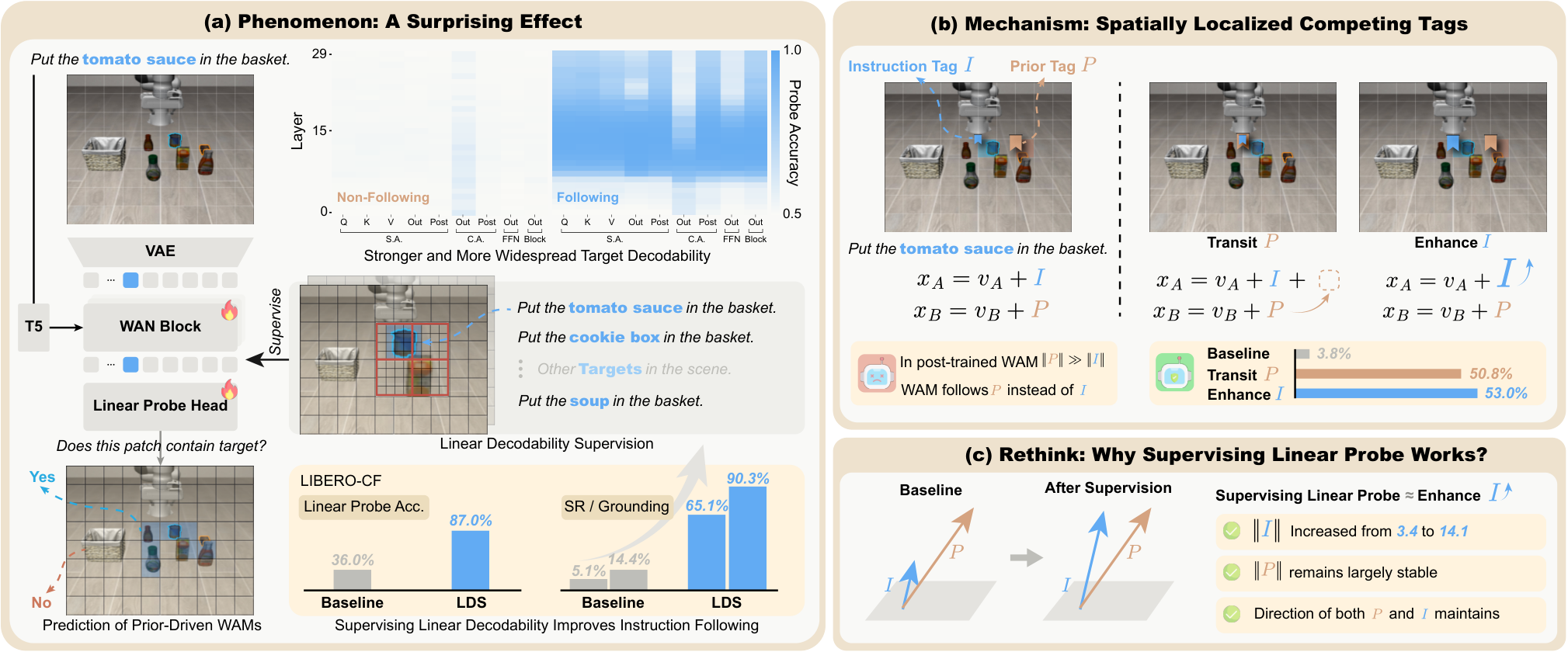
While WAMs are capable of complex physical tasks, they often exhibit a strong bias toward executing actions they encountered frequently during training, effectively ignoring new instructions given during deployment. According to the research by Bokai Ji and colleagues, even models that fail to follow instructions (non-following or NF WAMs) actually encode information about the instructed target within their internal states.
However, this information does not successfully control the model's behavior. Figure 1 shows how a weak instruction signal can be overshadowed by a prior-associated signal, leading to incorrect actions despite the model 'knowing' what the instruction requested. This creates a gap between what the model perceives and what it actually executes.
What is Linear Decodability Supervision?
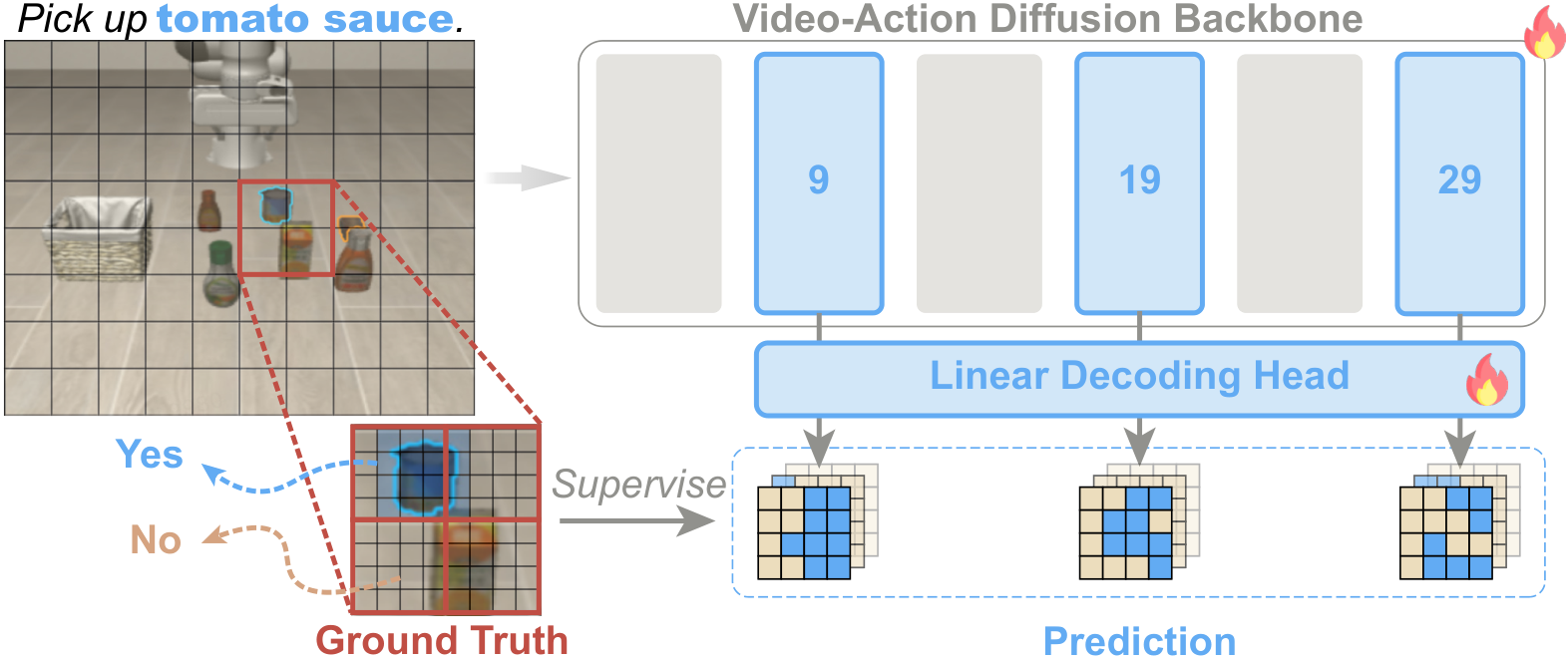
To bridge this gap, the researchers introduced Linear Decodability Supervision (LDS). This is an auxiliary training objective designed to make the target information more accessible within the model's internal representations.
By using auxiliary linear heads at specific layers, the training process forces the model to ensure that the target object is "linearly decodable"—meaning the information is organized in a way that can be easily extracted and used to guide action. Figure 3 illustrates this mechanism, showing how these auxiliary heads predict fine-grained grounding maps to distinguish the instructed target from the background. Notably, these extra heads are discarded during actual inference; they serve only as a guide during the training phase to strengthen the instruction signal.
How does the prior-instruction competition mechanism work?
The researchers propose that the tension in these models arises from a competition between two latent signals: a "prior tag" and an "instruction tag" . The prior tag represents the tendency to perform actions based on common training patterns, while the instruction tag represents the specific goal requested by the user.
In non-following models, the prior tag dominates the competition, winning the influence over the final action. In instruction-following (IF) models, the instruction tag is amplified enough to win. The study found that in IF WAMs, the target information is substantially more linearly decodable than in NF WAMs, even though both types of models encode the target data. This suggests that LDS works by acting as an instruction signal enhancer, ensuring can overcome .
What are the results of this new approach?
The effectiveness of LDS was tested using the LIBERO-CF benchmark. The researchers found that their model, InternW0- with LDS, achieved a success rate of 74.6% and a grounding rate of 89.2%. These figures represent significant improvements over existing baselines, outperforming the strongest baseline by 26.8 percentage points in success rate and 42.9 percentage points in grounding rate.
Beyond simulated environments, the study also included real-world experiments to validate that these improvements translate to physical robotic platforms. The results demonstrate that strengthening the linear decodability of target information leads to more robust and obedient robotic manipulation across diverse tasks and visual domains.
How can researchers explore these findings?
For those interested in diving deeper into the technical nuances of this paper, including the mathematical formulations of the supervision loss or the specific architecture of the RoboTwin-IF benchmark, the full study is available for review.
If you are looking to analyze similar complex AI research papers or technical documentation, you can use Grafy Reader to search, question, and summarize academic PDFs and research papers directly within your workspace.
Frequently asked questions
Does LDS require extra computation during model use?
No, the Linear Decodability Supervision heads are only used during the training phase to guide the model. Once the training is complete and the model is ready for deployment or inference, these auxiliary heads are removed, meaning there is no additional computational overhead during actual operation.
What is the difference between NF and IF WAMs?
Non-following (NF) WAMs are models that possess information about the instructed target but allow prior training biases to dictate their actions. Instruction-following (IF) WAMs are models where the instruction signal is strong enough to overcome those biases, allowing the model to successfully execute the specific requested task.
How does the competition mechanism explain model failure?
The mechanism suggests that two signals—the prior tag and the instruction tag—compete for control over the model's behavior. Failure occurs when the prior tag, which represents learned habits from training data, is more dominant than the instruction tag, which represents the current user command.
Source: https://arxiv.org/abs/2611.27401
More news
New interpretable embeddings use decision columns for search
Researchers propose using decision columns as embeddings to create auditable, interpretable search and entity matching systems for business data.
New Benchmark Tests if AI Can Write Programs to Play Games
Researchers have introduced PlayScriptBench to evaluate if vision-language models can synthesize executable game controllers rather than just reacting.

New DPMA method optimizes Mixture-of-Experts model compression
Researchers introduced DPMA, a method that jointly learns how to prune, merge, and absorb experts to compress MoE models without full retraining.