Prefix‑Guided Sampling Cuts Test‑Time Costs While Boosting LLM Reasoning
A new method called Prefix‑Guided Sampling (PreG) uses early confidence signals to prune low‑quality reasoning paths.
 Source: Grafy Research Lab
Parallel test‑time scaling (TTS) has become a standard way to improve large language model (LLM) reasoning by sampling many independent answer paths and aggregating them. A new arXiv paper titled Early Signals, Strong Decisions: Prefix‑Guided Sampling for Parallel Test‑Time Scaling proposes a way to keep the accuracy gains of TTS while cutting the heavy token cost that traditional methods incur. The authors, Jie Ren, Jonathan Rosenfeld and Neil Thompson, introduce Prefix‑Guided Sampling (PreG), a framework that evaluates short prefixes with internal confidence scores and continues only the most promising candidates.
What is Prefix‑Guided Sampling and why it matters?
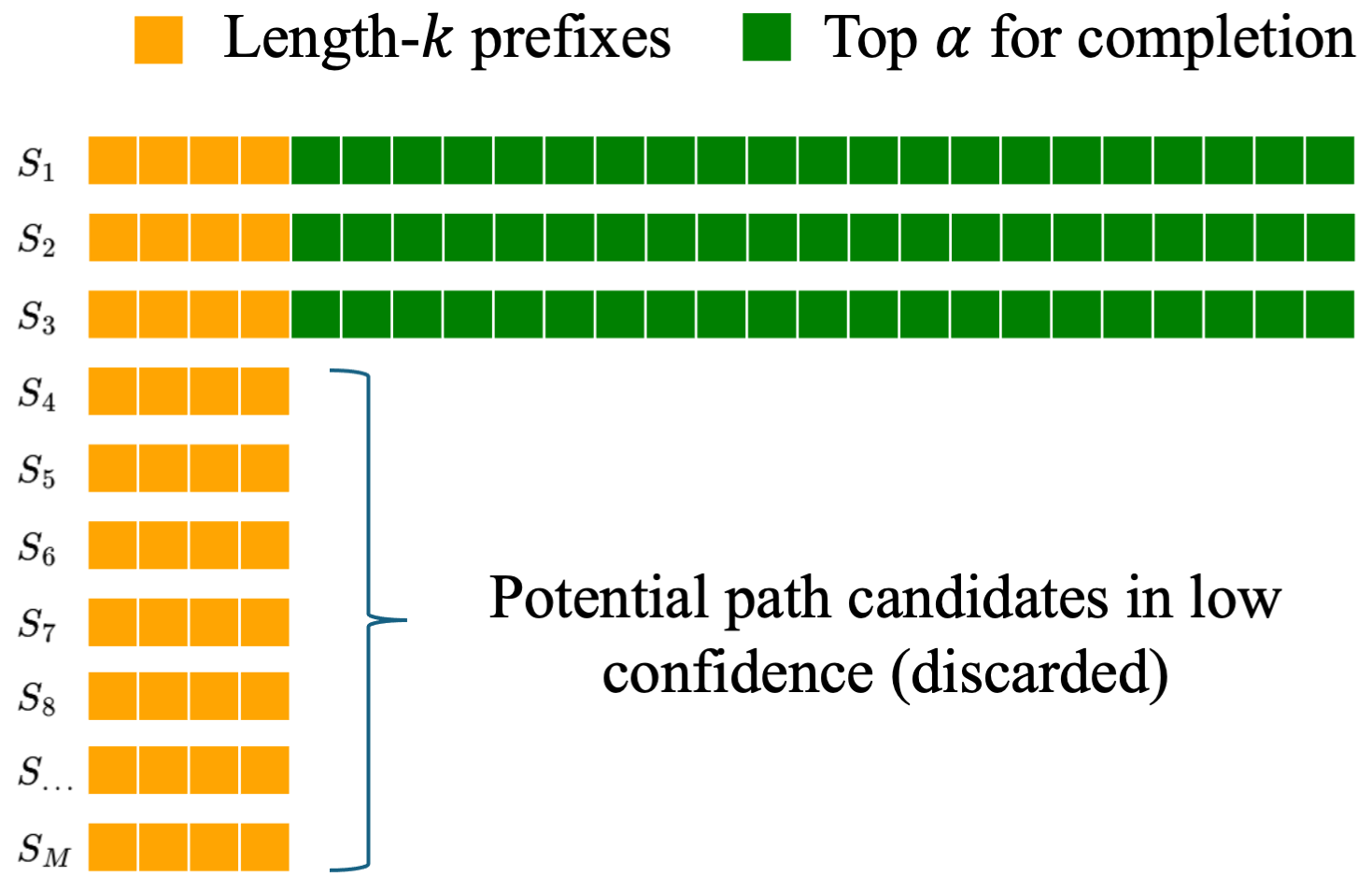
PreG re‑thinks the usual TTS pipeline. Instead of generating every reasoning path to completion before assessing its quality, the method first allocates a fraction of the token budget to produce brief prefixes – roughly 20 % of a full chain according to the paper. Those prefixes are scored with internal confidence metrics such as likelihood, entropy, Gini impurity, DeepConf or Self‑Certainty. Paths that rank low are discarded, and the remaining ones receive the remaining budget to finish their reasoning. By front‑loading the confidence estimate, PreG avoids spending tokens on trajectories that would ultimately be ignored, delivering a more token‑efficient inference process.
How does aggregation amplify confidence signals?
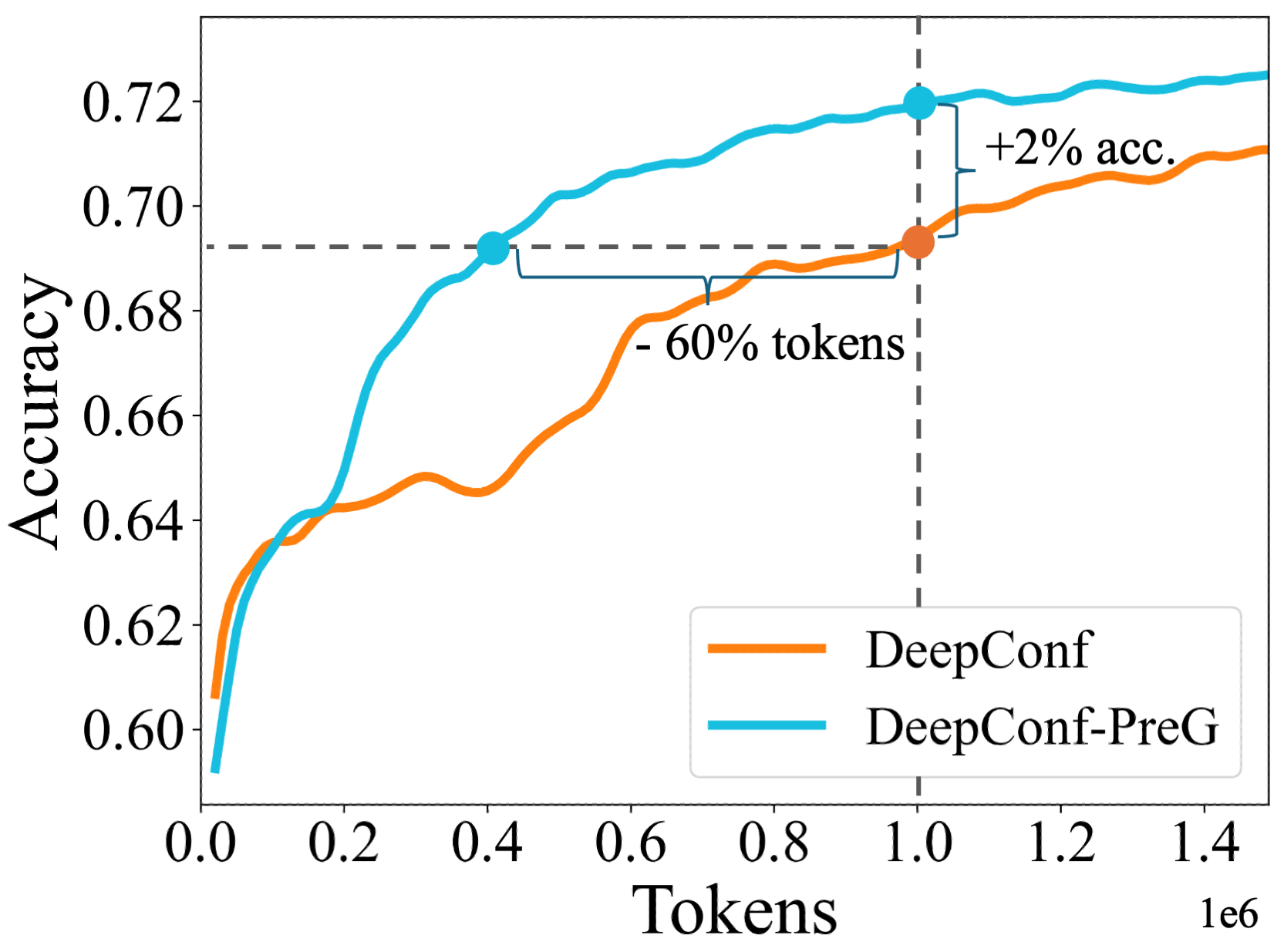
The authors observe that confidence scores have the greatest impact when the set of sampled paths is near the decision boundary – that is, when correct and incorrect answers appear in similar numbers. In such cases, even a modest boost to the probability of correct paths can be magnified by the aggregation step (majority voting or weighted voting). Their margin‑based analysis shows that aggregation turns a small confidence advantage into a larger effective margin, increasing the likelihood of the correct answer being selected. Figure 1 illustrates this effect: the DC‑PreG curve dominates the vanilla DeepConf baseline, especially in the regime where the number of sampled paths (M) is high and the decision margin is thin.
What theoretical guarantees does the paper provide?
The study supplies a formal model of parallel TTS under a fixed token budget . Using a margin‑based framework, the authors derive an expression for the expected prediction accuracy as a function of the confidence‑derived margin. They prove that allocating a portion of to short prefixes (parameterized by prefix length and filtering ratio ) strictly improves the effective margin compared to spending the entire budget on full paths. The optimal prefix length and filtering ratio are obtained by differentiating the objective and analyzing its curvature, showing that modest prefixes already contain enough signal to shift the decision boundary in the desired direction.
What experimental results support PreG’s efficiency?
The authors evaluate PreG on several reasoning benchmarks, including math and logical deduction datasets. Across all tests, PreG matches or exceeds the accuracy of standard parallel TTS that expands every path fully. More strikingly, token usage drops dramatically – the paper reports reductions of up to 40 % while preserving the same level of performance. Figure 3 visualizes the PreG workflow, highlighting the two‑stage generation (prefix then completion) and the selective continuation based on confidence ranking. Additional ablations (Sections 5.2‑5.5) confirm that the method remains robust under small compute budgets and that the gains are not limited to a single confidence metric; DeepConf, Self‑Certainty and likelihood all benefit from prefix‑guided filtering.
Applying Prefix‑Guided Sampling with Grafy
Grafy users can explore the ideas behind PreG without writing a full research prototype. The Grafy Code studio lets you prototype the two‑stage generation pipeline by calling any hosted LLM, generating a short prefix, computing an internal confidence score (e.g., token‑level likelihood), and then conditionally extending the most promising prefixes. A minimal script can be built in the Code app and run against the same models used in the paper (Qwen‑3‑8B, etc.). For a deeper dive into the paper’s methodology, the Grafy Reader app can ingest the arXiv PDF, allowing you to ask natural‑language questions about the margin analysis or the hyper‑parameter choices. Together, these tools give creators and developers a hands‑on way to test prefix‑guided sampling on their own prompts and datasets.
Frequently asked questions
Does PreG require a separate confidence model?
No. PreG relies on internal confidence signals that are already available from the base LLM (e.g., likelihood, entropy, DeepConf). The method does not add external models or extra inference passes.
How much of the token budget should be allocated to prefixes?
The paper’s analysis suggests a prefix length that covers about 20 % of a full reasoning chain (roughly 400 tokens for a 2000‑token path) and a filtering ratio around 0.3‑0.5. Exact values may vary with model size and task difficulty.
Can PreG be combined with other TTS efficiency tricks?
Yes. Prefix‑guided sampling is orthogonal to techniques such as early stopping, dynamic path pruning or ensemble voting. It can be layered on top of existing parallel TTS pipelines to further reduce token waste.
Source: arXiv:2611.14965 (2026‑11‑14)
More news

Sparse Teacher Support Cuts LLM Distillation Cost Without Losing Accuracy
Researchers show that keeping only 0.01% of a language model's vocabulary during forward‑KL distillation preserves MMLU‑Pro performance while slashing training.

Cmpnd launches dspy-wsp: weight‑space programming
Cmpnd released dspy-wsp, a prototype DSPy optimizer that edits model weights directly without gradients.

guardscope Framework Quantifies Runtime Control Coverage for LLM Agents
A new arXiv study introduces guardscope, a two‑stage framework that measures how many of an LLM agent's action paths are inspected by runtime controls.