Reasoning models struggle with scientific argumentation
New research shows that high performance in math and code does not translate to scientific reasoning, highlighting a gap in current AI capabilities.
 Source: Grafy Research Lab
Current advancements in large language models (LLMs) have produced impressive results in mathematical proofs, coding, and general logic, but these skills do not automatically transfer to the complexities of scientific discourse. According to a study by Buse Sibel Korkmaz and Antonio del Rio Chanona, frontier models often fail when tasked with the nuanced requirements of scholarly argumentation, such as evaluating evidence or generating academic rebuttals.
What is scientific argumentation?
Scientific progress relies on more than just raw data; it requires a structured process of making claims, providing empirical evidence, and critiquing existing methodologies. Unlike general debates found on social media or news commentary, scientific argumentation must adhere to strict evidential standards and maintain logical coherence across long, complex documents.
As noted by the authors, scientific reasoning often operates across multiple levels, from identifying a single claim in a sentence to synthesizing evidence across an entire research paper. This requires a model to navigate uncertainty and conflicting interpretations, a task that differs significantly from solving a closed-ended math problem or a coding puzzle.
How did researchers test these models?
To investigate this gap, the researchers developed a systematic evaluation framework covering seven distinct tasks. These tasks were categorized into three main families, as illustrated in Figure 1, which shows the spectrum of requirements from simple argument mining to complex discourse-level reasoning.
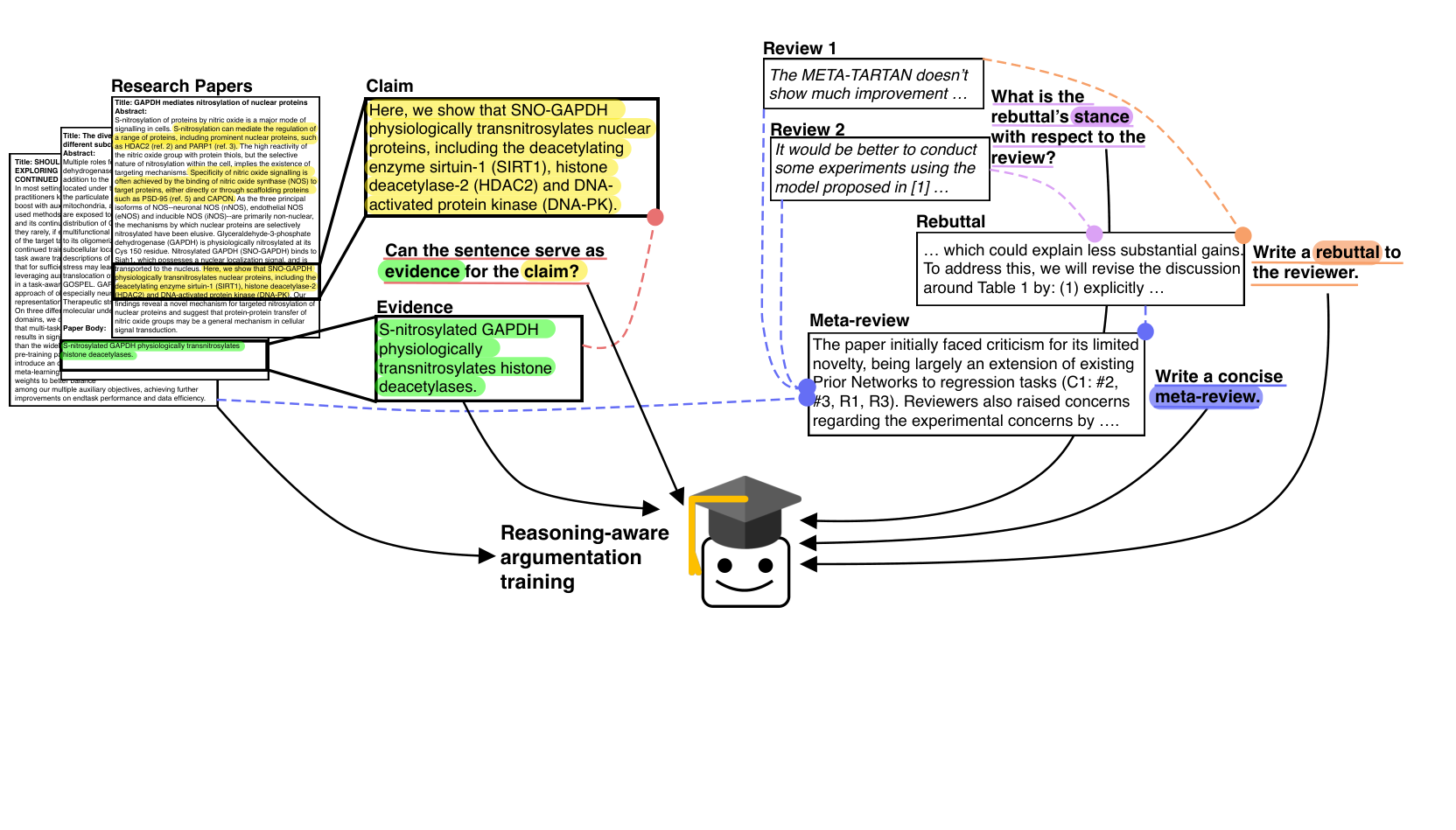
- Argument Mining: This involves identifying and classifying the building blocks of an argument. Tasks include claim detection (finding testable statements in grant abstracts), evidence detection (determining if a sentence supports or refutes a claim), evidence classification, and stance detection (analyzing how authors respond to peer reviewers).
- Argument Generation: This tests the ability to produce coherent text, such as generating point-by-point rebuttals to reviewer comments or synthesizing multiple reviews into a single meta-review.
- Discourse-Level Argumentation: This represents the highest level of complexity, requiring models to perform systematic answer composition by integrating evidence from multiple passages to answer research questions.
Why do frontier models fail at these tasks?
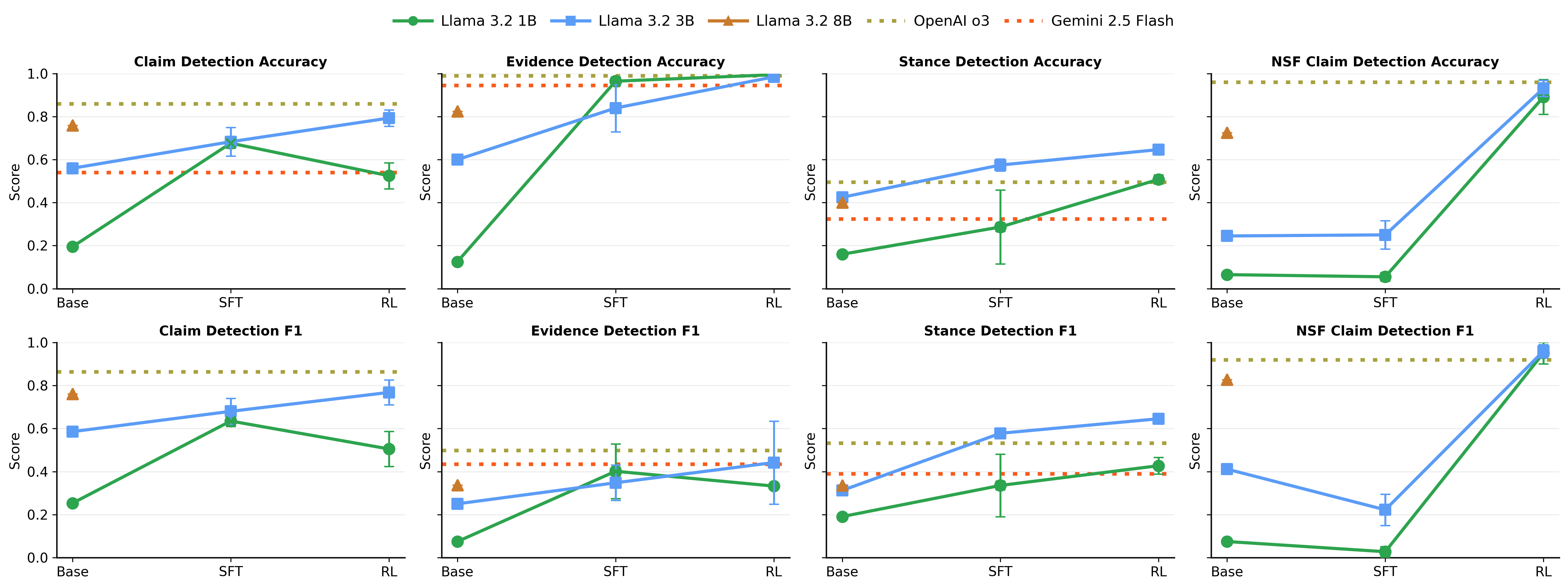
Despite the high performance of models like OpenAI o3 on logical benchmarks, the study found that these capabilities do not bridge the gap to scientific discourse. For example, in stance detection, where models must identify if an author agrees or disputes a reviewer, even top-tier models struggled significantly.
Figure 2 highlights the progression of performance during training, showing that significant improvements are required to move beyond baseline capabilities. The researchers observed that many models suffer from a "shallow pattern matching" problem. In tasks like evidence detection, where the data is heavily skewed toward irrelevant information, models often default to predicting the majority class rather than truly understanding the relationship between a claim and its supporting evidence. This leads to high accuracy scores that mask a fundamental failure in actual reasoning, as reflected by low F1 scores.
Can training improve scientific reasoning?
The researchers proposed a training methodology designed to scaffold these specific argumentative skills. This approach uses reasoning-aware knowledge distillation, multi-task supervised fine-tuning, and reinforcement learning with composite rewards.
By using distilled chain-of-thought (CoT) supervision, the training process encourages models to follow a structured reasoning path. The results indicated that this method could yield substantial improvements. Notably, the study found that a much smaller 3B parameter model, when trained with this reasoning-aware approach, could surpass much larger commercial baselines on several specific scientific tasks.
How can researchers apply these findings?
For researchers working with existing AI tools, these findings serve as a reminder that a model's ability to solve a math equation is not a guarantee of its ability to critically analyze a research paper. When using AI for literature reviews or hypothesis generation, it is essential to verify the logical connections the model draws between different pieces of evidence.
If you are conducting deep research or analyzing complex academic papers, you can use Reader to interact with scientific documents. While current models may struggle with the high-level argumentation described in this study, using a dedicated research workspace allows you to cross-reference the model's claims against the actual text of the PDF, helping you mitigate the risks of shallow reasoning or incorrect evidence synthesis.
Frequently asked questions
Does strong performance in math mean an AI can handle scientific papers?
No, strong performance in math and coding does not guarantee success in scientific argumentation. The research shows that scientific discourse requires domain-specific knowledge and the ability to evaluate evidence and navigate uncertainty, which are distinct from the logical and mathematical reasoning found in current frontier models.
What are the main tasks used to evaluate scientific reasoning?
Researchers used seven tasks across three families: argument mining (detecting claims and evidence), argument generation (writing rebuttals and meta-reviews), and discourse-level argumentation (composing systematic answers from multiple evidence sources). These tasks test everything from sentence-level identification to document-level synthesis.
How can models be trained to better understand scientific arguments?
Models can be improved through reasoning-aware training methodologies. This includes using distilled chain-of-thought supervision to provide structured reasoning steps and reinforcement learning with composite rewards to specifically target the nuances of scientific discourse, such as evidence classification and stance detection.
More news

New DPMA method optimizes Mixture-of-Experts model compression
Researchers introduced DPMA, a method that jointly learns how to prune, merge, and absorb experts to compress MoE models without full retraining.

Research identifies double counting risks in LLM evidence fusion
Researchers have identified how large language models can double count evidence when fusing reports, leading to inaccurate conclusions in multi-agent systems.

New LRSA method accelerates long-context AI inference
Researchers propose LongCat Recall Sparse Attention (LRSA) to solve retrieval bottlenecks in long-sequence models, significantly speeding up inference.