RegimeCouncil Introduces Dynamic Memory Conflict Governance for LLM Agents
A new routing system called RegimeCouncil lets language agents decide when to suppress stale memory locally or globally.
 Source: Grafy Research Lab
RegimeCouncil, a paired‑evidence routing mechanism, was unveiled to help large language model (LLM) agents manage outdated facts stored in long‑term memory. By dynamically choosing between local and global suppression of memory use, the method reduces harmful responses when knowledge drifts over time.
What is memory conflict governance?
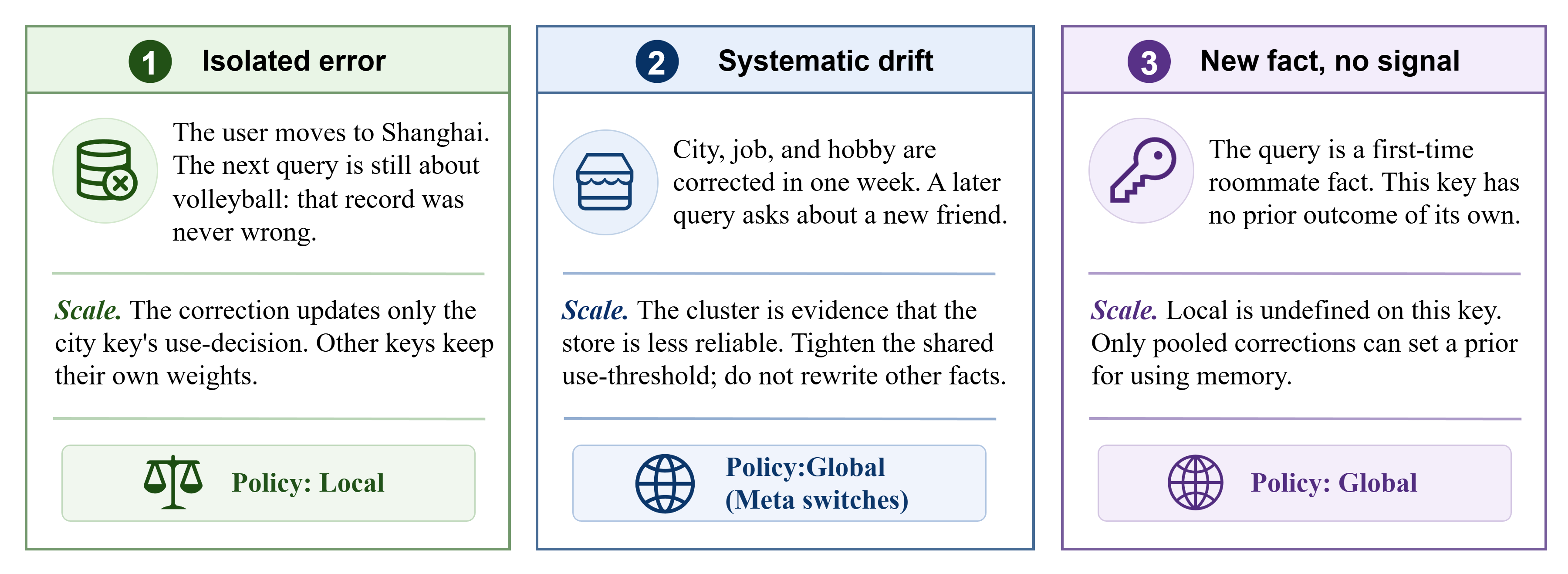
The problem arises when an LLM‑based assistant keeps a personal knowledge store that slowly becomes inaccurate as real‑world facts change. For example, an agent may still believe a user lives in Beijing after the user has moved to Shanghai. The error is usually discovered only after the assistant receives delayed feedback—such as a correction or a failed task. The question is how far that negative feedback should propagate: should the system block the stale entry only for future queries about that specific fact (a local policy), or should it also dampen the use of other stored facts (a global policy)? The authors formalize this decision‑making dilemma as memory conflict governance and prove that fixing the scope in advance leaves agents vulnerable to either missed warnings or unnecessary suppression (see the arXiv paper).
Why existing memory systems fall short
Current long‑term memory frameworks for LLM agents either update individual records in isolation or apply a shared confidence gate across the entire store. A local‑only approach avoids cross‑fact interference but cannot help unseen or rarely accessed facts, nor can it signal a broader shift when many entries become stale together. Conversely, a global‑only approach spreads evidence quickly but may over‑penalize stable facts because a few volatile entries dominate the shared signal. The paper cites recent benchmarks (LongMemEval, TempLAMA, TAQA) that demonstrate persistent performance gaps when agents rely on a single fixed scope.
How does RegimeCouncil work?
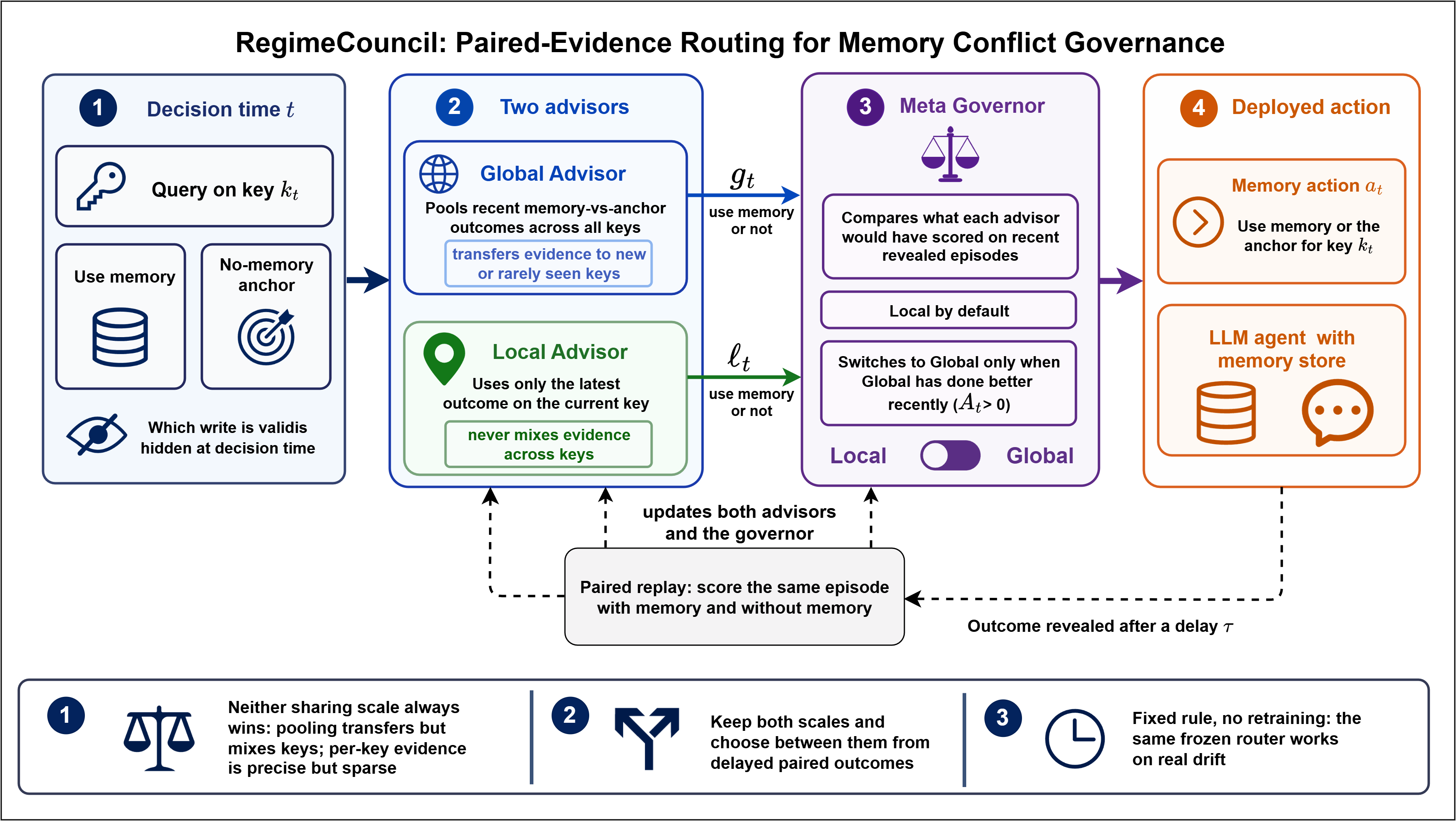
RegimeCouncil keeps both a Local Advisor and a Global Advisor active. When a query arrives, the system first decides whether to inject the stored memory (action ) or fall back to a no‑memory baseline (). After the interaction, delayed feedback is revealed as a paired comparison between the memory‑augmented answer and the no‑memory answer, isolating the contribution of the memory itself.
- Local Advisor – records the most recent outcome for the exact key being queried. It updates only when that specific fact is involved, preventing spill‑over effects.
- Global Advisor – aggregates recent paired outcomes across all keys, forming a pooled utility estimate that can act as a cold‑start prior for facts without history.
- Meta Governor – defaults to the Local Advisor but monitors the utility margin of the Global Advisor. When the global pool shows a strictly positive advantage, the governor switches to the global policy. The authors prove this margin‑based rule guarantees a finite‑time switch after any shift in the environment (Proposition 3).
Figure 1 illustrates the three possible influence scales—single‑fact, store‑wide, and cold‑start—while Figure 2 provides a schematic of the routing loop, showing how the advisors and governor interact at each step.
What were the experimental results?
The researchers evaluated RegimeCouncil on two fronts:
- Synthetic update streams from the LongMemEval benchmark, featuring 16‑ and 54‑fact pools with controlled drift schedules.
- Real‑world historical drift using the TempLAMA and TAQA datasets, with large LLMs (Qwen3‑30B‑A3B and GPT‑4o) as back‑ends.
Across all 30 held‑out settings, RegimeCouncil outperformed the better of the fixed‑scope baselines by – points on primary disagreement episodes. Ablation studies showed that removing any of the three components (Local Advisor, Global Advisor, or Meta Governor) dropped accuracy by 2–7 points, confirming that each part contributes meaningfully.
How can creators and developers try this approach in Grafy?
While Grafy does not yet ship RegimeCouncil as a built‑in module, the concepts can be explored with existing tools:
- Use Grafy Reader to load the arXiv PDF, then ask the conversational model to summarize the algorithm, step through the pseudo‑code, or extract the decision rule for the Meta Governor.
- In Grafy Chat, experiment with a simple prototype: store key‑value pairs in a temporary memory, feed a query, and compare the answer with and without the stored value. Manually compute a paired utility and switch between local and global heuristics to see the effect on response quality.
- For more systematic testing, the Graph app can record the sequence of queries, outcomes, and routing decisions, letting you visualise how the governor’s switches evolve over time.
These workflows let researchers prototype the paired‑evidence routing idea without retraining the underlying LLM, mirroring the lightweight nature of RegimeCouncil described in the paper.
What are the broader implications?
RegimeCouncil highlights that memory management in LLM agents is not merely a storage problem but a sequential decision problem under uncertainty. By treating delayed feedback as evidence that can be routed either locally or globally, agents become more resilient to non‑stationary environments—an essential capability for personal assistants, enterprise bots, and any application where knowledge evolves.
Future work may integrate the router directly into retrieval‑augmented generation pipelines, or combine it with reinforcement‑learning‑based memory updates. As the community builds richer long‑term memory APIs, the paired‑evidence paradigm could become a standard component for safe, up‑to‑date AI assistants.
Source: https://arxiv.org/abs/2611.22113
More news

Just‑Enough Exploration Tuning Cuts Tool Calls in Code‑Repo QA Agents
Researchers introduce JET, a fine‑tuning approach that trims unnecessary tool calls in repository‑level QA agents while keeping answer quality high.

Study Finds Confidence Scores Don't Guarantee Better LLM Answers
Researchers show that confidence signals can rank correct responses but often fail to improve outcomes.

Study finds multi-agent LLMs lose factual conflicts during delegation
Researchers introduced a benchmark that injects controlled factual conflicts into document‑review tasks and found that delegating work to multiple LLM agents.