Researchers Add Temporal Logic to Control AI Video Generation
A new framework called TSG uses temporal logic to enforce precise timing, ordering.
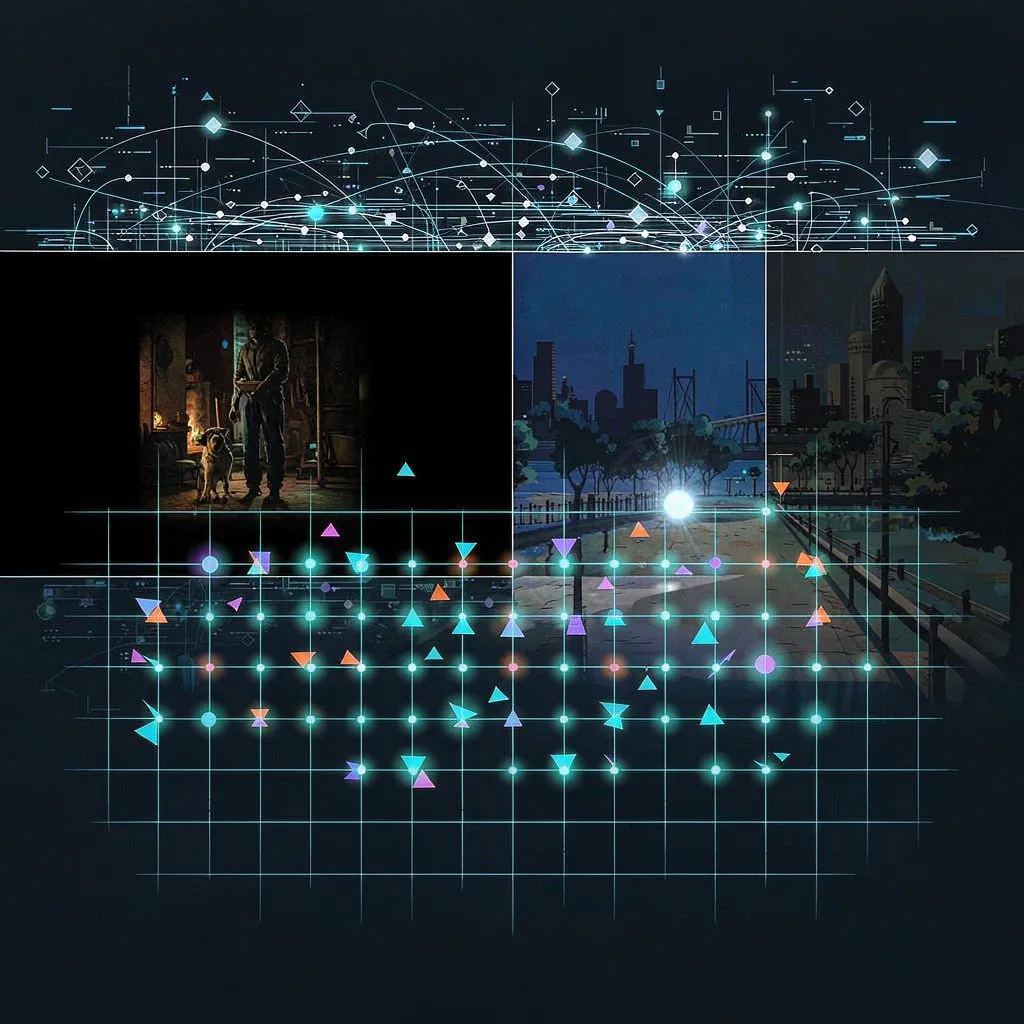
A research team has developed a method to give users precise, programmable control over the timing and sequence of events in AI-generated videos. This addresses a core frustration where models generate requested objects but fail to choreograph them correctly, turning a powerful creative tool into an unreliable one.
What problem does this research solve?
Current text-to-video models often misinterpret the temporal aspects of a prompt. According to the paper from researchers at the University of Pennsylvania and Toyota Technological Institute at Chicago, a prompt like "a cat enters, then a dog enters" might produce a video where both appear simultaneously or in the wrong order. The models capture visual concepts but struggle with their intended ordering, timing, and persistence—how long something stays on screen. The authors argue this limits the practical utility of video generation for storytelling, instruction, or any application requiring precise visual sequencing.
How does Temporal Specification Guidance (TSG) work?
The proposed solution, Temporal Specification Guidance (TSG), is a training-free framework applied during the video sampling process. Instead of relying solely on a natural language prompt, users can express requirements in a formal Temporal Logic—a mathematical language for describing how events unfold over time. TSG converts these logic-based specifications into executable objectives. During generation, it scores "traces of visual concept evidence"—essentially tracking when and how strongly concepts appear—using differentiable quantitative semantics. It then uses the gradient of this score to nudge the denoising process toward videos that satisfy the specified temporal rules, augmenting standard classifier-free guidance.
What were the results and technical advantages?
The researchers tested their method on a benchmark of 220 prompts spanning 11 categories of temporal constraints, such as ordered object entry and state transitions. Their instantiation of TSG, which uses video-text attention traces and efficient scores for Metric Temporal Logic, improved specification satisfaction accuracy over baseline methods by 9.5 to 20 percentage points across five different video generation models. A key technical advantage is that the framework requires neither an external concept classifier nor backpropagation through the video transformer, resulting in minimal memory overhead. The guidance is applied via gradient-derived attention biases during a standard forward pass.
What does this mean for creators and developers?
For developers, this research points toward a more structured, programmable interface for controlling generative AI, moving beyond the ambiguity of natural language. It demonstrates that formal logic can be integrated into the inference loop to enforce complex constraints. For creators, the eventual application of such techniques could mean the difference between generating a random sequence of images and directing a coherent scene. It unlocks the potential for more reliable animation of scripts, step-by-step tutorials, or narratives with specific plot beats, provided the underlying models can adopt similar guidance mechanisms.
How to explore this topic in Grafy
While Grafy's Creator app focuses on image and basic video generation, the direct application of temporal logic guidance is a specialized research technique not yet integrated into consumer platforms. However, the core topic—controlling AI to follow complex, multi-step instructions—is highly relevant to Grafy users. You can explore the original paper and its implications using the Reader app, which is designed for AI-assisted research over PDFs and academic papers. Upload the PDF to ask targeted questions about the methodology or results. Alternatively, use Grafy Chat to discuss the concept of temporal logic in AI with various models, or to brainstorm prompt engineering strategies that might approximate some temporal control in current video tools.
Frequently asked questions
What is Temporal Logic?
Temporal Logic is a formal system in logic and computer science for reasoning about propositions qualified in terms of time (e.g., "eventually," "always," "until"). In this research, it provides a precise, unambiguous language to specify requirements like "object A must appear before object B and remain visible for at least 16 frames."
Does TSG require retraining the video model?
No. A major feature of TSG is that it is a training-free, inference-time framework. It works by guiding the sampling process of an existing pre-trained text-to-video model, making it a potentially plug-and-play enhancement for various architectures without costly retraining.
When will this be available in consumer tools?
The paper is a research contribution, not a product announcement. Integrating such advanced control mechanisms into user-friendly interfaces like Grafy Creator would require significant engineering and likely depend on model providers adopting similar techniques. However, it sets a clear direction for the next generation of controllable video generation.
Source: arXiv AI — Temporal Specification Guidance for Text-to-Video Generation
More news

AI Lab Runs 10,000 Agents for 36+ Hours, Advancing Long-Running AI
Third Moment Research uses GPT-6 models to deploy thousands of AI agents that operate continuously for over 36 hours.

Higgsfield AI Video Generation Hits 10+ Minutes with GPT-6 Astra
Higgsfield's AI video generation now creates clips over 10 minutes long, powered by GPT-6 Astra, and introduces a path to voice-driven filmmaking with GPT-Live.

Gemini 4 Argon is now available for all developers, enterprises and researchers
Google has made its latest frontier AI model, Gemini 4 Argon, generally available via API.