Study Finds Motion Diffusion Models Show Physics Early, Not Hidden Inside
A new arXiv paper shows that text‑to‑motion diffusion models expose balance and flight information early in denoising.
 Source: Grafy Research Lab
What did the researchers investigate?
The paper Probing Physics in Motion Diffusion Models Against Their Own Estimate by Saeed Ghorbani (arXiv, 19 Nov 2026) asks whether kinematic text‑to‑motion diffusion models contain physical knowledge that is not reflected in their final output. Earlier work on video diffusion models suggested that internal activations can decode physical properties better than inputs or outputs, leading to the claim that such models “know more than they show.” Ghorbani’s study asks the same question for motion generators, where the physics of every intermediate estimate can be computed exactly.
How was the experiment constructed?
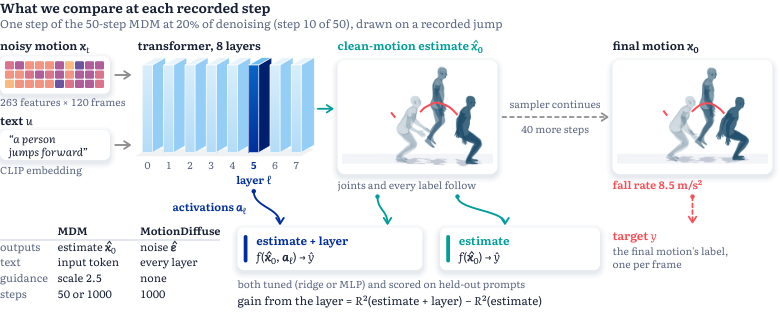
The author recorded every transformer layer during the sampling process of two widely used models – MDM (two checkpoints) and MotionDiffuse. For each model, thousands of complete denoising trajectories were captured: 6,000 motions from 250 prompts for MDM and 3,000 motions for MotionDiffuse. At each step the clean‑motion estimate (the model’s own prediction of the final pose) was stored, and physical labels such as dynamic balance, flight status, gravity during flight, and floating were computed from the joint positions. Linear probes were trained on three kinds of inputs: (1) the clean‑motion estimate alone, (2) the activations of a given layer, and (3) a combination of estimate plus layer. All readouts were tuned in the same way to ensure a fair comparison.
What did the results reveal about early physics readout?
The study found that physics is already readable early in the denoising process. About a fifth of the way through sampling, linear probes on the layers could predict dynamic balance with and flight with an AUC of 0.97 for the 50‑step MDM model. This early readability persisted across random seeds and held‑out prompts (see Figure 2). However, when the estimate itself was read out with the same level of tuning, the performance gap vanished. For balance and flight, adding a layer to the estimate improved by at most 0.01 – a difference that a positive control showed would be detectable if it existed.
Does the model actually hide physical knowledge?
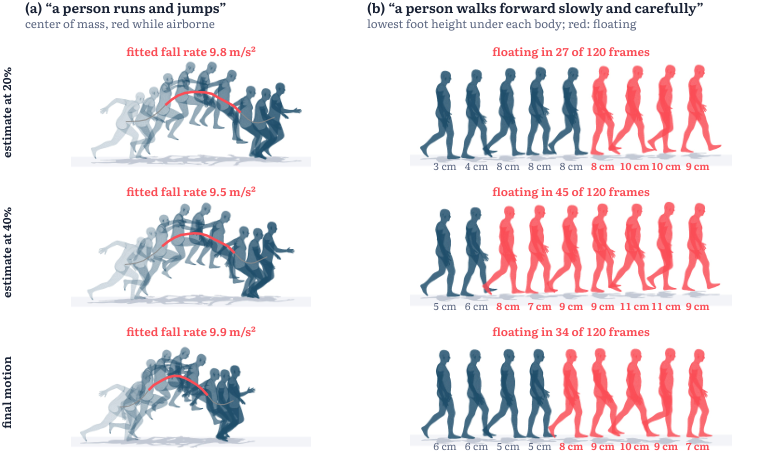
According to the paper, the apparent advantage of internal layers is a readout artifact. The clean‑motion estimate already encodes the same physical information; the gap observed in earlier studies stemmed from using less‑careful baselines for the estimate. The only robust exception was the fall rate of jumps in MDM. At 20 % denoising, probes on the layers added about 0.08 (up to 0.11 after refitting) to compared with the estimate alone, but this advantage faded as sampling progressed. MotionDiffuse showed a much smaller, non‑robust gain for the same metric.
Can the early physics signal be used to save compute?
Yes. The clean‑motion estimate at early steps can flag motions that will float – a failure mode where characters remain airborne for longer than 0.2 s with a fitted fall rate below 2 m/s². Detecting floating without any trained probe saves less than ten percent of total compute because floating occurs in only 9 % to 18 % of samples and tends to cluster in a few prompts. Aborting those samples early therefore yields modest but measurable efficiency gains (see Section 4.5 of the paper).
How does this relate to Grafy’s tools?
Researchers and creators can explore the paper directly with Grafy Reader (/reader), which lets you upload the PDF, ask natural‑language questions, and retrieve exact sections such as the probing methodology or the early‑warning experiments. Developers building custom motion generators can prototype linear probes on intermediate activations using Grafy Chat (/chat) to query multiple model back‑ends and compare readout performance without writing extensive code. While Grafy does not currently host a built‑in motion‑diffusion sandbox, the workflow described in the paper can be reproduced by exporting model checkpoints and feeding them through Grafy’s code environment.
What are the limitations and next steps?
The authors note several constraints. First, the study relies on kinematic models that output joint positions directly; physics‑based simulators were not examined. Second, the floating label had to be redefined during the study to avoid counting crawling as flight. Third, the advantage for jump fall rate was observed only on the larger 50‑step checkpoint and vanished on the 1000‑step version. Future work could extend the probing framework to physics‑aware generators, larger prompt sets, and more diverse physical attributes such as torque or muscle activation.
To explore this yourself, open Reader: read, search and question PDFs and papers with AI.
Frequently asked questions
Does the paper prove that motion diffusion models hide physics inside their latent space?
No. The research shows that the model’s own clean‑motion estimate already contains the physical information. The seeming gap between internal activations and the estimate disappears when both are read out with equally powerful probes.
Can the early‑warning technique be applied to any text‑to‑motion model?
The technique relies on having access to the clean‑motion estimate at each denoising step, which most diffusion‑based motion models provide. However, the effectiveness of early aborting depends on the prevalence of the failure mode (e.g., floating) and on how well a simple probe can detect it.
How can Grafy users experiment with the probing methodology described in the paper?
Users can upload the paper to Grafy Reader to locate the implementation details, then use Grafy Chat to run small‑scale experiments on their own models, testing linear probes on recorded layers and comparing them to the model’s estimate.
Source: Grafy Research Lab — Probing Physics in Motion Diffusion Models Against Their Own Estimate
More news
NVIDIA releases Nemotron-Labs-Sigma continuous diffusion models
NVIDIA has launched Nemotron-Labs-Sigma, a series of continuous diffusion language models that offer significantly faster decoding than standard models.

Frontier models can identify AI or human authors from single texts
Researchers have found that advanced AI models can accurately determine if a text was written by a human or an AI using only a single sample.

New DEO Method Fixes AI Retrieval Failures in Negation Queries
Researchers have introduced Direct Embedding Optimization (DEO) to solve how AI fails at exclusion queries. Learn how this training-free approach works.