Study Shows Reusing Old Vector Index Only Delays, Not Eliminates, Re‑encoding
A new Grafy Research Lab paper finds that reusing an existing embedding index merely postpones full re‑encoding.
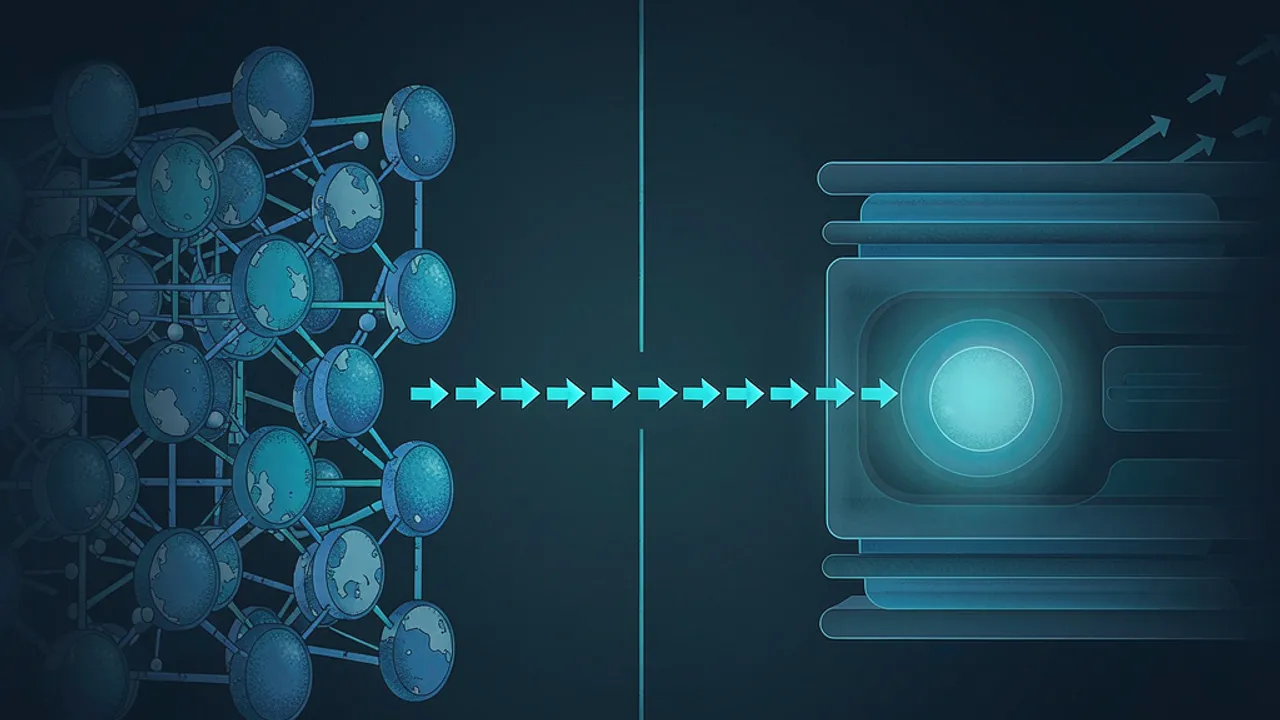 Source: Grafy Research Lab
Upgrading the embedding model that powers a vector index does not spare you from re‑encoding the entire corpus, according to a paper released by Grafy Research Lab on November 17, 2026. The finding matters for anyone who maintains large retrieval systems, because it clarifies the real cost and timing of model migrations.
What problem does the paper address?
Vector‑based retrieval systems store document embeddings in an index that is tightly coupled to the embedding model used at ingestion time. When a newer, often more capable model becomes available, practitioners face a choice: re‑encode every document with the new model—a costly operation—or try to reuse the existing index through techniques such as adapters or window‑based re‑ranking. The paper systematically evaluates these alternatives across a broad set of scenarios.
How was the evaluation conducted?
The authors experimented with sixteen model pairs covering both passage‑level and code corpora, and added eleven additional experiments on the Natural Questions (NQ) benchmark. For each pair they applied five different adapter configurations, including cross‑family bridges and same‑family LLM bridges, and measured both retrieval quality and the amount of re‑encoding performed over time. All experiments were run to completion, meaning the migration eventually had to support the full corpus.
What are the key findings?
- Reuse never avoids complete re‑encoding – The study shows that any migration strategy that must finish with the new model will, at some point, encode every document. Reusing the old index only shifts when the re‑encoding work occurs and can provide a temporary quality boost while the migration is in progress.
- Adapter evaluation must include the old model – When comparing adapters, the authors found that measuring performance solely against the new model gives a misleading picture. Only adapters that bridge models from the same family (e.g., LLM‑to‑LLM within the same architecture) consistently matched or exceeded the baseline set by the original model.
- Only same‑family LLM bridges proved reliable – Of the five adapter variants tested, the ones that connected models of the same underlying family—developed by Nannan Zhao, Jiameng Zhang, Taoyu Zhong, Hao Wang, and Bo Wang—delivered stable retrieval quality without excessive overhead. Cross‑family adapters lagged behind both the old and new models.
Why does re‑encoding remain unavoidable?
The index stores fixed‑dimensional vectors that are directly produced by the embedding model. When the model changes, the geometric properties of the vector space shift, breaking the assumptions that the index relies on for nearest‑neighbor search. Even sophisticated adapters that transform old vectors into the new space cannot guarantee perfect alignment for all documents, especially as the corpus grows. Consequently, a full re‑encoding step is required to restore the index’s optimal performance.
Practical implications for developers and researchers
- Plan migration windows – Since reuse only delays the work, schedule re‑encoding during low‑traffic periods to minimize impact on end‑users.
- Benchmark adapters against both models – When testing a new adapter, include the original model in the evaluation suite to detect regressions that would be hidden if you only compare against the target model.
- Prefer same‑family bridges – If you must use an adapter, choose one that connects models within the same architecture family, as these showed the most reliable results.
- Monitor quality during transition – Use a staged rollout where a portion of queries are served by the new embeddings while the rest continue to use the old index. This approach lets you observe quality changes in real time.
How to explore the study with Grafy tools
Grafy Reader lets you load the arXiv PDF, ask natural‑language questions about the methodology, and retrieve specific passages without leaving the workspace. Pair it with Grafy Chat to discuss the findings with a model of your choice, or to brainstorm migration strategies for your own retrieval pipelines. Both apps are accessible from the Grafy dashboard:
- Reader –
/reader - Chat –
/chat
By loading the paper into Reader, you can instantly search for the sections on adapter variants, compare the reported metrics, and export annotations to a Graph view for further analysis.
Source: Grafy Research Lab, “When the Bill Falls: Reusing the Old Index Defers, Never Avoids, Re‑encoding in Complete Embedding‑Model Migration,” arXiv abs/2611.20702 (2026‑11‑17).
More news

Local Agent Harnesses Scale From 0.75B to 4.7B, New Study Finds Mingbird Leads
A Grafy Research Lab paper maps five locally‑run agent harnesses across four open‑weight models, showing the Mingbird harness outperforms others at every size.

CARE Introduces Retrieval‑Aligned Semantic IDs for Generative Retrieval
Grafy Research Lab unveils CARE, a new SID tokenizer that quantizes in a retrieval‑aligned space.

New Study Maps Consistency, Completeness, and Repair in Agent Memory Reads
Grafy Research Lab released a paper on read boundaries in agent memory, showing how protection mechanisms affect recall consistency and performance for AI.