Typed-Centrality Grounding Boosts Deterministic Reasoning in Agentic GraphRAG
A new agent‑based GraphRAG framework adds a symbolic layer based on typed centrality.
 Source: Arxiv AI Recent
What is Typed-Centrality Grounding for Agentic GraphRAG?
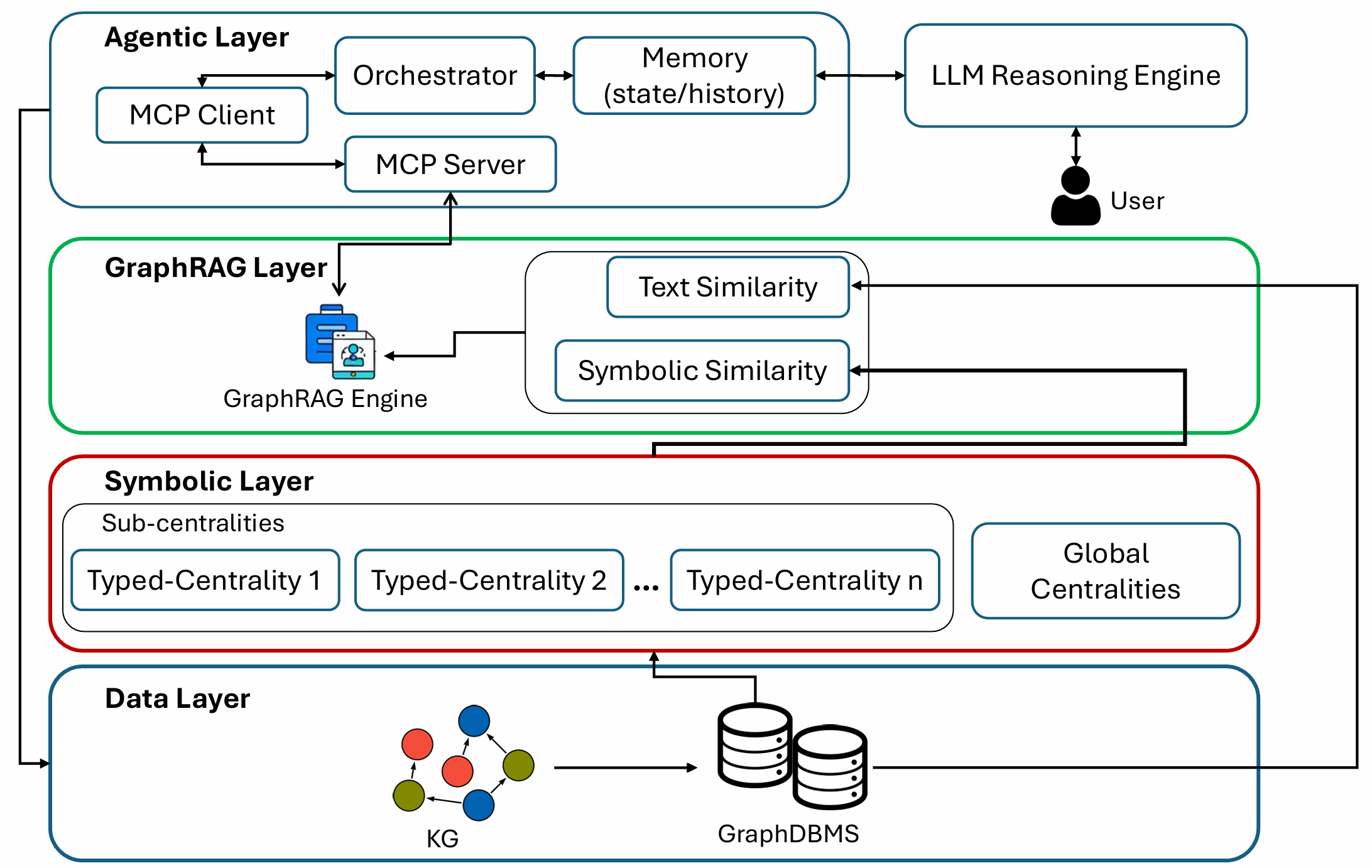
The paper Typed-Centrality Grounding for Agentic GraphRAG: A Symbolic Approach for Agentic Reasoning introduces a four‑layer architecture that augments traditional Graph Retrieval‑Augmented Generation (GraphRAG) with a deterministic symbolic layer. The system separates the knowledge graph into typed sub‑structures (Person, Object, Location, Event) and computes centrality measures—such as degree, betweenness, closeness, PageRank, and eigenvector—independently for each type. These typed centralities are then packaged as symbolic facts that accompany the textual context supplied to a large language model (LLM). By doing so, the LLM can draw on both probabilistic language patterns and graph‑theoretic signals when generating answers.
Figure 1 shows the hierarchical layout: a Data Layer stores the raw KG, the Symbolic Layer derives typed centralities, the GraphRAG Layer retrieves relevant nodes, and the Agentic Layer orchestrates reasoning steps.
How does the symbolic layer differ from existing GraphRAG approaches?
Current GraphRAG pipelines treat knowledge graphs as homogeneous collections of labels and rely almost exclusively on textual similarity between a user prompt and node attributes. This practice leaves the structural information of the graph under‑utilized, often resulting in hallucinations—plausible‑sounding but incorrect statements. The proposed symbolic layer flips that paradigm: instead of using the KG merely as a source of extra text, it supplies deterministic metrics that directly reflect the graph’s topology. Typed centralities act as a grounding anchor, ensuring that the LLM’s reasoning respects the relative importance of entities within each class. The authors argue that this dual‑source grounding reduces “ranking blindness” and improves answer explainability.
What centrality measures are used and why?
The framework evaluates five classic centrality metrics, each computed per type:
- Degree Centrality – captures local connectivity within a class.
- Betweenness Centrality – highlights nodes that bridge different parts of the typed sub‑graph.
- Closeness Centrality – measures how quickly information can spread from a node to others of the same type.
- PageRank – provides a global importance score that respects the directed nature of relationships.
- Eigenvector Centrality – emphasizes nodes connected to other high‑scoring nodes.
By calculating these metrics separately for Persons, Objects, Locations, and Events, the system preserves semantic nuances that would be lost in a monolithic graph analysis. For example, a high‑degree postcode node may indicate dense local activity, while a high‑betweenness crime node could signal a critical connector between otherwise unrelated incidents.
What were the experimental results on the POLE dataset?
The authors validated the architecture on the POLE (Person, Object, Location, Event) dataset, a real‑world collection that reflects heterogeneous entities and relationships. Two experiments were reported:
- Experiment 1 – Resolving Ranking Blindness – compared answer consistency when the symbolic layer was present versus absent. The inclusion of typed centralities led to responses that aligned more closely with the underlying graph semantics.
- Experiment 2 – Quantitative Signal Restoration – measured how well the system could recover the original centrality signal after retrieval. Figure 3 illustrates that typed PageRank restores signal magnitude far better than a global baseline, confirming the benefit of type‑aware calculations.
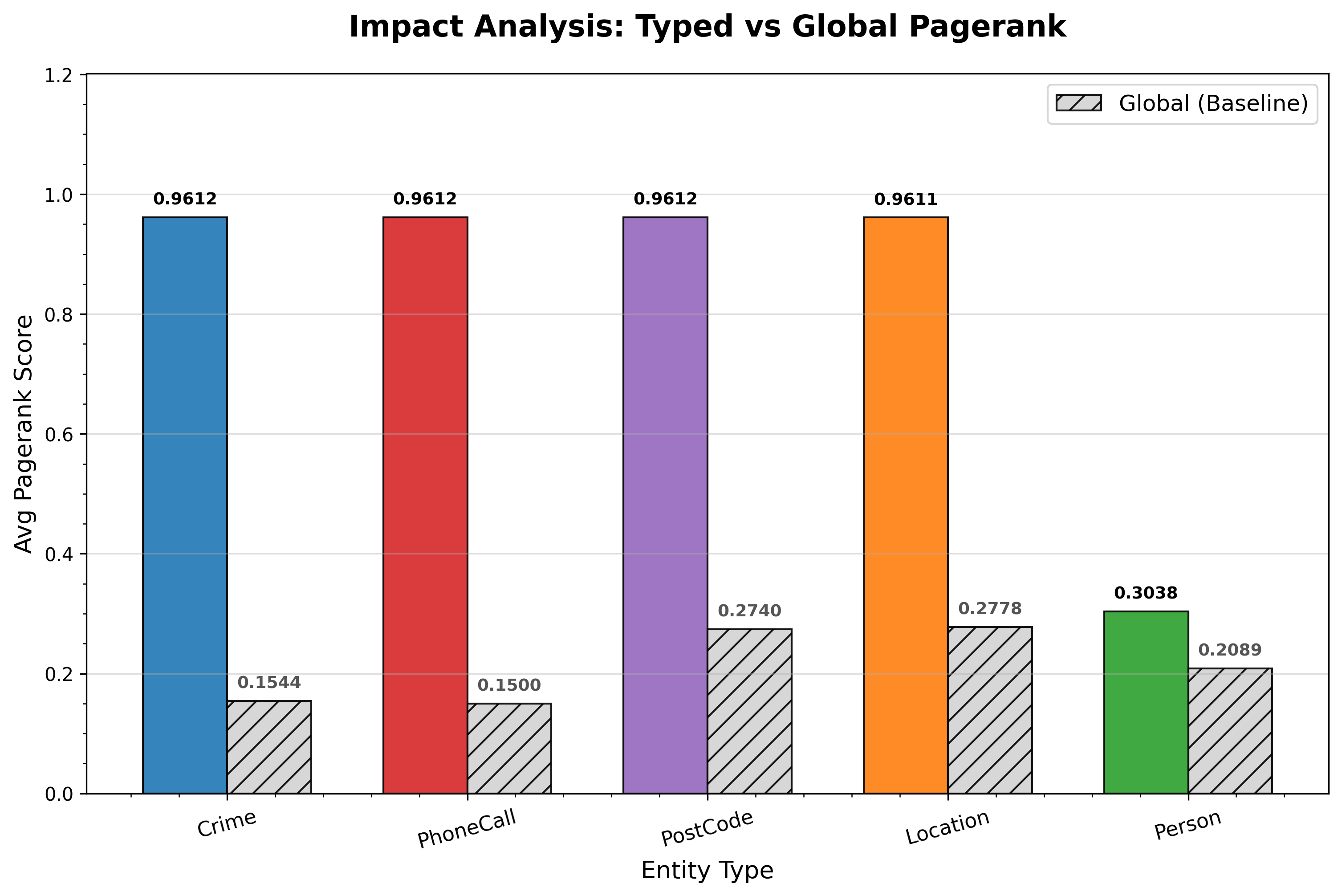
Across both experiments, the authors observed fewer hallucinations and higher explainability, though precise numeric improvements were not disclosed in the abstract.
How can Grafy users experiment with this approach?
Grafy does not yet ship a dedicated “typed‑centrality” module, but creators, developers, and researchers can explore the concepts using existing tools:
- Grafy Reader – upload the POLE dataset PDF and let the AI extract the schema, node types, and raw centrality values. This mirrors the paper’s Data Layer extraction step.
- Grafy Graph – construct a visual branching graph of prompts, retrieved KG snippets, and the symbolic centrality facts. By chaining these nodes, users can emulate the multi‑step reasoning flow of the Agentic Layer.
- Grafy Code – prototype a small Python script that computes degree, betweenness, and PageRank per node type using NetworkX. The resulting metrics can then be fed to a LLM via Grafy Chat for downstream generation.
These workflows let practitioners test deterministic grounding without waiting for a built‑in feature. As the community adopts the approach, we may see a future Grafy plugin that automates typed‑centrality extraction and injection into LLM prompts.
Frequently asked questions
Does the paper claim that typed centrality eliminates hallucinations entirely?
No. The authors report that the symbolic layer reduces hallucinations and improves answer consistency, but they do not claim complete elimination.
Are the centrality calculations performed on the whole graph or separately for each class?
The methodology computes each centrality metric separately for each KG class (Person, Object, Location, Event), producing type‑specific scores.
Can Grafy’s existing apps run the full Agentic GraphRAG pipeline out of the box?
Not yet. Grafy provides components (Reader, Graph, Code, Chat) that can be combined to prototype parts of the pipeline, but a turnkey GraphRAG system with a symbolic layer is not currently offered.
Source: arXiv, https://arxiv.org/abs/2611.09414
More news
Claude Code settings files leak thousands of secrets on GitHub
Security researchers discovered over 100,000 public Claude Code settings files on GitHub.

Meta unveils Muse Ember, a low‑cost AI model for agent workloads
Meta's Superintelligence Lab released Muse Ember, a lightweight model that handles tool calls.

ENGRAM framework lets AI agents consolidate experience into weights
A new ENGRAM framework separates when language‑model agents admit new skills from when they discard external memory.