World Models Tend to Favor Common Priors Over Visual Evidence
Researchers have identified that AI world models often ignore visual cues in favor of common training patterns. Discover how the RIFT method fixes this.
 Source: Grafy Research Lab
AI world models often struggle to adapt to new physical environments because they rely too heavily on patterns seen frequently during training. This tendency can cause models to ignore direct visual evidence of a unique physical rule in favor of a more common, "learned prior."
According to a study by Han Xiao, Zhiyong Bao, Xiaotong Liu, Yanhao Chen, and Qingqiang Wu, this behavior creates a significant hurdle for scalability in AI simulations. While training a unique model for every possible environment is impractical, current models often fail to generalize across different physical conditions. Even when a short video provides clear evidence of how an object is behaving—a process known as visual calibration—the model may default to the most frequent behavior it encountered during its training phase.
Why do world models ignore visual evidence?
In many physical scenarios, the visual appearance of an object does not reveal its underlying properties, such as mass or friction. For example, two identical-looking spheres might behave differently due to their internal density. To understand the environment, a model must observe how these objects interact, such as through a collision.
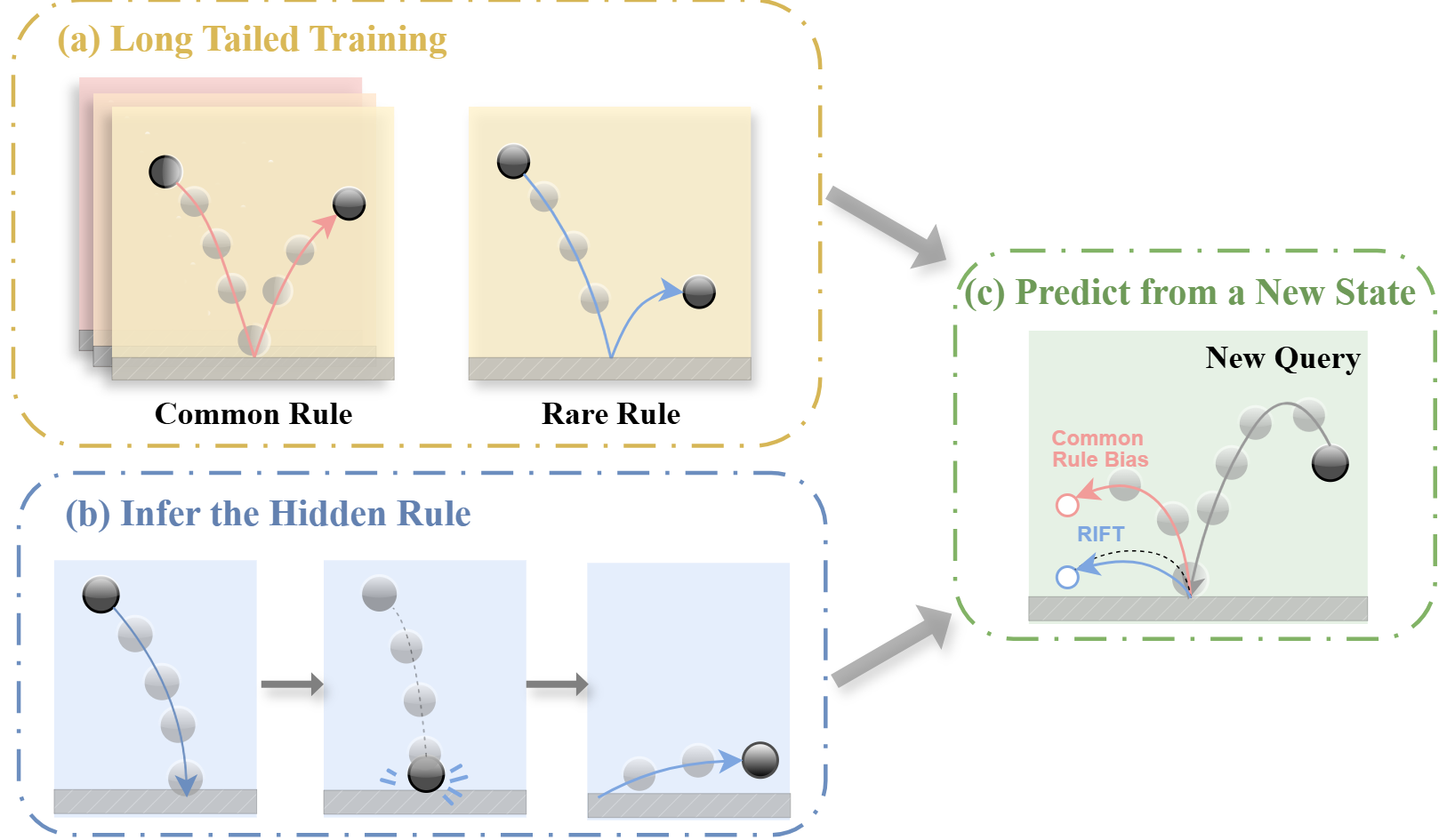
However, the authors note that training data is rarely distributed evenly. Some physical rules are common, while others are rare (the "long-tail"). When a model is trained on a long-tailed distribution, it develops a strong preference for the common rules. If a model is presented with a rare physical interaction, it may treat that evidence as an outlier or noise, choosing instead to predict motion based on the high-frequency patterns it learned previously. This results in a failure to accurately transfer rules from a demonstration to a new starting state.
What is the TailWorld benchmark?
To measure this bias, the researchers introduced TailWorld, a benchmark designed to evaluate how well models perform visual calibration under imbalanced conditions. TailWorld allows researchers to independently control two variables: how often a rule appears in training (imbalance) and how much information a short demonstration provides (informativeness).
Each task in the benchmark involves a calibration video where an object interacts with its environment, followed by a query where the model must predict future motion from a different initial state. To quantify bias, the benchmark provides two different "future" paths from the same starting point: one that follows the actual demonstrated rule and one that follows a common rule. By comparing the model's prediction against both, researchers can see if the model is being pulled toward the common alternative despite the evidence.
How does the RIFT method solve this?
To address these shortcomings, the authors proposed Rule Inference for Transfer (RIFT). This framework is designed to decouple the influence of training frequency from the actual observation of physical laws.
As shown in Figure 4, RIFT operates in several stages. First, it learns the relationship between different physical rules and how they affect object motion. Second, it uses the interactions observed in a calibration video to infer which specific rule is currently in effect. Finally, it applies that inferred rule to predict motion in a new scenario. Figure 1 illustrates how RIFT can successfully transfer a calibrated physical rule across different states, allowing the model to accurately predict rare dynamics that it might otherwise have ignored due to training imbalances.
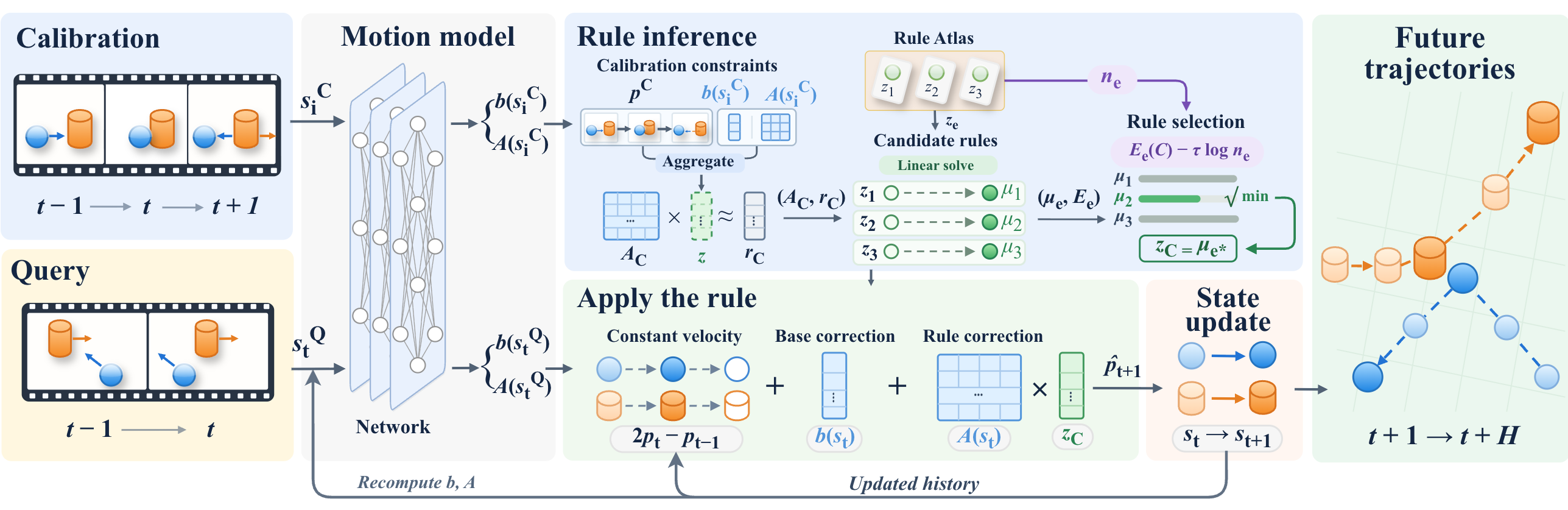
Crucially, RIFT explicitly controls how much training frequency influences the inference process. This ensures that when a demonstration provides sufficiently strong and informative evidence of a rare rule, the model is capable of overriding its learned preference for common dynamics.
What are the results of the research?
Experiments conducted on the TailWorld benchmark indicate that RIFT provides measurable improvements in both prediction accuracy and physical consistency. The method proved particularly effective at handling distribution shifts and predicting rare dynamics that standard models typically fail to capture. By allowing the model to focus on the specific evidence provided during the calibration phase, RIFT helps bridge the gap between general knowledge and specific, real-time environmental observations.
For researchers and developers working with complex simulations, this highlights a critical tension in AI development: the balance between robust general knowledge and the ability to remain sensitive to specific, localized evidence. As world models become more integrated into robotics and autonomous systems, solving this "preference bias" will be essential for safe and reliable interaction with the physical world.
If you are looking to dive deeper into the technical specifics of this paper or explore similar research in machine learning and physics-based AI, you can use Reader to search, summarize, and ask questions directly about the full PDF of the study.
Frequently asked questions
Why do world models favor learned priors?
World models favor learned priors because they are often trained on datasets where certain physical rules appear much more frequently than others. This creates a long-tailed distribution where the model develops a statistical preference for common behaviors, leading it to ignore unique visual evidence that contradicts those frequent patterns.
What is the purpose of the TailWorld benchmark?
TailWorld is a benchmark designed to test how well AI models can identify and apply rare physical rules from short video demonstrations. It specifically measures prediction bias by providing two different possible futures—one following the actual rule and one following a common rule—to see which one the model chooses.
How does RIFT improve prediction accuracy?
RIFT improves accuracy by learning how rules shape motion and then using calibration interactions to infer the current rule. It is designed to explicitly control the influence of training frequency, which prevents the model from defaulting to common rules when strong visual evidence for a rare rule is present.
Source: Grafy Research Lab — World Models Favor Learned Priors over Visual Evidence
More news

New Framework Proposes Edit-Based Training for LLM Reasoning
Researchers have proposed a new edit-based training framework to improve how large language models follow complex reasoning instructions.

AI Prediction Depth Correlates with Human Reading Time
Researchers have found that the layer depth at which a language model resolves a word predicts how long humans take to read it. Learn why this matters.

New CDP Algorithm Finds Flatter Minima in Optimization
Researchers have introduced Critically Damped Polyak stepsizes to bias gradient descent toward flatter minima, improving model generalization.