Compose a song note by note — then score your film with it
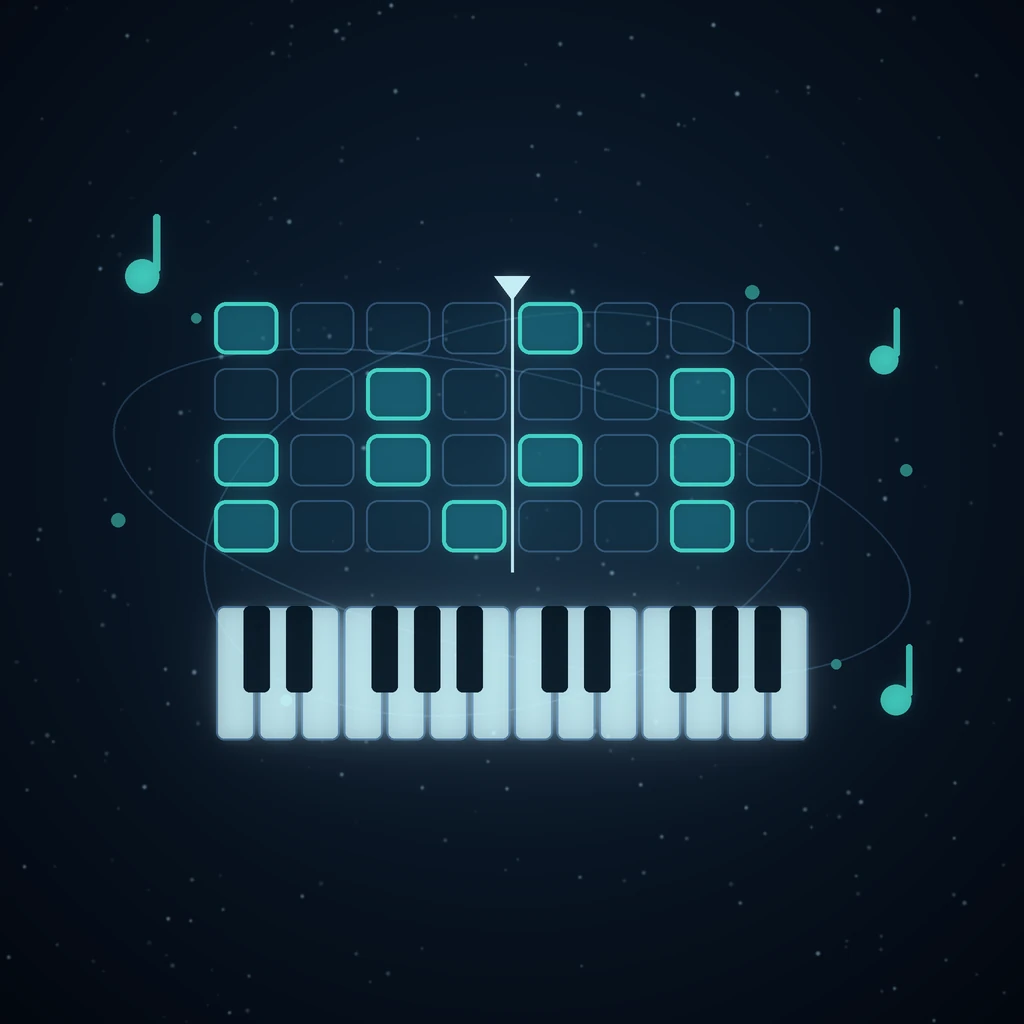
Text-to-music gives you thirty seconds of something. What it will not give you is a second verse, a key change, or a track that is four bars shorter because the edit moved. Music Studio starts from a brief like text-to-music does, but what it hands back is a document — patterns, an arrangement, a mixer — where every note is yours to move.
A brief, then a song that already plays
“Upbeat lo-fi hip hop in A minor, 90 BPM, about two minutes” is the whole input. The brief is parsed for the things that actually change the music — key, tempo, mood, length, instrumentation — and each one is shown back beside the control it filled, so you can see what was heard before anything is composed. What lands is not a preview: it is a complete starter song with drums, bass, chords and a lead, playing in the browser.
The model writes patterns, never code
An AI composer that emits code is an AI composer that emits broken code. Here the model writes pattern data — steps, notes, velocities, section order — against the studio's own schema, and every writer, model or human, goes through one normalize gate before the document is stored. A model that hallucinates a note outside the scale, a negative length or a section that does not exist gets corrected on the way in rather than crashing the page. When no model is available at all, a deterministic fallback composes from music theory instead, so the studio never sits there with nothing to play.
A real sequencer, a real mixer
The step sequencer is where you draw the pattern; the arrangement editor is where you decide the song has an intro, two verses, a bridge and an outro; the mixer is where each track gets its level, pan and reverb. Record a vocal or a guitar through your mic and it lands as another track. Nothing here waits on a model — editing a song is arithmetic, so it is instant and it is free.
Two roads to a score
A film or a game already had one way to get music: pick a mood and let text-to-music generate a bed. Now there is a second. From Film Studio or Game Studio you can commission a track — Music Studio opens with a starter song already shaped to the mood you chose and briefed with the project's own subject — edit it until it is right, then deliver it back. It drops into the same music step a generated bed would have, so the build inlines it and the assembler ducks it under narration identically.
Both directions are free: the starter composer and the offline render are pure arithmetic with no model involved. A short track loops up to a film's running time; a long one is trimmed to what the build can carry. The commission lives on the track's own document server-side, so a page save can neither forge a delivery target in another studio nor lose the one it was created with.
Export
Render the mix to a WAV offline — no upload, no queue — and it lands in your asset library like anything else you made here, ready for Video Edit, Social Studio or a question in the graph.
Why patterns beat waveforms
A generated audio file is finished the moment it exists. If the second verse is wrong, your options are to regenerate the whole thing and lose the first verse, or open a waveform editor and start cutting.
A pattern document has no such problem. The song is stored as steps, notes, velocities and a section order, so changing the second verse changes the second verse. Rendering is a separate, free step that happens whenever you want to hear it. That is the difference between a track you received and a track you own.
It also makes the AI genuinely useful rather than decorative. A model that writes pattern data is proposing something you can edit; a model that writes audio is presenting a fait accompli.
The normalize gate
Every writer to the document — the brief parser, the AI composer, the sequencer, you — goes through one normalization step before anything is stored. A note outside the scale, a negative length, a section that does not exist or a velocity beyond range is corrected on the way in.
This is why a hallucinating model cannot break the page. The studio does not trust its own AI any more than it trusts a malformed request, which is the only sane posture when a model is one of several writers to a shared document.
A worked example
“Melancholy lo-fi in D minor, 80 BPM, about ninety seconds, brushed drums.”
The brief parser fills tempo, key, mood, length and instrumentation, and shows each one beside the control it set — so you can see what was heard before anything is composed. What lands plays immediately: drums, bass, chords, a lead.
The lead is too busy. Open the sequencer, thin the pattern, and it is thinner — instantly, with no model call and no credits. The arrangement is intro-verse-chorus-verse-outro; drag the outro earlier and the song is eighty seconds instead of ninety. Drop the reverb on the lead in the mixer. Render to WAV.
Every one of those edits was arithmetic. None of them cost anything.
Frequently asked questions
Does composing or editing cost credits?
The starter composer and the offline WAV render are pure arithmetic with no model involved, so they are free. Only the AI composer — asking a model to write or rewrite pattern data — reaches a provider. Editing your song note by note never does, which is deliberate: iteration should not be metered.
What happens if no model is available?
A deterministic fallback composes from music theory instead, so the studio always has something to play. That is also why the brief parser is a separate, pure component: understanding “D minor, 80 BPM” does not require a model at all.
Can I record my own vocals or guitar?
Yes. Mic recording lands as another track alongside the generated ones and mixes like anything else — level, pan and reverb per track. The recording is part of the same document, so it is included in the offline render.
How does a song become a film's score?
From Film Studio or Game Studio you commission a track: Music Studio opens with a starter song already shaped to the mood you chose and briefed with the project's subject. When it is right, you deliver it back, and it drops into the same music step a generated bed would occupy — the build inlines it and the assembler ducks it under narration identically. A short track loops up to the running time; a long one is trimmed to what the build can carry.
Can I use a song I wrote here anywhere else?
The WAV render lands in your shared asset library like any other result, so Video Edit can cut to it, Social Studio can post it, and the canvas can question it. Nothing is locked to the studio that made it — see reproducible workflows for how provenance travels with it.
Open Music Studio and describe a song.
Read next
More from the Grafy blog.
Type the words, and an AI sings your song
Write or generate lyrics in Music Studio and a song model sings them into a finished track — with remixing, cover art, playlists and a community shelf.
Deep research from one link: a cited report on the graph
Give Grafy a question and one starting link. It crawls the pages that matter, writes a report that cites every claim by number, and files it as a node.
Two AI hosts, one topic: a podcast from your own notes
Grafy writes a two-host conversation on any topic, grounds it on the note you have selected, voices each host in its own preset and saves one audio node.