CrossEnv Introduces Scalable Cross‑Service Tasks for Long‑Horizon AI Agents
Researchers unveil CrossEnv, a framework that automatically builds verifiable tasks spanning multiple services.
 Source: Grafy Research Lab
CrossEnv introduces a systematic way to synthesize executable, verifiable tasks that require an AI agent to coordinate actions across multiple services. The ability to train agents on such cross‑environment workflows promises more realistic long‑horizon behavior while keeping the cost of data generation low.
What is CrossEnv and why does it matter?
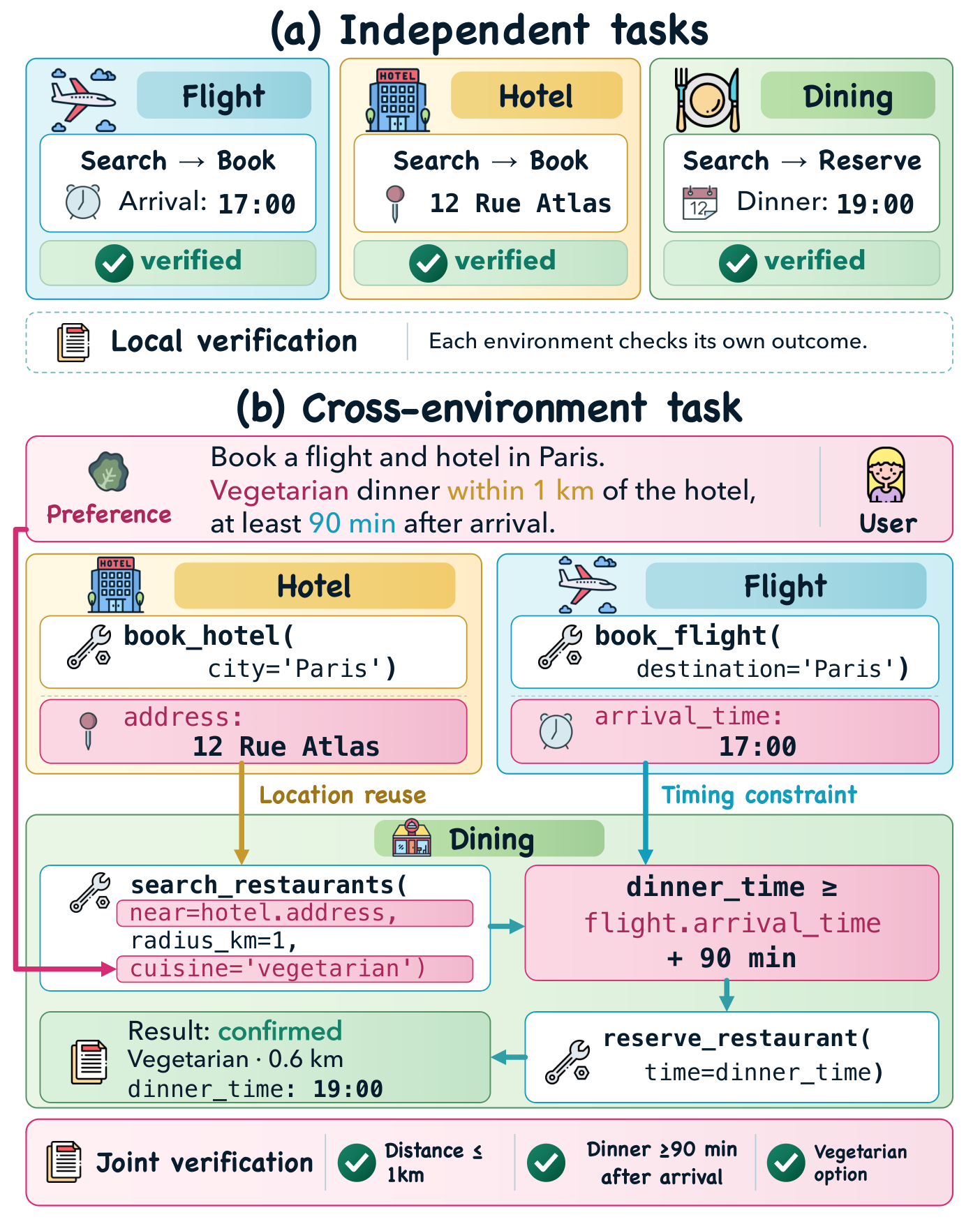
CrossEnv is a framework designed to generate synthetic training tasks that span several distinct environments, such as a flight‑booking API, a hotel‑reservation system, and a restaurant‑reservation service. According to the authors of the paper (Yu et al., 2026), existing synthesis methods typically create tasks confined to a single environment, which fails to capture real‑world workflows where information flows between services. By producing cross‑environment tasks that are both executable and verifiable, CrossEnv closes a gap that has limited the scalability of long‑horizon agent training.
How does CrossEnv generate cross‑environment tasks?
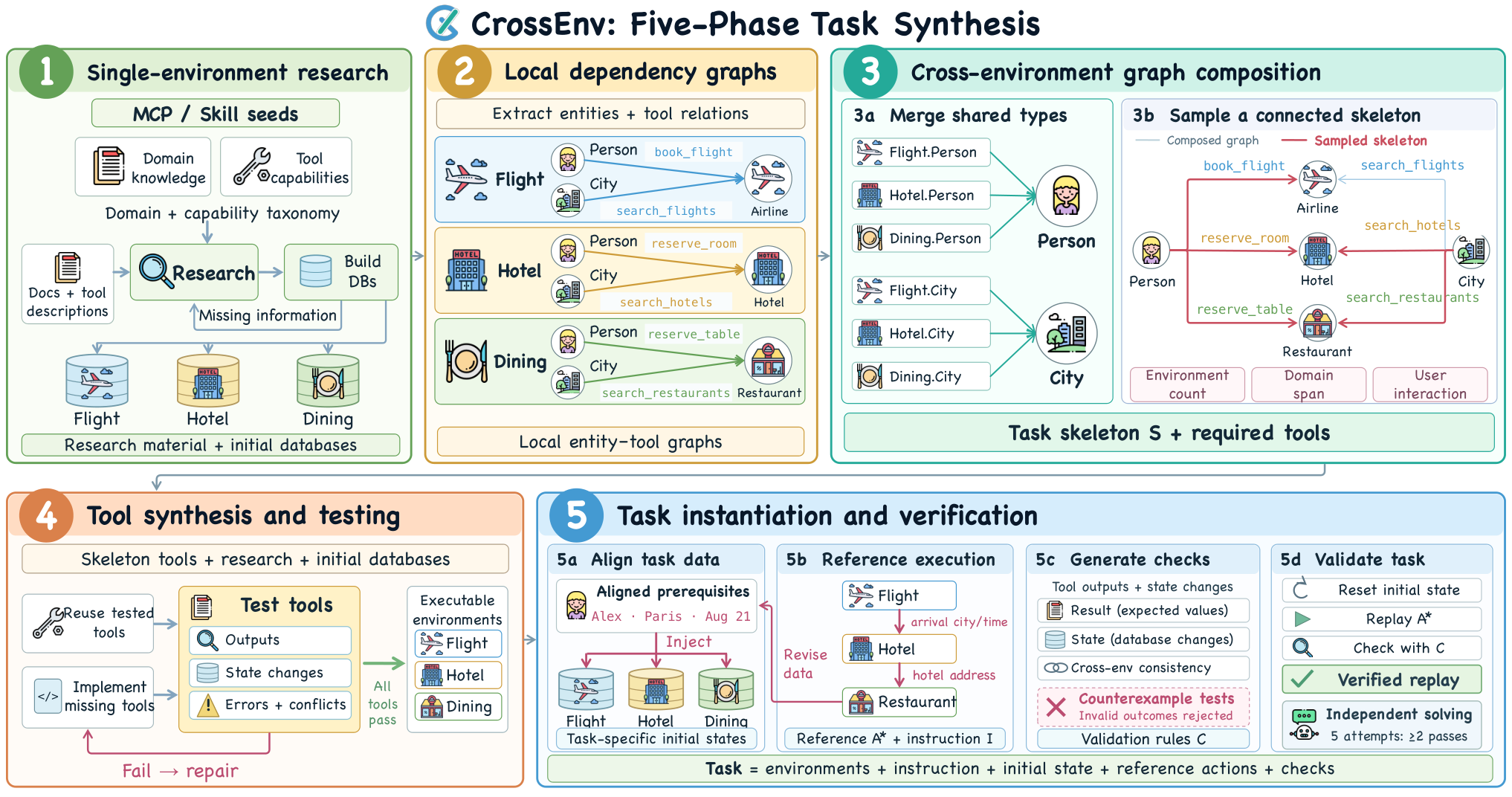
The core of CrossEnv is an entity–tool graph that maps shared entity types (e.g., flight arrival time, hotel location) to the tools available in each environment. The synthesis pipeline proceeds through five phases:
- Single‑Environment Research – collect independent environments and their tool specifications.
- Local Dependency Graphs – identify intra‑environment dependencies.
- Cross‑Environment Graph Composition – connect environments via shared entities, forming a multi‑service workflow skeleton.
- Tool Synthesis and Testing – generate the concrete tool calls and verify that they can be executed.
- Task Instantiation and Verification – align task‑specific data across environments, run a reference execution, and derive verification rules from the outcome. Figure 2 shows how the entity–tool graph guides the construction of a task skeleton, while Figure 1 contrasts independent single‑environment tasks with a coordinated cross‑environment travel‑planning example.
What is the CrossEnv‑Curriculum and how does it improve training?
CrossEnv‑Curriculum is a staged training regime that starts with simple single‑environment tool use and gradually introduces more complex coordination across services and domains. The curriculum follows three main stages:
- Supervised fine‑tuning on reference trajectories from single‑environment tasks.
- Stagewise reinforcement learning that expands the agent’s horizon to multi‑environment workflows within a single business domain, then across domains.
- User‑interaction integration where the agent must incorporate external preferences or constraints. The authors report that this curriculum enables agents to achieve competitive performance on four external benchmarks while requiring fewer training examples than baselines that train on mixed or single‑environment data alone.
How does CrossEnv perform compared to existing methods?
In the experimental section, the paper compares CrossEnv‑generated tasks against prior synthesis approaches such as ToolLLM, Toucan, Simia, and programmatic environments like ScaleEnv and Skill2Env. Across the four benchmarks, agents trained with the CrossEnv‑Curriculum matched or exceeded the performance of agents trained on single‑environment data, despite using a smaller dataset. Additional analyses demonstrated better generalisation to unseen environment combinations, longer workflows, and tasks that were less similar to the training distribution.
How can creators and researchers explore CrossEnv concepts with Grafy?
While Grafy does not yet host a built‑in CrossEnv engine, the Reader app lets you upload the arXiv PDF and interactively query the methodology, reproducing the entity–tool graph steps in your own sandbox. You can also use Code to prototype the five‑phase pipeline, leveraging Grafy’s multi‑model support to generate tool specifications, align data, and run verification checks. For visualising the workflow, the Graph app can map the entity–tool connections, mirroring Figure 2’s layout. These tools let you experiment with cross‑environment task design without building a full‑scale environment suite.
Source: https://arxiv.org/abs/2611.22777
Frequently asked questions
How does CrossEnv ensure data consistency across different services?
CrossEnv aligns task‑specific records by using the shared entity types identified in the entity–tool graph. During the Task Instantiation phase, it forces the same entity (e.g., a hotel address) to have a single canonical representation across all participating environments, then validates the alignment through reference execution and verification rules.
What kinds of verification does CrossEnv provide for the synthesized tasks?
Verification is derived automatically from the task objective and the reference execution trace. The framework generates programmatic checks that confirm each tool call succeeded and that cross‑environment constraints (e.g., the restaurant reservation time matches the flight arrival time) hold true.
Can the CrossEnv‑Curriculum be applied to domains outside travel planning?
Yes. The curriculum is domain‑agnostic; it only requires a set of environments that share entity types. By defining new entity–tool graphs for other sectors—such as e‑commerce order fulfillment or multi‑step data pipelines—researchers can follow the same staged training approach to teach agents coordinated multi‑service behavior.
More news

Movie2Game-Bench Introduces a Holistic Metric for Turning Films into Playable Games
A new benchmark, Movie2Game-Bench, evaluates film‑to‑game adaptations beyond basic playability.
RSI‑Prime Dataset Enables LLMs to Train Other Models
A new arXiv dataset, RSI‑Prime, provides 350 full training trajectories to teach large language models how to conduct model‑training.

LoopCache speeds up long‑context decoding in Looped Transformers
Researchers introduce LoopCache, a technique that removes stale speculation in looped transformers and cuts compute for long‑context generation.