DeltaVisionX Demonstrates Low‑Cost Vision‑Guided Automation with YOLOv11 and PLC Actuation
Researchers unveiled DeltaVisionX, a budget‑friendly system that couples YOLOv11 detection with a Delta PLC to sort items on a conveyor.
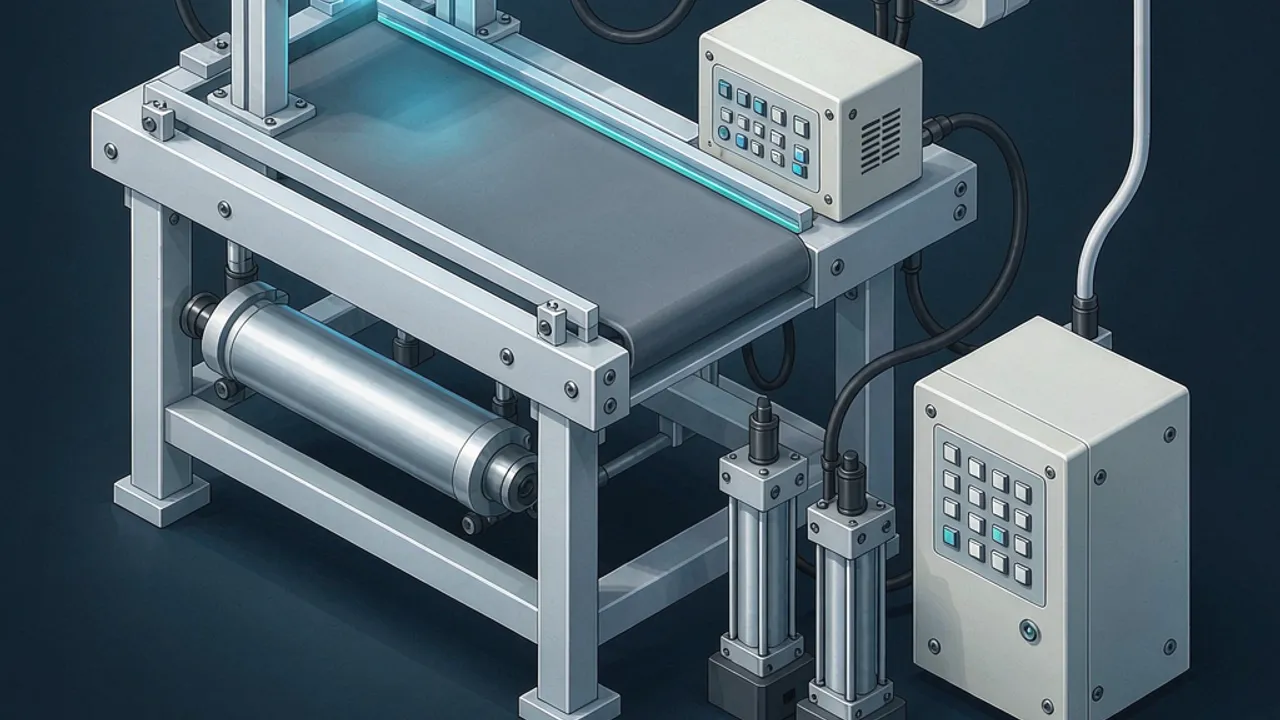 Source: Grafy Research Lab
DeltaVisionX, a new prototype presented at the 2026 International Conference on Mechatronics and Robotics Engineering, combines a state‑of‑the‑art YOLOv11 detector with a Delta DVP‑SE programmable logic controller (PLC) to sort objects on a moving belt. The authors claim the approach delivers industrial‑grade performance while keeping component costs low, a point that matters to small‑scale manufacturers and hobbyist makers alike.
What is DeltaVisionX and how does it operate?
DeltaVisionX is built around three core elements: a vision subsystem, a communication bridge, and an actuation layer. A camera mounted above an operating conveyor captures images at line speed. Those frames are fed to a YOLOv11 model, which outputs class labels and bounding boxes for each visible item. The detection results travel over a network connection to a Delta DVP‑SE PLC. Based on the received class, the PLC triggers pneumatic pistons that divert the object into the appropriate bin. An encoder attached to the belt provides position feedback, ensuring that the timing of the actuation matches the object's location.
Why was YOLOv11 chosen for the vision task?
YOLOv11 belongs to the "You Only Look Once" family, known for balancing accuracy and inference speed. In the paper, the authors trained YOLOv11 on a custom‑collected dataset that they labeled and augmented themselves. The trained model reached a mean average precision (mAP) of 0.97 and could process each frame in roughly 100 ms, which the authors describe as real‑time for a conveyor moving at the tested speed. The high mAP indicates reliable classification, while the sub‑second latency keeps the overall system responsive enough for the reported throughput.
Which hardware components make up the system?
The physical stack consists of a standard industrial camera, a modest‑power edge compute device (the paper does not specify the exact processor, but it runs the YOLOv11 model at the stated speed), a Delta DVP‑SE PLC, and a set of pneumatic pistons for sorting. An incremental encoder is mounted on the belt to track movement and synchronize detection with actuation. The PLC communicates with the vision node via a simple protocol that conveys object IDs and positions; the PLC then issues digital outputs to control the pistons.
What performance results did the authors report?
Testing on a prototype line, the system achieved a sorting throughput of about 80 objects per minute. The authors attribute this rate to the combination of fast inference (100 ms per frame) and reliable encoder‑based tracking, which together keep the latency between detection and actuation low enough to handle the observed item density. The high mAP of 0.97 suggests that mis‑classifications were rare, contributing to the overall efficiency.
How can creators and developers experiment with a similar setup using Grafy?
While Grafy does not host a dedicated PLC simulation, the Grafy Code app allows users to prototype the communication logic that would bridge a vision model and an actuator controller. Developers can import a YOLOv11 model via OpenRouter or Replicate, run inference on sample images, and then write Python scripts that emulate PLC commands—sending JSON payloads that represent detection results. Those scripts can be visualized in the Grafy Graph app to track prompt‑to‑output flows, mirroring the encoder‑synchronized pipeline described in the paper. For those who simply want to read the full research, the Grafy Reader app offers PDF upload, keyword search, and question‑answering over the document. Links to these tools are provided below.
What are the next steps and open challenges?
The authors note that the novelty of DeltaVisionX lies in the tight integration of vision and PLC rather than in the detection algorithm itself. Future work will explore adding a high‑speed Delta robot controlled via EtherCAT, which would enable more complex pick‑and‑place tasks beyond binary sorting. Open challenges include scaling the system to higher object rates, handling occlusions on the belt, and providing a more generic software stack that can be reused across different PLC brands.
Explore the paper with Grafy: Upload the PDF to Grafy Reader to ask questions directly to the model, or use Grafy Code to prototype the detection‑to‑actuation workflow described above. For visualizing the sequence of prompts and model outputs, try the Grafy Graph app.
Frequently asked questions
How accurate is the YOLOv11 model used in DeltaVisionX?
According to the authors, the model achieved a mean average precision of 0.97 on their custom dataset, indicating that it correctly identified and localized objects in the vast majority of test frames.
What is the reported latency for each image processed by the system?
The paper states that inference takes about 100 ms per frame, which the researchers consider sufficient for real‑time operation on a conveyor moving at the tested speed.
Can the DeltaVisionX architecture be adapted to other types of actuators?
Yes. The core idea is to send detection results from the vision module to a controller that can drive any actuator—pneumatic pistons, electric grippers, or robotic arms—provided the controller can receive the same data format and execute timely commands.
More news

Local Agent Harnesses Scale From 0.75B to 4.7B, New Study Finds Mingbird Leads
A Grafy Research Lab paper maps five locally‑run agent harnesses across four open‑weight models, showing the Mingbird harness outperforms others at every size.

CARE Introduces Retrieval‑Aligned Semantic IDs for Generative Retrieval
Grafy Research Lab unveils CARE, a new SID tokenizer that quantizes in a retrieval‑aligned space.
Study Shows Reusing Old Vector Index Only Delays, Not Eliminates, Re‑encoding
A new Grafy Research Lab paper finds that reusing an existing embedding index merely postpones full re‑encoding.