Full-Ledger Counterfactual Audit Shows How Much Extra Compute Repairs Wrong Answers
A new audit method (FLCVA) measures the true value of continuing reasoning versus answering immediately.
 Source: Grafy Research Lab
A new audit method called the Full‑Ledger Counterfactual Value Audit (FLCVA) quantifies how much additional compute can actually repair a wrong answer, and it matters because developers have long relied on confidence signals that do not guarantee improvement.
The study, authored by Xiaopeng Chu, Wenzheng Kong, Wei Liu, and Wenyi Zhang, finds that a random 256‑token continuation fixes a wrong answer in 26.6% of Qwen3‑8B cases and 18.9% of DeepSeek‑R1‑Distill‑Qwen‑7B cases, while only damaging a correct answer in about 1.5% of instances.
What is the Full‑Ledger Counterfactual Value Audit?
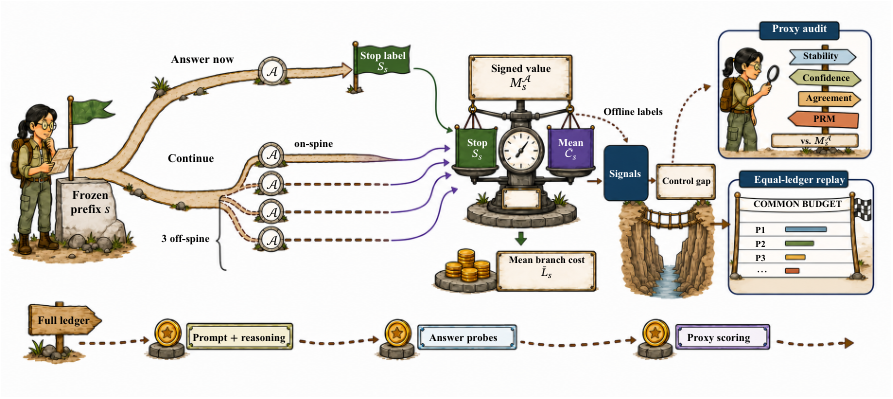
FLCVA is a measurement protocol that compares two actions taken from the exact same frozen prefix of a model’s reasoning trace: (1) answering immediately and (2) continuing the reasoning for a fixed length (256 tokens in the paper). For each action the authors apply a single answer extraction procedure and grade the result offline on standard math benchmarks (GSM8K and MATH‑500). The signed change in correctness divided by the cost of the additional tokens defines a local continuation value.
Figure 1 shows the protocol: a prompt generates a prefix, then three independently sampled continuations of the same length are evaluated alongside the “stop‑now” answer. All signals that a policy might observe—such as confidence, agreement, or entropy—are charged so that any real‑time controller can be compared fairly against the offline gold labels.
Why do current confidence signals fall short?
Existing adaptive‑reasoning systems often use signals that predict whether the current answer is wrong. As the authors note, “predicting that the current answer is wrong does not establish whether further reasoning will improve it.” Figure 2 illustrates two prefixes with identical current‑error probabilities but different probabilities of recovery when continued. In such cases a policy that only halts on high error would miss opportunities where a cheap continuation could restore correctness, or it might waste compute on prefixes where continuation is unlikely to help.
How much does extra reasoning actually help?
On the GSM8K benchmark, a random 256‑token continuation:
- Fixed the answer in 26.6% of Qwen3‑8B wrong cases.
- Fixed the answer in 18.9% of DeepSeek‑R1‑Distill‑Qwen‑7B wrong cases.
Conversely, it damaged a correct answer in only 1.4% (Qwen3‑8B) and 1.9% (DeepSeek) of cases. The authors also replicated the experiment on a Llama‑8B model, observing similar repair rates, which suggests the phenomenon is not model‑specific.
Can we predict which continuations will be valuable?
The paper evaluates a suite of observable proxies—confidence, token entropy, agreement among sampled continuations, and a public Process‑Reliability‑Metric (PRM). All proxies contain information about the future correctness of a continuation, but the tested lightweight, myopic controllers primarily learn to recognize when the current answer is already wrong. In offline replay, using the continuation‑correctness labels to allocate compute improves DeepSeek’s accuracy, while the gain for Qwen3 remains inconclusive. This indicates that while signals can guide allocation, most of the benefit comes from a simple “continue when currently wrong” heuristic.
How does the audit inform practical compute budgeting?
FLCVA separates three stages:
- Measurement – quantifying signed continuation value per token.
- Prediction – training a policy to estimate that value from cheap signals.
- Allocation – deciding, under a shared compute budget, whether to halt or continue.
The authors show that accounting for the cost of every observed signal is essential; a policy that spends too much on expensive signals may lose the net benefit of continuation. For developers building adaptive pipelines, the audit suggests a two‑step approach: first, use a cheap error detector (e.g., confidence < 0.7) to trigger a short continuation, then optionally invoke a richer signal set if budget permits.
How can Grafy users explore these ideas?
Grafy’s Reader app lets you upload the full paper PDF and ask follow‑up questions about the methodology, reproducing the audit on your own data. For a hands‑on experiment, you can use Graph to construct a branching prompt tree: start with a math question, generate a base answer, then branch into multiple 256‑token continuations and compare outcomes. This mirrors the FLCVA protocol and lets you see, in real time, how often extra tokens repair errors for the model you select via Chat.
If you prefer a quick test, open Chat, select the Qwen3‑8B or DeepSeek model (available through OpenRouter), and ask a GSM8K‑style problem. Then, without resetting the conversation, request a 256‑token continuation and see whether the answer improves. Remember to record the token usage so you can approximate the cost accounting described in the paper.
What are the limitations and future directions?
The authors acknowledge several constraints:
- The audit uses a fixed continuation length; longer or adaptive lengths may yield different repair rates.
- Only one answer extraction procedure is examined; alternative parsers could change the measured value.
- The study focuses on math benchmarks; domains like commonsense QA or code generation may exhibit different continuation dynamics.
Future work could integrate FLCVA with more sophisticated controllers that predict specific recovery probabilities rather than a binary “wrong‑now” signal. Combining the audit with reinforcement‑learning‑based policies may also close the gap between offline diagnostics and deployed performance.
Frequently asked questions
How does FLCVA differ from existing adaptive‑reasoning methods?
FLCVA treats the decision to continue as a counterfactual comparison against an immediate answer, measuring the actual change in correctness per token and charging the cost of every observed signal. Most prior methods only estimate current error probability and do not account for the value of a specific continuation.
Can I use FLCVA with models other than Qwen3‑8B and DeepSeek?
The paper includes a replication on Llama‑8B and reports similar repair patterns, suggesting the approach is model‑agnostic. You can apply the same protocol to any model accessible through Grafy Chat by logging the prefix, generating continuations, and grading results offline.
Does the audit guarantee that a continuation will always improve a wrong answer?
No. The audit reports average repair rates (≈27% for Qwen3‑8B) and also notes a small chance of damaging a correct answer (≈1.5%). Allocation policies must weigh these probabilities against compute costs and the specific tolerance for error in your application.
Source: Grafy Research Lab — A Full-Ledger Counterfactual Audit of Adaptive Reasoning
More news

Movie2Game-Bench Introduces a Holistic Metric for Turning Films into Playable Games
A new benchmark, Movie2Game-Bench, evaluates film‑to‑game adaptations beyond basic playability.

RSI‑Prime Dataset Enables LLMs to Train Other Models
A new arXiv dataset, RSI‑Prime, provides 350 full training trajectories to teach large language models how to conduct model‑training.

LoopCache speeds up long‑context decoding in Looped Transformers
Researchers introduce LoopCache, a technique that removes stale speculation in looped transformers and cuts compute for long‑context generation.