Generative Design Merges Inverse Modeling and Real‑Time Physics Surrogates
Researchers combine invertible neural networks with physics‑based surrogates to create an explainable.
 Source: Grafy Research Lab
Generative design researchers have announced a new framework that unites invertible neural networks (INN) for inverse engineering with real‑time physics surrogates, promising instant feedback on how a proposed geometry behaves. The approach, detailed in a pre‑print posted to arXiv on 12 Nov 2026, aims to make AI‑driven product definition both explainable and trustworthy for mechanical engineers.
What does the new framework combine?
The authors propose a two‑stage pipeline. First, a Diagonal Flow Matching (Diag‑CFM) model, a variant of continuous‑time INN, translates customer‑level performance targets (e.g., lift and drag) into feasible design parameters. Second, a learned surrogate—either a conditional GAN or the Transformer‑based neural operator called Transolver—predicts the full physical field (velocity, pressure, etc.) of the generated design in real time. By visualising the surrogate’s output alongside the design, engineers can see why a geometry meets the requested specifications. Figure 1 illustrates the overall workflow, showing the flow from label conditions through Diag‑CFM to a learned physics model.
How do invertible neural networks enable inverse design?
Traditional inverse problems require solving a forward simulation many times, which is computationally expensive. INNs, originally introduced as normalising flows for image generation, are bijective: they map design parameters to performance labels and can be run in reverse to retrieve from a desired . The missing degrees of freedom in label space are filled with stochastic noise, allowing the model to sample multiple viable designs for the same performance target. Diag‑CFM improves on earlier flow‑matching techniques by aligning the conditional and diagonal components of the flow, yielding higher fidelity in the inverse mapping. According to the paper, this method has already been applied to airfoil, vehicle, and gas‑turbine combustor design.
What role do real‑time physics surrogates play?
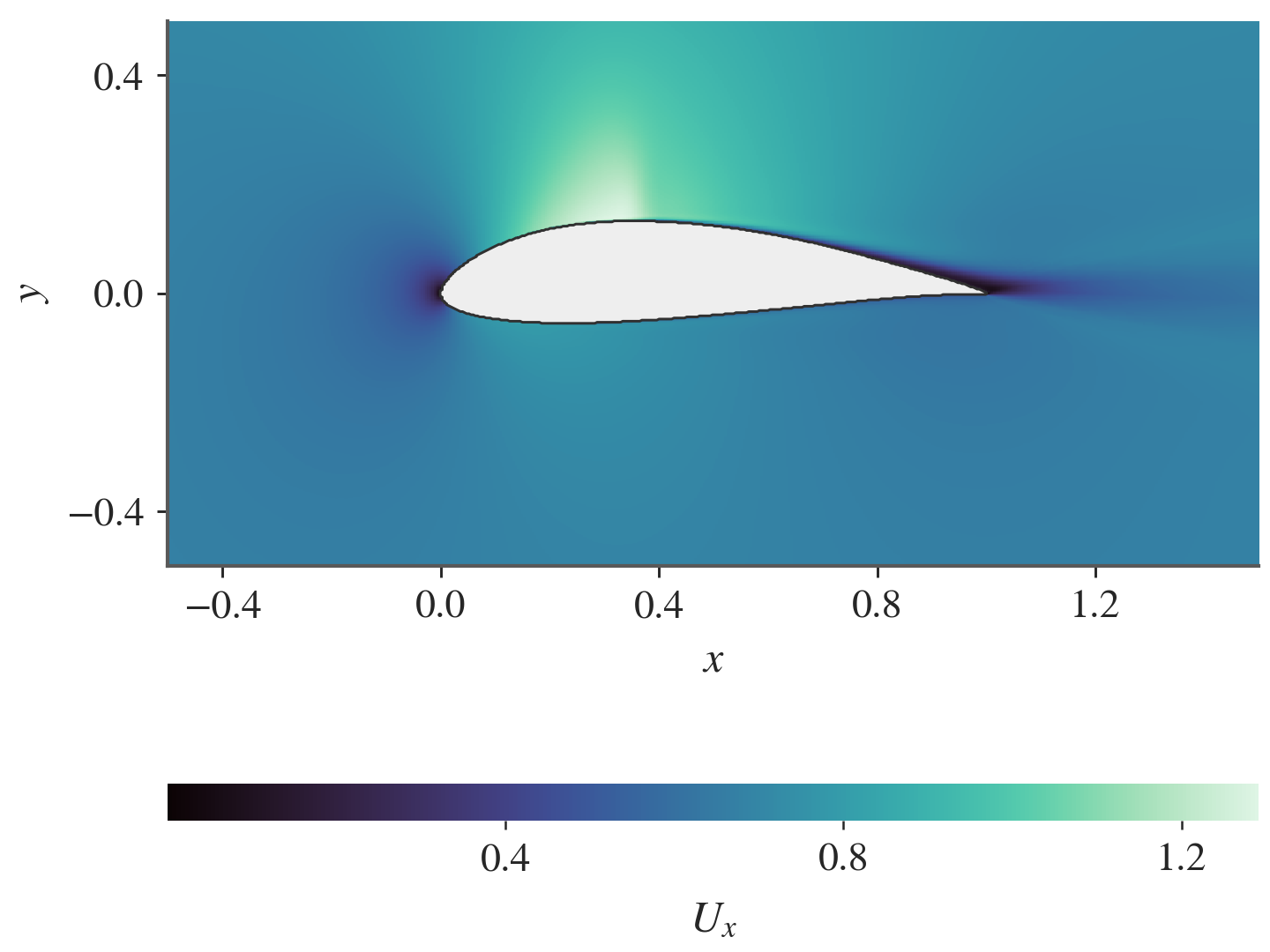
While INNs generate candidate geometries, engineers still need to validate that those shapes behave as expected under fluid or structural loads. The paper demonstrates two surrogate families. The conditional GAN learns to reconstruct full‑field data (e.g., pressure maps) from a design encoding, whereas Transolver, a neural operator, directly maps boundary conditions and geometry to field solutions. Both surrogates run on a single consumer‑grade GPU and produce predictions within milliseconds, enabling interactive visualisation. Figure 4 compares an ADflow CFD reference solution for a held‑out airfoil at , , with a Transolver prediction and shows the absolute error, confirming that the surrogate can capture the flow field with acceptable accuracy for design exploration.
How is uncertainty quantification (UQ) integrated?
Generative AI models can hallucinate physically impossible configurations, such as an airfoil with negative drag. To guard against such failures, the authors embed UQ mechanisms that estimate the confidence of each generated design and its surrogate prediction. When the model detects a request outside the learned data manifold, it either abstains or flags the output for human review. This safety net is essential for high‑stakes engineering where downstream CFD or structural analysis incurs significant cost.
How does the framework handle validation?
Even with fast surrogates, final products must pass conventional high‑fidelity simulation or experimental testing. The proposed workflow includes a validation step where the selected design is fed into a traditional CFD or combustion solver. The resulting data can also be fed back into the training set, creating a loop that continuously enriches the surrogate’s knowledge base. This closed‑loop strategy aligns with the authors’ view that generative design should be data‑driven yet respect the rigor of classical engineering practice.
How can creators experiment with these ideas in Grafy?
Grafy does not yet host a turnkey version of Diag‑CFM or Transolver, but the research can be explored using existing tools. The Reader app lets you upload the arXiv PDF and ask follow‑up questions to extract details about model architecture or training data. For hands‑on prototyping, the Code studio can run open‑source implementations of INNs and neural operators on Grafy’s GPU backend. You could also use Graph to build a branching workflow that links a prompt for generating an airfoil shape (via a generative model) to a Python script that calls a pre‑trained surrogate for instant flow visualisation. Finally, the Chat interface can help you compare model cards, troubleshoot training scripts, or brainstorm constraint‑handling strategies, all without leaving the Grafy environment.
Frequently asked questions
Does Diagonal Flow Matching replace traditional CFD in the design loop?
No. Diag‑CFM produces candidate geometries based on performance targets, but the physical behaviour of those candidates is still approximated by a surrogate. High‑fidelity CFD is reserved for final validation.
Can the generative surrogates predict fields for completely new geometries?
The surrogates are trained on a bounded design space; they extrapolate poorly outside that range. Uncertainty quantification flags such out‑of‑distribution cases, prompting the user to either refine the dataset or fall back to a full simulation.
Is it possible to use Grafy’s existing apps to run the full framework without custom code?
Grafy provides the building blocks—Reader for paper analysis, Code for model execution, Graph for workflow orchestration, and Chat for support—but a complete end‑to‑end implementation still requires custom scripting and model integration.
More news

Local Agent Harnesses Scale From 0.75B to 4.7B, New Study Finds Mingbird Leads
A Grafy Research Lab paper maps five locally‑run agent harnesses across four open‑weight models, showing the Mingbird harness outperforms others at every size.

CARE Introduces Retrieval‑Aligned Semantic IDs for Generative Retrieval
Grafy Research Lab unveils CARE, a new SID tokenizer that quantizes in a retrieval‑aligned space.
Study Shows Reusing Old Vector Index Only Delays, Not Eliminates, Re‑encoding
A new Grafy Research Lab paper finds that reusing an existing embedding index merely postpones full re‑encoding.