Minimal RAG memory 'Bridge' matches SOTA on benchmarks, challenges agentic memory evaluation
The new Bridge system shows a stripped‑down RAG memory can equal state‑of‑the‑art scores while exposing flaws in current agentic‑memory benchmarks.
 Source: Grafy Research Lab
What is the Bridge memory system and how does it differ from existing agentic memory designs?
Bridge is presented by Liu, Li, Xu, Zhou, Rabbani, Song and Zhang as a deliberately minimal retrieval‑augmented generation (RAG) memory layer. Instead of the complex stacks seen in recent work—fact extraction, supersession graphs, reflection passes, working‑memory caches, or cross‑session synthesis—Bridge stores observation notes per block, links them chronologically, and retrieves using a hybrid BM25 + cosine similarity engine. The retrieved notes are rendered in two tiers: a chronological reorder followed by a concise block‑summary. Crucially, Bridge makes no use of a graph database, no supersession layer, and no dedicated agent‑framework integration. Each ingestion requires a single LLM call to produce the observation note, and each query uses one LLM call for the reader, consuming roughly reader‑prompt tokens per query.
How does Bridge perform on standard memory benchmarks?
When evaluated with the same reader model as prior work, Bridge reaches parity within bootstrap confidence intervals on the LongMemEval‑S and BEAM suites, matching the previously reported state‑of‑the‑art (SOTA) scores. On EverMemBench, it outperforms the best published baseline by 5.7–6.3 points. These results are notable because they are achieved with far fewer tokens and model calls than full‑context baselines—up to 154× fewer tokens in some cases (see Appendix M.2 of the paper). The authors argue that this parity demonstrates that many of the added primitives in current agentic‑memory systems do not earn their computational cost on these recall‑focused benchmarks.
What new adversarial probes reveal about memory designs?
To expose what standard benchmarks miss, the authors built five adversarial probes covering 20 scenarios across four domains. Each probe requires the agent to apply a remembered rule or pattern that is never named in the request. The probes fall into three categories: Rule Application (positive/negative), Pattern Induction (style or procedural), and Dynamic Multi‑turn interactions. A cross‑vendor verification chain judges the generated response at generation time, ensuring the evaluation is not biased toward any single model.
The findings are split:
- Bridge’s block‑summary memory excels at pattern‑induction probes, where the retrieved summary preserves the structural form of a demonstrated pattern.
- LangMem’s atomic‑fact extraction wins rule‑application and multi‑turn consistency probes, because it stores discrete facts that can be directly invoked.
No architecture wins universally; each design fails on the opposite set of probes. The paper notes that the gap is not due to retrieval quality—Bridge does retrieve the correct rule in all 20 rule‑application cases—but because the reader does not act on the retrieved rule. Re‑presenting the rule more prominently closes most of the gap without changing what is stored.
Why do current benchmarks fail to capture applied memory capabilities?
Standard memory benchmarks such as LongMemEval‑S, BEAM and EverMemBench primarily measure recall: whether the system can retrieve the right piece of information. The authors argue that agentic memory should be judged on what behavior the memory enables, not merely on what it returns. Applied‑memory scenarios—like a coding assistant silently enforcing a banned‑API rule weeks after it was set—require the system to surface and act on stored knowledge without the user explicitly mentioning it. The adversarial probes demonstrate that recall‑only metrics miss these subtleties, allowing architectures that retrieve the right fact but never use it to score as highly as a system that both retrieves and applies the knowledge.
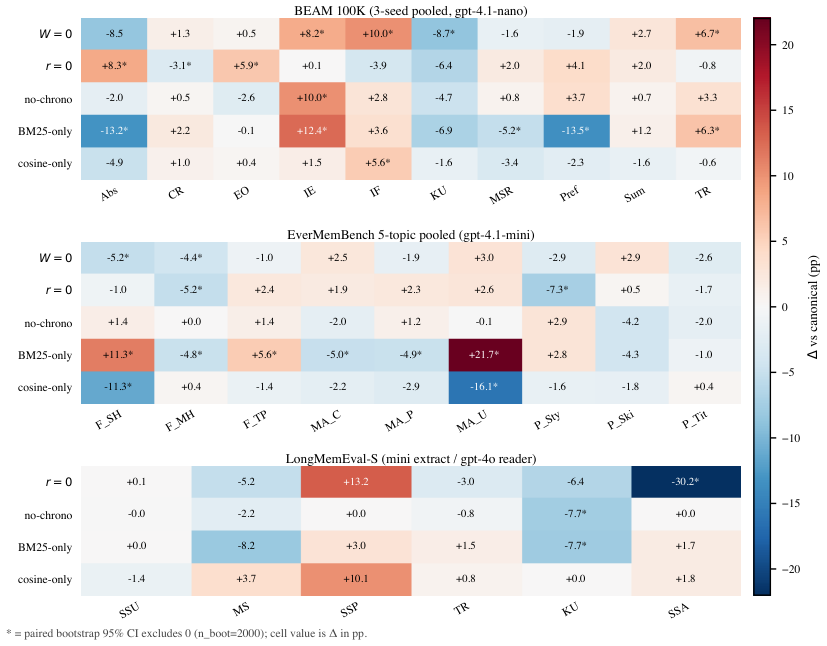
Figure 6 shows the change in benchmark score when each primitive (extraction, supersession, reflection, etc.) is removed. The bars hover around zero, indicating that most primitives have negligible impact on overall scores, reinforcing the claim that current benchmarks are blind to the functional differences between memory designs.
How can Grafy users experiment with minimal RAG memory concepts?
While Grafy does not yet ship a dedicated “Bridge” module, creators can explore the underlying ideas using existing tools:
- Grafy Chat lets you chain prompts and store intermediate observations manually, mimicking Bridge’s per‑block notes. By feeding the output of one turn as context to the next, you can emulate a chronological rendering pipeline.
- Grafy Reader can ingest PDFs or long documents, then issue BM25‑style keyword queries combined with cosine similarity through the multi‑model backend. This approximates the hybrid retrieval strategy described in the paper.
- For developers wanting to prototype the two‑tier rendering, the Graph app can visualize a branching history of notes and their chronological order, helping you see how information flows over time.
Experimenters interested in the adversarial probe methodology can script their own probes in Grafy Code, using the Operator browsing agent to fetch benchmark texts and the Bots framework to automate cross‑vendor verification. By reproducing the probe taxonomy (Rule Application, Pattern Induction, Dynamic Multi‑turn) you can test whether your own memory design truly enables applied behavior.
Source: https://arxiv.org/abs/2611.22179
More news

RegimeCouncil Introduces Dynamic Memory Conflict Governance for LLM Agents
A new routing system called RegimeCouncil lets language agents decide when to suppress stale memory locally or globally.

SkillBuffBench Reveals Real‑World Impact of Agent Skills Across Harnesses and Memory Modes
A new benchmark called SkillBuffBench measures how file‑based Agent Skills affect coding agents in deployment.

Study finds multi-agent LLMs lose factual conflicts during delegation
Researchers introduced a benchmark that injects controlled factual conflicts into document‑review tasks and found that delegating work to multiple LLM agents.