Mu-Edit tackles knowledge conflicts in multi‑task LLM editing
Researchers introduce Mu-Edit, a method that reduces interference when large language models are edited across multiple domains.
 Source: Grafy Research Lab
Large language models (LLMs) need frequent knowledge updates that span factual, multilingual, safety, QA and sentiment domains, but existing editing techniques break down when applied sequentially across such heterogeneous tasks. The new Mu‑Edit framework, presented on arXiv (\cite{MuEdit2026}), proposes a geometry‑aware solution that preserves earlier edits while accommodating new ones.
What is multi‑task model editing and why does it matter?
Model editing refers to the targeted modification of an LLM’s parameters so that the model learns a specific piece of knowledge without full retraining. In real‑world deployments, updates are rarely confined to a single domain; a product may need to correct factual errors, add new multilingual terms, tighten safety guards, and adjust sentiment responses over time. The goal of multi‑task editing is to perform these updates one after another while keeping the model’s performance on all previously edited tasks intact. Failure to do so leads to forgetting or even catastrophic interference, undermining the reliability of deployed AI systems.
Why do existing editing methods fail across domains?
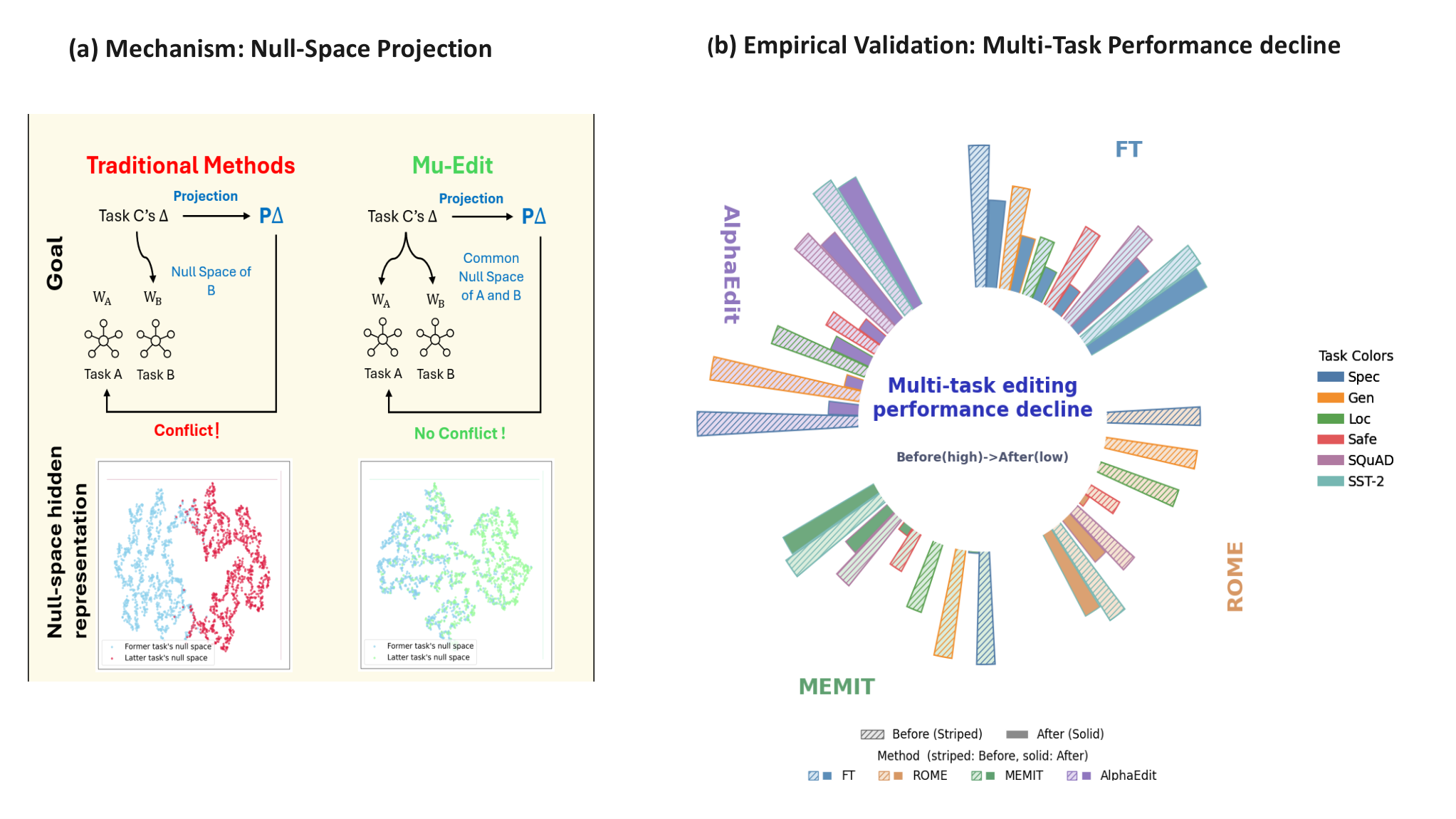
Prior work such as AlphaEdit and PRUNE focuses on a single domain and relies on null‑space constraints that protect preserved representations. The authors of Mu‑Edit observe that each domain induces its own Jacobian geometry, yielding a task‑specific preservation matrix. When multiple domains are edited, the intersection of these null spaces can shrink dramatically, leaving few admissible directions for new updates. The paper calls this phenomenon inter‑domain null‑space misalignment and demonstrates it empirically: Figure 1 shows how existing methods experience steep performance drops after a few sequential edits across different tasks.
How does Mu‑Edit address inter‑domain conflicts?
Mu‑Edit introduces two complementary mechanisms.
-
Conflict‑aware ordering – The authors define a Conflict Index that quantifies the geometric overlap between the null spaces of any two tasks. By arranging tasks so that adjacent pairs have low Conflict Index values, the cumulative interference is minimized. In an offline setting the optimal order can be searched exhaustively; for online or incremental scenarios a greedy algorithm selects the next task with the smallest conflict to the current state.
-
Dynamic low‑rank approximation – When ordering alone cannot provide enough admissible directions, Mu‑Edit applies a low‑rank compression to the preservation matrices, effectively expanding the common null space. Adaptive thresholds decide how much rank to drop, balancing edit fidelity against the risk of over‑compressing useful knowledge.
The combined approach yields a closed‑form parameter update using the pseudo‑inverse of the (potentially reduced) preservation matrix, as detailed in the paper’s Section 3.4.
What were the experimental results?
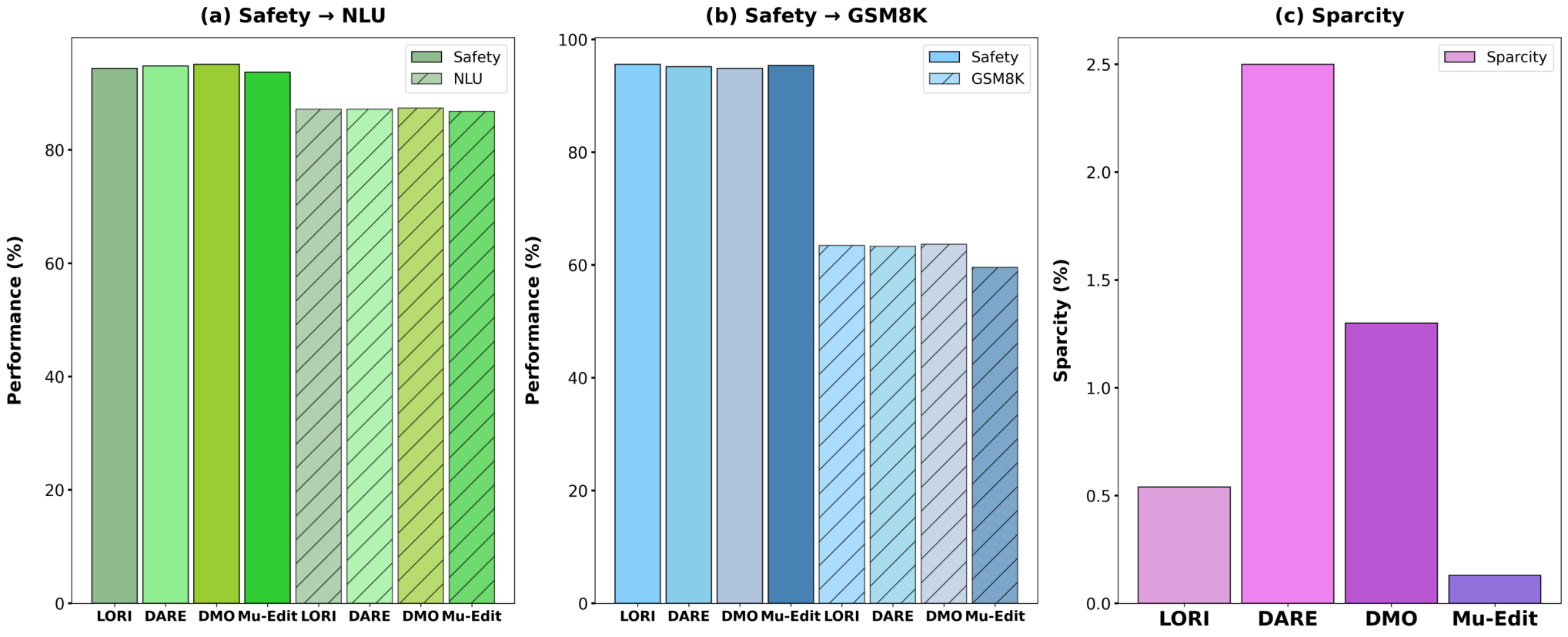
The authors evaluated Mu‑Edit on five functional domains (factual, multilingual, safety, QA, sentiment) using three popular LLM backbones. Across all settings, Mu‑Edit achieved higher final editing accuracy than baseline methods while preserving general capabilities. A seven‑task extension confirmed that conflict‑aware ordering scales: the greedy ordering variant reached performance within a few percentage points of the offline best‑order search but required far less computational time. Figure 5 visualises these comparisons, showing Mu‑Edit’s superiority over traditional multi‑task learning baselines. Additional ablations demonstrated that rank reduction improves task preservation without harming edit fitting, and that the method remains robust in low‑resource and imperfect‑boundary scenarios.
How can Grafy users explore or apply these ideas?
While Grafy does not yet expose a built‑in multi‑task editing engine, creators and researchers can experiment with the underlying concepts using existing tools:
- Grafy Reader (/reader) lets you upload the Mu‑Edit PDF, ask the AI to summarise the Conflict Index definition, or extract the pseudo‑inverse update formula.
- Grafy Graph (/graph) can be used to visualise a sequence of edits as nodes, manually reorder them, and observe how the Conflict Index changes between steps.
- Grafy Chat (/chat) enables rapid prototyping: you can prompt the chat model to simulate a low‑rank compression of a preservation matrix and see the resulting parameter perturbation in a toy model.
By chaining these apps, a developer could build a lightweight sandbox that mimics Mu‑Edit’s ordering strategy on a small LLM, gaining intuition before integrating a full‑scale implementation.
Source: arXiv pre‑print "MuEdit: An efficient multi‑task editing method towards inter‑domain knowledge conflicts" (2026‑11‑14) https://arxiv.org/abs/2611.14910
Frequently asked questions
How does the Conflict Index differ from a simple similarity measure between tasks?
The Conflict Index is derived from the null‑space geometry of each task’s preservation matrix, measuring the overlap of admissible update directions rather than raw feature similarity. This makes it a direct proxy for potential interference during sequential editing.
Does Mu‑Edit completely eliminate forgetting of earlier edits?
No. Mu‑Edit reduces forgetting by expanding the shared null space and ordering low‑conflict tasks first, but some degradation can still occur, especially in extreme conflict cases noted in the paper’s limitations section.
Can the greedy ordering be used for an unlimited stream of incoming tasks?
The greedy strategy selects the next task with minimal conflict to the current model state, so it scales to online scenarios. However, the authors caution that performance may diverge from the offline optimal order when the task stream becomes very long or highly conflicting.
More news

Cmpnd launches dspy-wsp: weight‑space programming
Cmpnd released dspy-wsp, a prototype DSPy optimizer that edits model weights directly without gradients.

Prefix‑Guided Sampling Cuts Test‑Time Costs While Boosting LLM Reasoning
A new method called Prefix‑Guided Sampling (PreG) uses early confidence signals to prune low‑quality reasoning paths.

guardscope Framework Quantifies Runtime Control Coverage for LLM Agents
A new arXiv study introduces guardscope, a two‑stage framework that measures how many of an LLM agent's action paths are inspected by runtime controls.