New ALF architecture enables cross-layer attention in LLMs
Researchers have introduced Attention Latent Feedback (ALF) to allow transformer sublayers to access deeper representations from previous tokens.
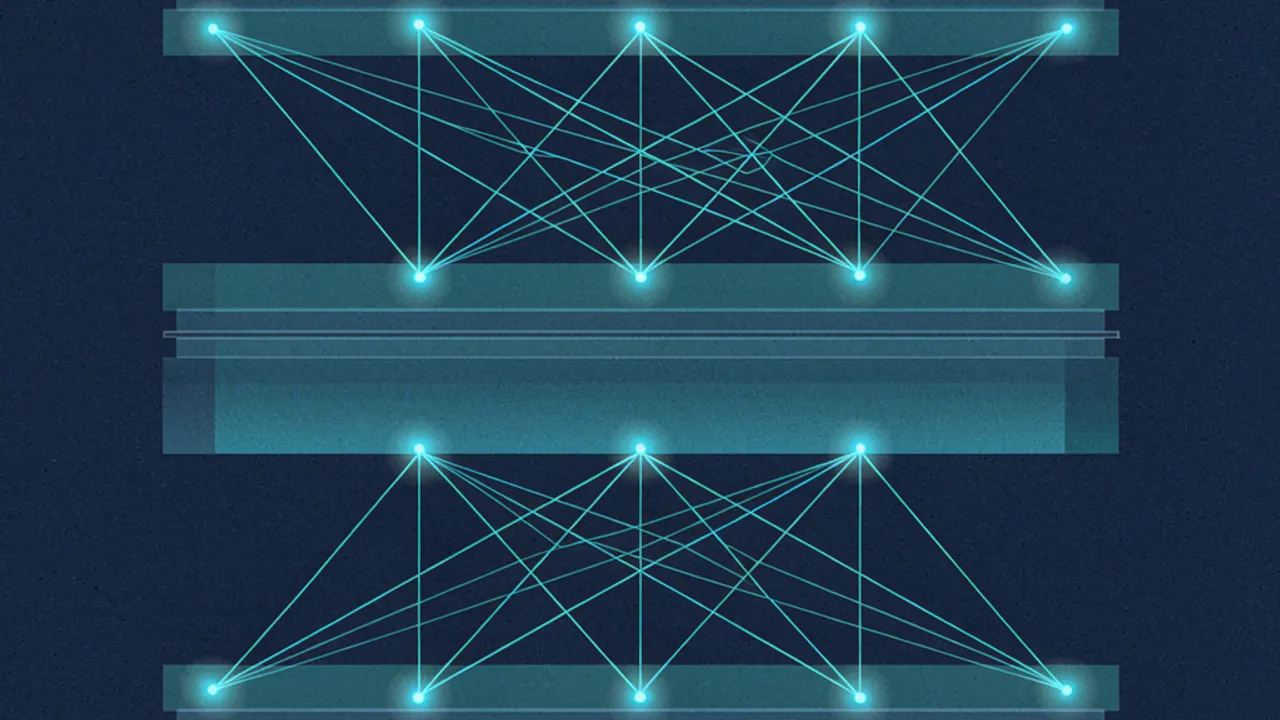 Source: Grafy Research Lab
Researchers have proposed a new architectural modification called Attention Latent Feedback (ALF) that allows transformer sublayers to access information from deeper layers of previous tokens. This approach addresses a fundamental limitation in standard self-attention mechanisms where layers are restricted to communicating only with other layers at the same depth.
What is Attention Latent Feedback?
In standard autoregressive decoding, a model generates text one token at a time. While the deeper layers of a previous token have already computed high-level representations, the shallower layers of the current token cannot directly access that information. According to the paper by Xuyuan Xiong, Siyu Chen, and colleagues, standard self-attention typically connects positions only at the same depth within the transformer stack.
Attention Latent Feedback (ALF) changes this by allowing every sublayer to attend to the outputs of the deeper layers from the preceding position. This creates a form of cross-position recurrence, enabling a more integrated flow of information across the entire depth of the model during the decoding process.
How does ALF work during training and decoding?
Implementing this architecture requires different approaches depending on whether the model is being trained or used for inference. According to the authors, training the model involves unrolling the cross-position recurrence into two parallel passes. This allows the gradient to flow through the complex inter-layer dependencies.
During the actual decoding phase, however, the process remains efficient. The model utilizes cached states from the previous token, allowing it to maintain single-pass decoding. This distinction is critical for ensuring that the architectural improvements do not result in prohibitive computational costs during real-world application.
Does ALF improve Mixture-of-Experts models?
The research indicates that the benefits of ALF are observable across various model types, including Mixture-of-Experts (MoE) architectures. By allowing shallower layers to benefit from the sophisticated computations performed in deeper layers, the architecture optimizes how information is processed throughout the transformer stack. This mechanism essentially bridges the gap between the initial processing stages and the highly refined representations found in the final layers of the model.
Why does this matter for AI development?
This development targets the way information is synthesized within a transformer. Currently, much of the "intelligence" or high-level reasoning in a model is concentrated in the final layers. By allowing earlier layers to incorporate these deep representations earlier in the computation of the current token, the model can potentially achieve better coherence and understanding.
If implemented widely, this could lead to more efficient training and more capable models that make better use of the latent information already present in their own hidden states. It represents a shift from purely depth-wise processing to a more integrated, multi-depth approach to information retrieval during token generation.
How to explore this research with Grafy
For researchers and developers looking to dive deeper into the technical specifics of the ALF paper, such as the mathematical implementation of the recurrence or the specific performance metrics on MoE models, the Reader app is the most effective tool. You can upload the full PDF of the research to analyze complex formulas and query specific findings about the architecture's efficiency.
Frequently asked questions
What does Attention Latent Feedback allow sublayers to do?
Attention Latent Feedback allows every sublayer within a transformer to attend to the outputs of deeper layers from the previous token position. This breaks the standard limitation where self-attention only connects positions at the same depth, enabling a more direct flow of high-level information to shallower layers.
How is ALF handled during the decoding process?
During decoding, ALF remains a single-pass process. The architecture utilizes cached states from the previous token to maintain efficiency. This ensures that the model can leverage the deeper latent feedback without the computational overhead of the parallel passes required during the training phase.
Does the ALF architecture affect training complexity?
Yes, training with ALF is more complex than standard transformers because it unrolls the cross-position recurrence into two parallel passes. This structure is necessary to manage the dependencies between different layers and positions during the gradient descent process used to optimize the model.
More news

New Loom Attention Method Enables Rewirable Transformer Circuits
Researchers have introduced Loom Attention, a method that allows Transformers to dynamically rewire their internal circuits at every token for better.

New RoFE method fixes multimodal tabular learning errors
Researchers have introduced RoFE to prevent data geometry collapse in multimodal learning, improving performance when labeled data is scarce.

New Framework Evolves Evaluation for Computer-Use Agents
Researchers have introduced CUA-SEE, a closed-loop system that automatically creates harder tasks and verifiers to keep pace with improving AI agents.