New Benchmark Reveals AI Gap in Early-Grade Literacy Knowledge
Researchers have introduced the Linguistic Knowledge Benchmark to test if AI understands the foundations of literacy, revealing significant gaps in LMICs.
 Source: Grafy Research Lab
A new research study has identified a significant performance gap in how large language models (LLMs) handle the linguistic foundations required for early-grade literacy, particularly in low- and middle-income countries (LMICs). The findings suggest that while frontier models excel, the smaller, more efficient models intended for local deployment often lack the specific linguistic knowledge necessary to support foundational reading and writing in underrepresented languages.
What is the Linguistic Knowledge Benchmark?
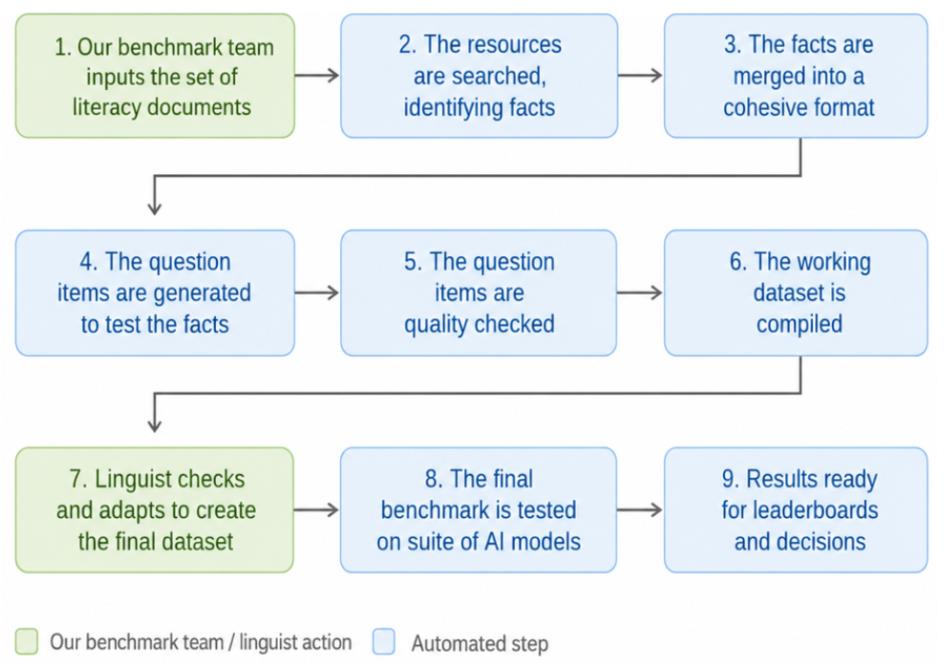
To address the lack of specialized testing for literacy-focused linguistic knowledge, researchers Maxime Lelièvre, Alasdair Mackintosh, and colleagues developed the Linguistic Knowledge Benchmark. According to the researchers, the benchmark utilizes a reproducible, largely automated pipeline to transform primary educational materials—such as curriculum documents, teacher guides, and pupil books—into a vetted set of questions.
These questions are organized across a structured grid consisting of nine linguistic domains and seven grade levels. Figure 1 illustrates this end-to-end pipeline, which moves from surveying source documents and merging extracted facts to generating and quality-checking question items. The process is designed to be language-agnostic, allowing the same framework to be applied to different languages by simply swapping the source documents and adjusting the prompts.
How does AI perform in different languages?
The researchers instantiated the benchmark for two specific cases: Kiswahili (focused on Kenya) and English (focused on the United Kingdom). They evaluated over 120 models for each language to determine their accuracy in answering questions about fundamental linguistic features.
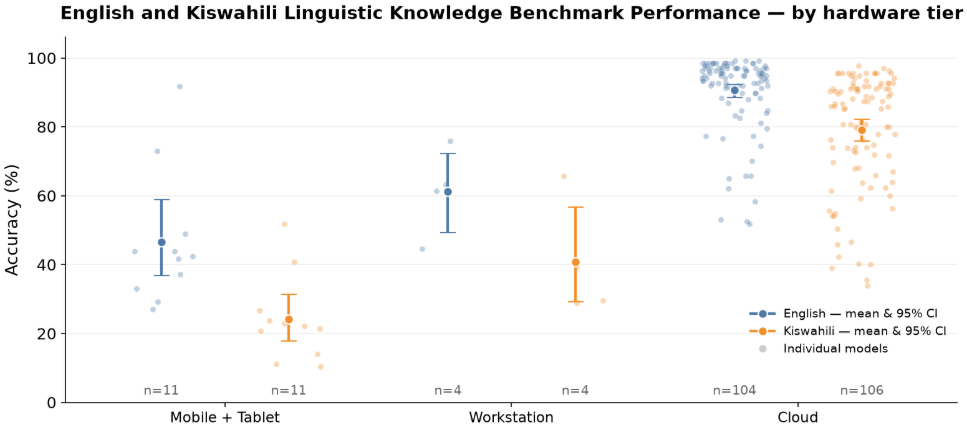
According to the study, frontier models achieved accuracy exceeding 90% in both English and Kiswahili. However, a sharp decline in performance was observed as model size and cost decreased. The disparity was even more pronounced in Kiswahili. For instance, while the two best models under 10 billion parameters reached 91.7% accuracy in English, they only achieved 51.9% and 40.7% in Kiswahili. This indicates that the linguistic structures of non-English languages are often less effectively captured by smaller-scale AI architectures.
Why is there a gap in low-resource languages?
The performance deficit is largely attributed to the imbalance in training data. The researchers note that many languages used in LMICs are poorly represented in the massive datasets used to train modern LLMs. For example, the study cites that African languages account for well below 1% of the content identified in Common Crawl, a primary source for AI training.
This lack of exposure means models struggle to learn the specific grammatical and phonological patterns of these languages. In Kiswahili, for example, grammatical number is often marked by changes at the start of nouns, whereas English typically marks plurals at the end. Without sufficient data, models fail to master these foundational rules, which are essential for generating "decodable text"—material specifically designed to help children practice sounds they have already learned.
What are the implications for local deployment?
The most critical finding for developers and educators concerns the hardware required to run these models. In many educational contexts in LMICs, AI tools are expected to run on mobile phones or tablets rather than high-end servers.
Figure 6 highlights the accuracy of models when grouped by their deployment hardware tier. The data shows that the mean accuracy for models capable of running on mobile and tablet hardware is 47% in English, but drops significantly to just 24% in Kiswahili. This creates a paradox where the models most practical for use in resource-constrained classrooms are the least capable of serving the linguistic needs of the students in those very environments.
How can this benchmark be used in the future?
The authors describe this benchmark as the first rung of a three-level evaluation ladder. The subsequent rungs, currently under development, will include "Decodability Assessment," which tests if a model can identify words a child cannot yet decode, and "Decodable Text Generation," which tests if a model can actually write appropriate reading material. By separating linguistic knowledge from functional competence, the researchers aim to provide a roadmap for where developers need to intervene to make AI a viable tool for global literacy efforts.
Exploring linguistic research with Grafy
For researchers and developers looking to dive deeper into complex linguistic papers or technical documentation regarding model performance, Grafy offers tools to facilitate high-level analysis. You can use Reader to upload research papers and ask specific questions about methodology or results, or utilize Chat to compare how different models respond to specific linguistic prompts across various languages.
Frequently asked questions
What does the Linguistic Knowledge Benchmark measure?
The benchmark measures a model's formal linguistic competence. It specifically tests how well a model understands the fundamental rules and features of a language—such as grammar and word structure—that are essential for early-grade literacy instruction, rather than its ability to use the language for general conversation.
Why do smaller models struggle more with Kiswahili than English?
Smaller models struggle more because they have less capacity to capture complex patterns from limited training data. Since Kiswahili is significantly underrepresented in major web-based training datasets compared to English, these smaller models lack the necessary exposure to learn the specific linguistic nuances required for high accuracy.
What is decodable text?
Decodable text refers to reading material that is strictly limited to the specific letter-sound correspondences that a student has already been taught. This type of text is a crucial component of early literacy instruction because it allows children to practice their decoding skills without being overwhelmed by unfamiliar patterns.
Source: Maxime Lelièvre, Alasdair Mackintosh, Dominic Andrews, Tobias Murray, Moritz Boos, Oliver G. B. Garrod (https://arxiv.org/abs/2611.34823)
More news

Study finds AI models struggle with partially covered questions
A new pilot evaluation shows AI models often add unsupported claims when reference material only partially answers a user's question. Learn more.

New Framework Repairs Trustworthiness in Distilled AI Models
Researchers have developed a new framework to fix truthfulness and ethics issues in compressed AI models without needing the original training data.

AI models struggle to predict actual human behavior
Researchers have found that language models fail to accurately simulate audience behavior when validated against real-world actions instead of words.