New Framework Repairs Trustworthiness in Distilled AI Models
Researchers have developed a new framework to fix truthfulness and ethics issues in compressed AI models without needing the original training data.
 Source: Grafy Research Lab
Knowledge distillation allows developers to shrink massive language models into smaller, faster versions, but this process often compromises the model's truthfulness and ethical alignment. Researchers have proposed a new method to fix these reliability regressions without requiring access to the massive datasets used during the initial distillation process.
Why does distillation damage model trustworthiness?
Knowledge distillation works by training a compact "student" model to mimic the behavior of a much larger "teacher" model. While this is effective for maintaining performance on general tasks, it does not always preserve the nuances of the teacher's behavior. According to the research paper by Kumar Shubham et al., the transfer corpus used during distillation may only capture a fraction of the teacher's distribution.
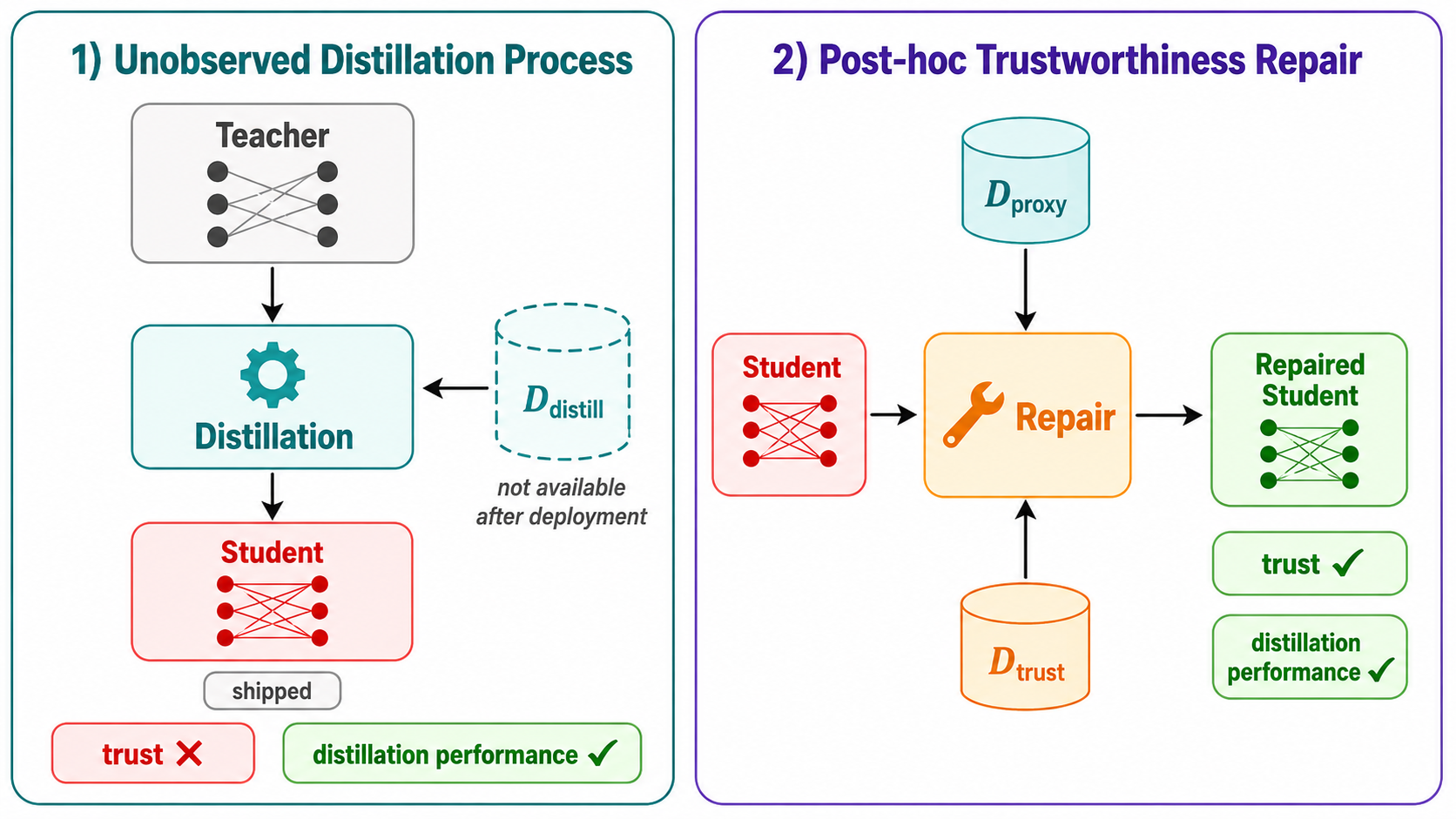
This imbalance means that rare but critical behaviors—such as factual accuracy (truthfulness) or adherence to social norms (machine ethics)—receive less supervision than dominant task-specific patterns. Consequently, a student model might achieve high scores in perplexity or general accuracy while still exhibiting significant flaws in reliability. Figure 1 shows how a shipped student model may inherit a teacher's task performance but suffer from degraded trustworthiness due to an unobserved distillation process.
How can developers fix distilled models post-deployment?
Fixing a model after it has been released is difficult because the original distillation data is often unavailable to the developers of the student model. One common solution is to repeat the entire distillation process with a better dataset, but this is often impractical due to the high computational costs and the lack of transparency regarding the original teacher's training recipe.
Another option is direct preference optimization, but the authors note that this can be a double-edged sword. While it can improve specific behaviors, it risks altering the broader capabilities the student originally inherited from the teacher. This creates a tension between making a model safer and making it less capable at its primary tasks.
What is the PBRF repair framework?
To solve these issues, the researchers introduced a targeted repair framework based on the proximal Bregman response function (PBRF). This method constrains model updates in both function and parameter space, ensuring that the changes made to improve trustworthiness do not drift too far from the original student model.
To address the problem of missing data, the framework uses a surrogate proxy dataset to estimate the required curvature and proximity for the updates. This removes the need to possess the original, often proprietary, distillation corpus. Furthermore, the researchers extended this framework to handle preference-based supervision. This allows the model to learn from pairs of preferred and dispreferred responses using an odds-ratio objective, making it compatible with modern alignment datasets that focus on human preferences.
What are the results of this new approach?
Experimental results indicate that this method provides a practical way to improve model reliability with minimal side effects. The researchers found that the proposed approach could improve targeted trustworthiness behaviors in both pre-training and post-training models by up to 8%.
Crucially, this improvement comes at a very low cost to the model's general intelligence. The study reported a decrement in perplexity of less than 1%, suggesting that the model remains highly capable of its original tasks while becoming significantly more truthful and ethically aligned. This offers a viable alternative to the expensive process of re-distillation or the potentially disruptive nature of unconstrained preference optimization.
How can researchers explore these topics?
For researchers looking to dive deeper into the technical specifics of these distillation failures or the mathematical foundations of the PBRF framework, the Reader app provides an ideal environment. You can upload the full PDF of the research paper to analyze its findings, query specific equations, or summarize complex sections regarding the surrogate proxy datasets and the odds-ratio objective.
Frequently asked questions
Does distillation always preserve model truthfulness?
No, distillation does not guarantee the preservation of truthfulness. While a student model may match a teacher's performance on standard benchmarks, the compression process can lead to regressions in factual accuracy and machine ethics because the transfer data may not sufficiently cover these critical behavioral dimensions.
Can models be repaired without the original training data?
Yes, the new framework proposed by the researchers allows for model repair without access to the original distillation corpus. By using a surrogate proxy dataset to estimate the necessary curvature for the proximal Bregman response function, developers can target specific reliability issues post-deployment.
Does improving trustworthiness reduce a model's general performance?
The research shows that trustworthiness can be improved with very little impact on general performance. Specifically, the authors demonstrated that improvements in targeted behaviors can be achieved with less than a 1% decrease in perplexity, meaning the model's fundamental language capabilities remain largely intact.
Source: Grafy Research Lab — Repairing the Trustworthiness of Distilled Language Models
More news

Study finds AI models struggle with partially covered questions
A new pilot evaluation shows AI models often add unsupported claims when reference material only partially answers a user's question. Learn more.

New Benchmark Reveals AI Gap in Early-Grade Literacy Knowledge
Researchers have introduced the Linguistic Knowledge Benchmark to test if AI understands the foundations of literacy, revealing significant gaps in LMICs.

AI models struggle to predict actual human behavior
Researchers have found that language models fail to accurately simulate audience behavior when validated against real-world actions instead of words.