New Benchmark Uses Developer Actions to Evaluate AI Code Review
Researchers introduced CodeReviewBench, a new system that evaluates AI code review quality by tracking whether developers actually act on bot suggestions.
 Source: Grafy Research Lab
Measuring the quality of AI-driven code reviews is notoriously difficult because there is no objective "correct" answer, only the subjective judgment of the developer. Researchers have addressed this challenge by developing CodeReviewBench, a new automated benchmark that evaluates AI tools based on real-world developer behavior rather than static, human-labeled datasets.
Why is evaluating AI code review so difficult?
Unlike code generation, where a model's output can be objectively verified by running unit tests, a code review comment is a matter of professional judgment. According to the researchers, a review's utility depends on the specific context of the pull request (PR), the priorities of the engineering team, and whether the author was already aware of the issue.
Existing benchmarks often rely on third-party annotators to label issues. The authors of the CodeReviewBench paper argue that this creates a structural misalignment: these annotators act like the AI bots they are evaluating, rather than the PR authors who actually decide which suggestions are worth implementing. Furthermore, traditional benchmarks often use small, static sets of issues that can become outdated or suffer from data leakage, where models simply memorize the "gold" answers from their training data.
How does CodeReviewBench measure quality?
Instead of relying on what an annotator says is good, CodeReviewBench uses "revealed developer preferences" as its primary signal. The methodology is built on a simple premise: if a developer pushes a commit that addresses a suggestion made by an AI bot, that suggestion is treated as useful. If the developer ignores the suggestion, it is treated as unhelpful.
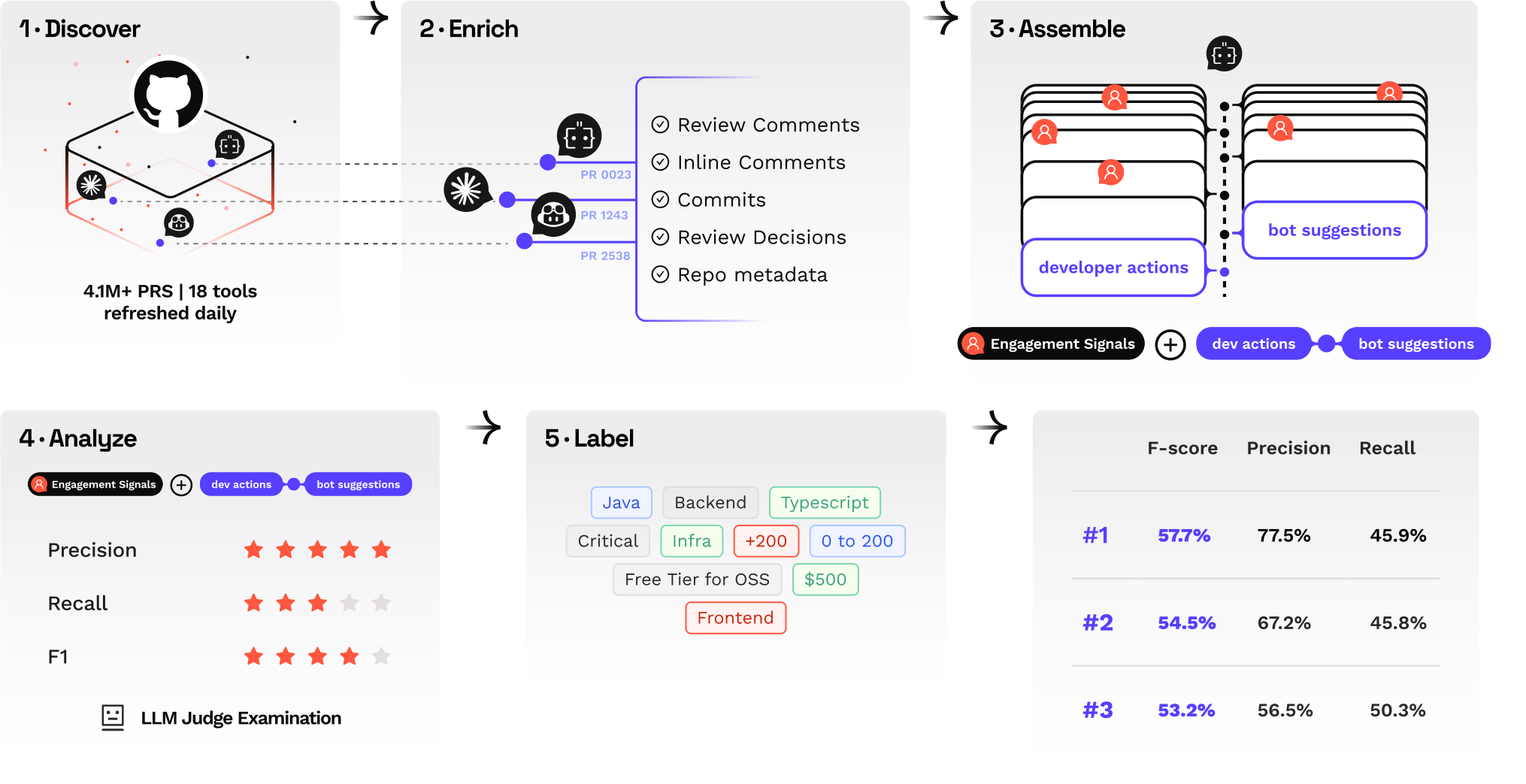
Figure 1 shows the five-stage pipeline used to transform raw GitHub events into scored records. The process begins with a daily scan of the GitHub Archive via BigQuery to identify PRs where AI bots have commented. The system then enriches this data using the GitHub REST API, assembles a timeline of bot suggestions followed by developer actions, and finally uses an LLM judge to score the interaction. This continuous pipeline allows the benchmark to refresh daily, making it resistant to "gaming" and capable of detecting real-time improvements or regressions in AI tools.
What makes this benchmark different from previous ones?
CodeReviewBench is significantly larger than existing efforts. The researchers report that the online dataset contains over 500,000 judged pull requests spanning 18 different tools. This is more than three orders of magnitude larger than previous benchmarks and approximately 20 times the scale of SWE-rebench.
Because the data is mined from the public GitHub event stream, it is naturally dynamic. While static datasets eventually saturate, CodeReviewBench evolves alongside the tools it measures. The researchers also included a 50-PR offline "gold set" of expert-labeled issues to validate the behavioral signal. They found that the behavioral data and the human-labeled data agreed on precision rankings and were both able to independently detect product updates within days of a vendor's release.
Can AI code review tools be gamed?
The researchers addressed the risk of "Goodhart's Law"—the idea that when a measure becomes a target, it ceases to be a good measure. They identified several ways developers or vendors might attempt to manipulate scores, such as selective deployment, judge alignment, or flooding the system with low-effort suggestions.
However, because the benchmark relies on actual changes to code repositories in the real world, gaming the system would require changing the behavior of millions of human developers at scale, which is a much higher bar than optimizing a model to pass a fixed set of test cases. The benchmark also provides a configurable public leaderboard, allowing users to filter results by programming language, domain, and the severity of the issues being reviewed.
How can developers use these insights?
For engineering teams, the stratified leaderboard allows for a more nuanced evaluation of tools. Instead of looking at a single aggregate score, a team can see how a specific tool performs in their specific language or on the types of code complexity they encounter daily. The researchers also suggest that the massive dataset of suggestion-action pairs can serve as a high-quality training corpus for developers looking to fine-tune open-source models for automated code review.
For those working in AI-assisted development, understanding the gap between what a bot suggests and what a human accepts is critical for building more reliable "software factories" where AI agents can operate with increasing autonomy.
If you are looking to experiment with AI-driven coding workflows, you can explore how different models handle complex programming tasks in Grafy Code. For researchers interested in diving deeper into the technical specifics of this new evaluation method, Grafy Reader can assist in analyzing the full technical paper and its associated data structures.
Frequently asked questions
What is the primary signal used by CodeReviewBench?
CodeReviewBench uses revealed developer preferences as its primary signal. This means the benchmark determines the quality of an AI's suggestion by observing whether a human developer actually implements the suggested change in a subsequent commit. If the developer acts on the suggestion, it is marked as useful; if they ignore it, it is marked as unhelpful.
How does CodeReviewBench avoid the problem of data leakage?
CodeReviewBench avoids data leakage by using a continuous, automated pipeline that mines fresh data from the GitHub event stream every day. Because the benchmark is not based on a fixed, static set of questions, models cannot simply memorize the answers through training, as the data is constantly evolving and reflecting real-world developer interactions.
Is CodeReviewBench larger than existing benchmarks?
Yes, CodeReviewBench is significantly larger than previous benchmarks. It includes a dataset of over 500,000 judged pull requests across 18 different tools. This makes it more than 1,000 times larger than many existing code-review benchmarks and roughly 20 times the scale of the SWE-rebench dataset.
Source: Grafy Research Lab — CodeReviewBench: An Automated Benchmark for Evaluating the Software Factory
More news

AI Agents Are Now Writing and Reviewing Their Own Code
Nearly half of engineers report that AI agents are reviewing the code they generate, creating new bottlenecks in the software delivery lifecycle.

New RoFE method fixes multimodal tabular learning errors
Researchers have introduced RoFE to prevent data geometry collapse in multimodal learning, improving performance when labeled data is scarce.

New Framework Evolves Evaluation for Computer-Use Agents
Researchers have introduced CUA-SEE, a closed-loop system that automatically creates harder tasks and verifiers to keep pace with improving AI agents.