New failure-driven flywheel improves vision-language-action models
Researchers propose a data flywheel that uses reconstructed scenes to target model failures, helping vision-language-action models adapt to new platforms.
 Source: Grafy Research Lab
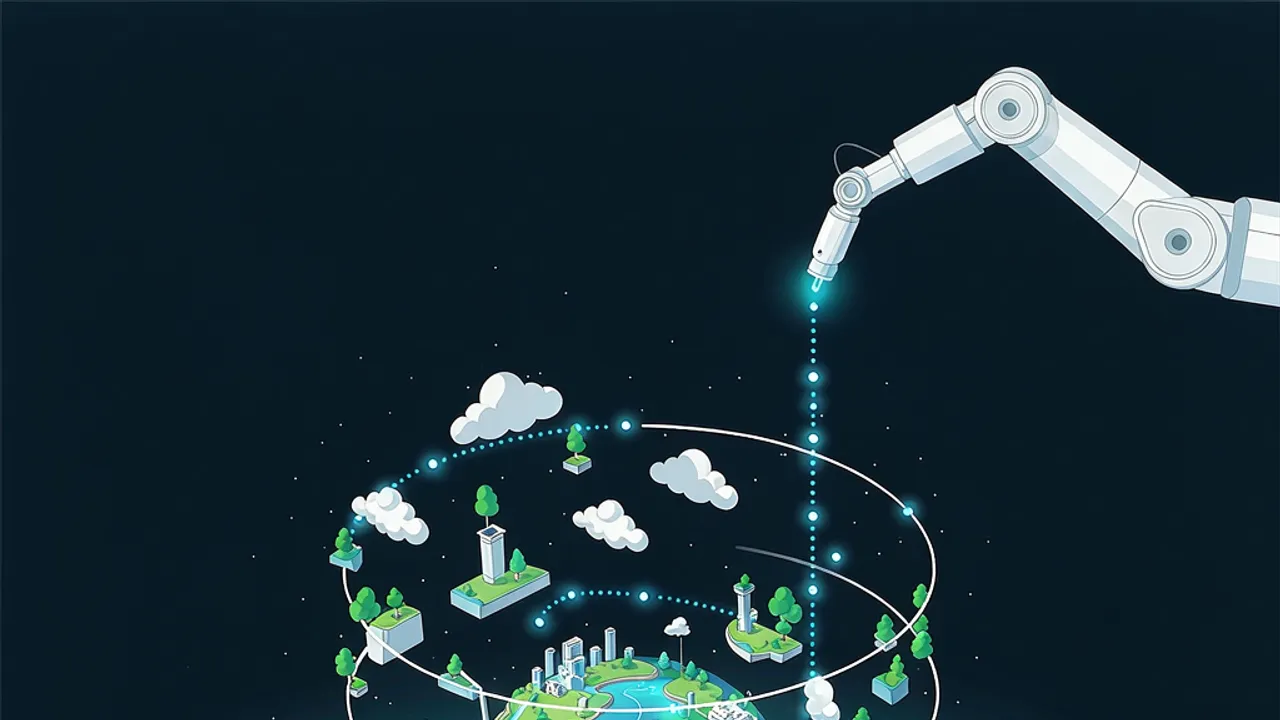
Researchers have proposed a new method to improve vision-language-action (VLA) models by using a "failure-driven data flywheel" to address performance gaps. This approach helps models adapt to new physical platforms even when teams lack large amounts of real-world deployment data.
What is a vision-language-action model?
Vision-language-action (VLA) models represent a class of artificial intelligence designed to bridge the gap between perception and physical movement. According to the research paper by Yuhao Luo et al., these models process visual inputs and linguistic instructions to produce specific actions. This capability is critical for robotics, where an agent must understand a command like "pick up the red block" by seeing the environment and executing the precise motor movements required to complete the task.
Why do these models struggle with new platforms?
Even when a VLA model is highly capable, it often fails to meet the specific behavioral requirements of a new robotic platform or environment. The authors note that teams developing these systems frequently face a data scarcity problem: they do not have a large enough fleet of deployed robots to collect the massive amounts of diverse data needed to correct these errors. Because the model has not encountered specific edge cases or the unique physics of a new device, its performance can drop significantly when moved from a training simulation to a real-world setting.
How does the failure-driven data flywheel work?
To solve the data scarcity issue, the researchers developed a system that identifies exactly where a model is failing and generates targeted data to fix it. Instead of collecting random new data, the flywheel follows a structured process of reconstruction and insertion.
First, the system reconstructs real-world scenes from existing data. It then inserts task-relevant entities—such as new objects or obstacles—into these reconstructed environments to create "target scenarios" that were missing from the original dataset. This allows the system to simulate difficult or rare situations that the model has not yet mastered.
Once these scenarios are generated, the model is evaluated against specific behavioral requirements. The researchers track the results to create a "failure map," which visualizes failure rates across different task conditions and difficulty levels. This map serves as a guide for the next stage of training, ensuring that the data being added to the model's training set is specifically designed to close the identified performance gaps.
How does this improve model training?
By iterating through this cycle, the flywheel creates a continuous loop of improvement. The failure map is re-evaluated after each training cycle, allowing the system to refine its focus. This targeted approach means that rather than needing millions of hours of generic robot footage, developers can focus on high-value, synthetic data that addresses the specific weaknesses of the model. This makes post-training more efficient and allows for faster adaptation to new hardware or complex environments.
How can researchers apply this approach?
For researchers and developers working on the cutting edge of multimodal AI, understanding the nuances of failure modes is essential for building robust agents. While the flywheel described in this paper is specialized for robotics and VLA models, the concept of using error analysis to drive data generation is a growing trend in AI development.
If you are currently reviewing complex technical papers on robotics or machine learning architectures, you can use Reader to parse the mathematical frameworks and methodologies presented in such studies. This can help you quickly identify how specific failure-driven methodologies might intersect with your own development workflows or research interests.
Frequently asked questions
What is the primary goal of the failure-driven data flywheel?
The primary goal is to help vision-language-action models adapt to new platforms by generating targeted training data. By identifying specific failures and creating synthetic scenarios that include those failures, the system allows models to learn from their mistakes without requiring massive amounts of new real-world data.
How does the system create new training scenarios?
The system creates new scenarios by reconstructing real-world scenes from existing data and then inserting task-relevant objects or entities into those scenes. This process produces specific target scenarios that were previously absent from the training set, allowing the model to practice in controlled, difficult environments.
What is a failure map in this context?
A failure map is a visual representation of a model's performance across various task conditions and difficulty levels. It tracks where the model succeeds and where it fails, providing a structured way to guide the data flywheel toward the most effective training improvements in subsequent cycles.
Source: Grafy Research Lab — A Failure-Driven Data Flywheel for Post-Training Vision-Language-Action Models
More news

New DART method mines better reasoning traces for math models
Researchers have introduced DART, a technique that recovers failed reasoning attempts to improve LLM math performance. Learn how it works here.

New vSFT framework enables verbal fine-tuning for AI agents
Researchers have introduced vSFT, a method that uses natural language feedback to update AI agent weights during test time. Learn how it works.

AI models struggle to predict actual human behavior
Researchers have found that language models fail to accurately simulate audience behavior when validated against real-world actions instead of words.