New Gridworld Benchmark Attributes Why AI Agents Fail to Reason
Researchers have introduced MultiNet v2.0-Gridworld to distinguish between different types of agentic failures. Learn why current models struggle.
 Source: Grafy Research Lab
Current agentic benchmarks often fail to explain why an AI agent fails a task, grouping distinct errors into a single success rate. A new study introduces an interactive 2D environment designed to isolate and attribute specific reasoning failures in vision-language models (VLMs).
Why do current AI agent benchmarks fail to diagnose errors?
Most existing evaluations for AI agents focus on functional correctness—whether the agent reached the final goal or not. According to the researchers Pranav Guruprasad, Sean Rivera, Helen Lu, Arushi Jain, Hangliang Ren, and Harshvardhan Sikka, this approach confounds different types of errors. An agent might fail because it misreads the visual environment, because it never understands how a specific component (like a switch) works, because it executes steps in the wrong order, or because it cannot recover from a mistake.
Treating these as the same failure makes it difficult for developers to decide on a fix. For instance, a model that lacks environmental understanding requires a different training intervention than one that understands the rules but lacks the logic to sequence them correctly. Existing benchmarks like SWE-bench or WebArena often use real-world interfaces that models may have seen during pretraining, meaning success might simply be a matter of memorization rather than true reasoning.
How does MultiNet v2.0-Gridworld isolate failures?
To solve the attribution problem, the researchers developed MultiNet v2.0-Gridworld, an interactive maze environment. Unlike previous benchmarks that vary the entire world, this environment keeps the renderer, the action space, and the scoring function fixed while allowing specific "mechanisms" to be added or removed.
These mechanisms include key-door pairs, switch-gate pairs, distractors, and decoys. Because these elements can be modified independently, researchers can observe how a model's performance changes when a specific mechanic is introduced. This allows for quantitative attribution: if a model succeeds in mazes with keys but fails in mazes with switches, the failure is clearly linked to the switch mechanism.
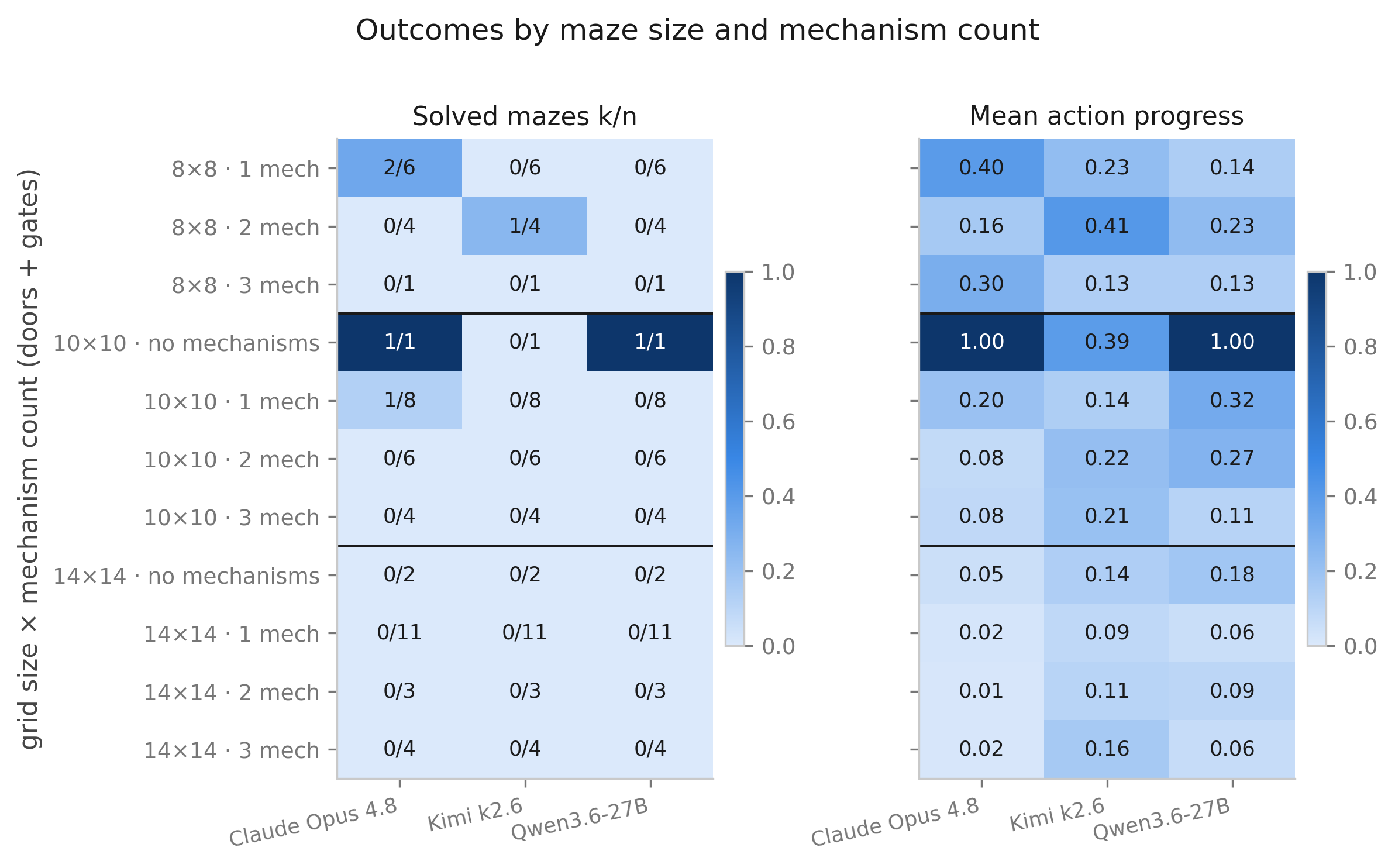
Figure 1 shows how different instance categories affect solve rates, illustrating that successes are limited to specific combinations of mechanisms.
What did the study reveal about current model performance?
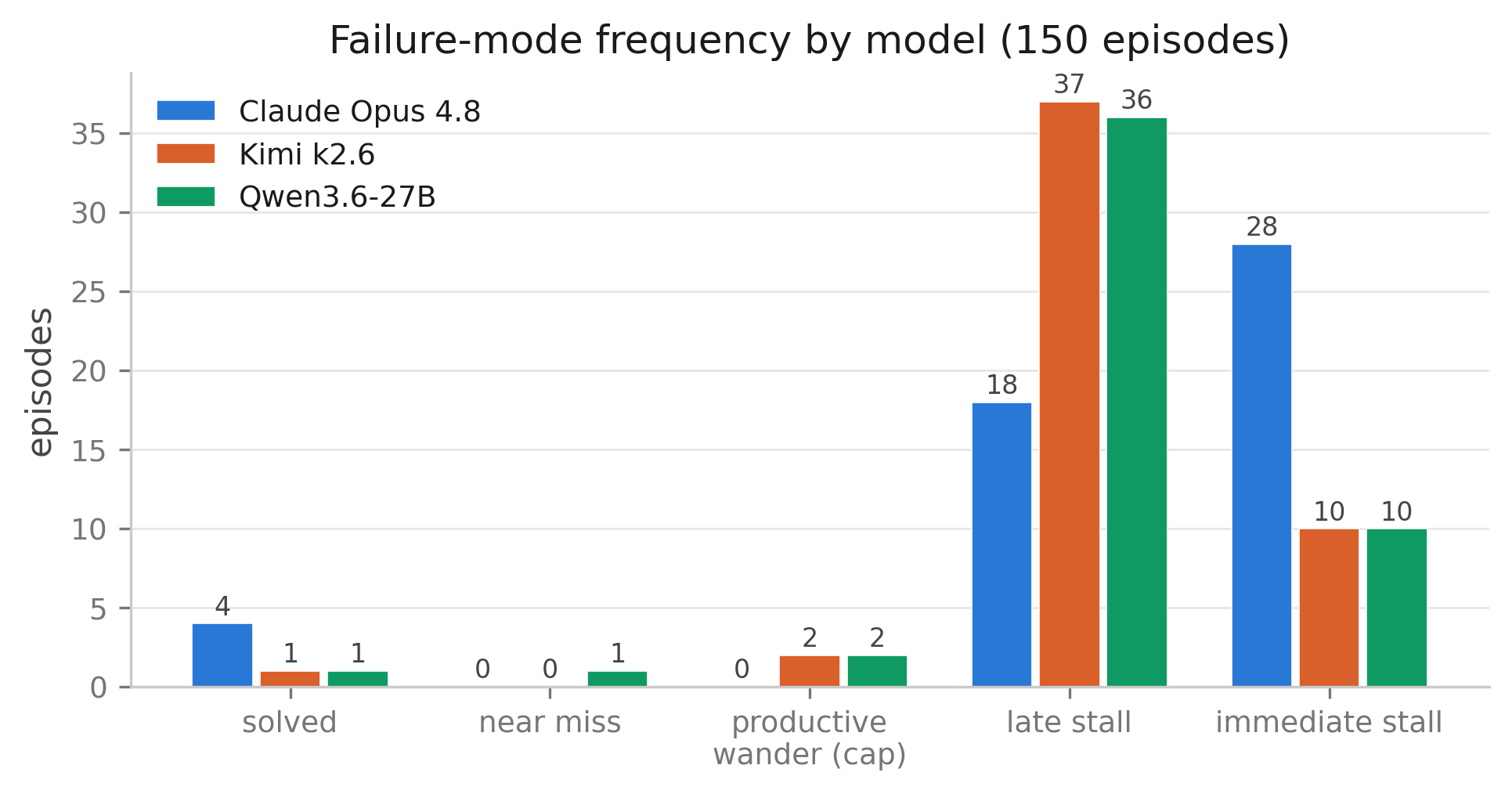
The researchers tested three vision-language models: Claude Opus 4.8, Kimi K2.6, and Qwen 3.6-27B. The results indicated significant limitations in agentic reasoning. Out of 150 episodes, the models solved only 6. Notably, 45 of the 50 mazes tested were not solved by any of the models.
One of the most striking findings was the complete failure regarding switch-gate mechanisms. According to the study, none of the 105 episodes containing a switch and gate were solved, despite the models standing on a live switch in 38 of those instances. While the models showed partial success with key-and-door mechanisms, they struggled significantly with the logic required for switches.
Figure 3 highlights the different terminal behaviors observed across the models. For example, Claude tended to drive forward into walls, Kimi frequently retreaded previously visited ground, and Qwen accumulated turn actions that failed to move the agent to any new tiles.
How is difficulty measured in this new environment?
Because the maze is a finite, deterministic system, the researchers can use a breadth-first search to determine the exact optimal action count from any given state. This allows the environment to provide an "oracle" that knows the perfect path.
This oracle enables a graded scoring system. Instead of a binary pass/fail, the environment can measure partial progress. An agent can be credited for subgoals, such as successfully acquiring a necessary key, even if it does not reach the final exit. This provides a much more granular view of an agent's intelligence and progress through a task.
How can researchers apply these findings?
The introduction of MultiNet v2.0-Gridworld moves the field toward more diagnostic evaluations. By moving away from high-fidelity, potentially contaminated real-world interfaces and toward controlled, generative, and verifiable environments, developers can better understand the "sharpest gap" in current AI: discovery through interaction. This research suggests that for agents to become truly reliable in complex environments, they must move beyond pattern recognition and toward a deeper understanding of how environmental components interact through trial and error.
For those looking to dive deeper into the technical specifics of the paper or explore similar academic research, you can use Grafy Reader to upload the PDF and ask specific questions about the mathematical implementation of the scoring functions or the specific maze configurations used in the evaluation.
Frequently asked questions
What is the primary goal of MultiNet v2.0-Gridworld?
The primary goal is to provide a benchmark that attributes specific causes of failure in vision-language models. Instead of just reporting a success rate, the environment allows researchers to identify whether a model failed due to misreading the environment, incorrect sequencing, or a lack of understanding regarding specific interactive mechanisms like switches or keys.
Which models were tested in the research?
The researchers evaluated three specific vision-language models: Claude Opus 4.8, Kimi K2.6, and Qwen 3.6-27B. The study found that these models had very low success rates in the interactive maze environment, with none of them successfully navigating episodes that required the use of switch-gate mechanisms.
How does the environment measure partial progress?
The environment uses an oracle based on a breadth-first search to find the optimal action sequence for any state. This allows the system to calculate a graded progress metric, which credits the agent for achieving subgoals, such as picking up a key, rather than only rewarding the agent for reaching the final destination.
More news

New benchmark reveals AI struggle with interactive charts
Researchers have introduced ChartInt, a new benchmark that shows multimodal models often fail to generate interactive code even when they can mimic static.

New approach uses confidence scores to gate AI agent decisions
Researchers have developed a method to predict LLM correctness via confidence scores, allowing agents to automate tasks or route errors to humans.

Can Open-Weight Models Run Frontier-Level Scientific Agents?
Researchers evaluated whether open-weight models can execute complex scientific workflows designed for frontier models. Discover the performance gaps.