New method enables efficient, error-controlled AI inference
Researchers have developed e-RWSC, a new rule that allows AI models to stop generating answers once they are statistically certain, saving token costs.
 Source: Grafy Research Lab
Researchers have developed a new mathematical framework that allows large language models to stop generating multiple candidate answers as soon as a dominant answer is statistically certified. This approach aims to solve the inefficiency of current inference-time alignment methods, which often waste computational resources by applying a fixed budget to every prompt regardless of its difficulty.
Why is inference-time alignment expensive?
Inference-time alignment techniques, such as Best-of-N (BoN), improve the quality of model outputs by generating a large number of candidate responses and then using a reward model to select the best one. According to the research by Vishesh Kumar Singh and Sayak Chowdhury from the Indian Institute of Technology Kanpur, this process is inherently costly because the number of generations, , must be large enough to accommodate the most difficult prompts in a given workload.
Currently, most systems use a fixed budget. This results in overspending on simple prompts where the model is immediately certain of the answer, and underspending on complex prompts where the model remains divided. While some adaptive methods exist to halt generation early, the authors note that these methods typically rely on tuned heuristics that lack formal statistical control over the risk of stopping on the wrong answer.
How does the e-RWSC method work?
To address these inefficiencies, the authors introduce Reward-Weighted Self-Consistency (RWSC) and a new stopping rule called e-RWSC. Instead of looking at individual reasoning traces, the method aggregates responses by their final answers. The RWSC score evaluates these answer clusters by combining the frequency of the answers with the reward scores assigned to them by a reward model. This ensures that a cluster is favored if it contains many responses or if its members are highly rewarded.
To decide when to stop, the authors move away from standard sequential probability ratio tests (SPRT), which they argue are unsuitable because the leading answer can shift during the process. Instead, they utilize an anytime-valid construction based on "e-processes." This method maintains a separate betting supermartingale for every answer produced. By using Ville's inequality, the system can guarantee that the probability of ever mistakenly certifying a non-dominant answer is kept below a user-defined error tolerance, , regardless of how many different answers the model generates.
Does this method actually save tokens?
Theoretical analysis suggests that the number of samples required for certification scales with the difficulty of the prompt. Specifically, the certification process takes approximately samples. This means that if a model is very confident in an answer, it will reach a certified conclusion much faster than if the answer is near the decision boundary.
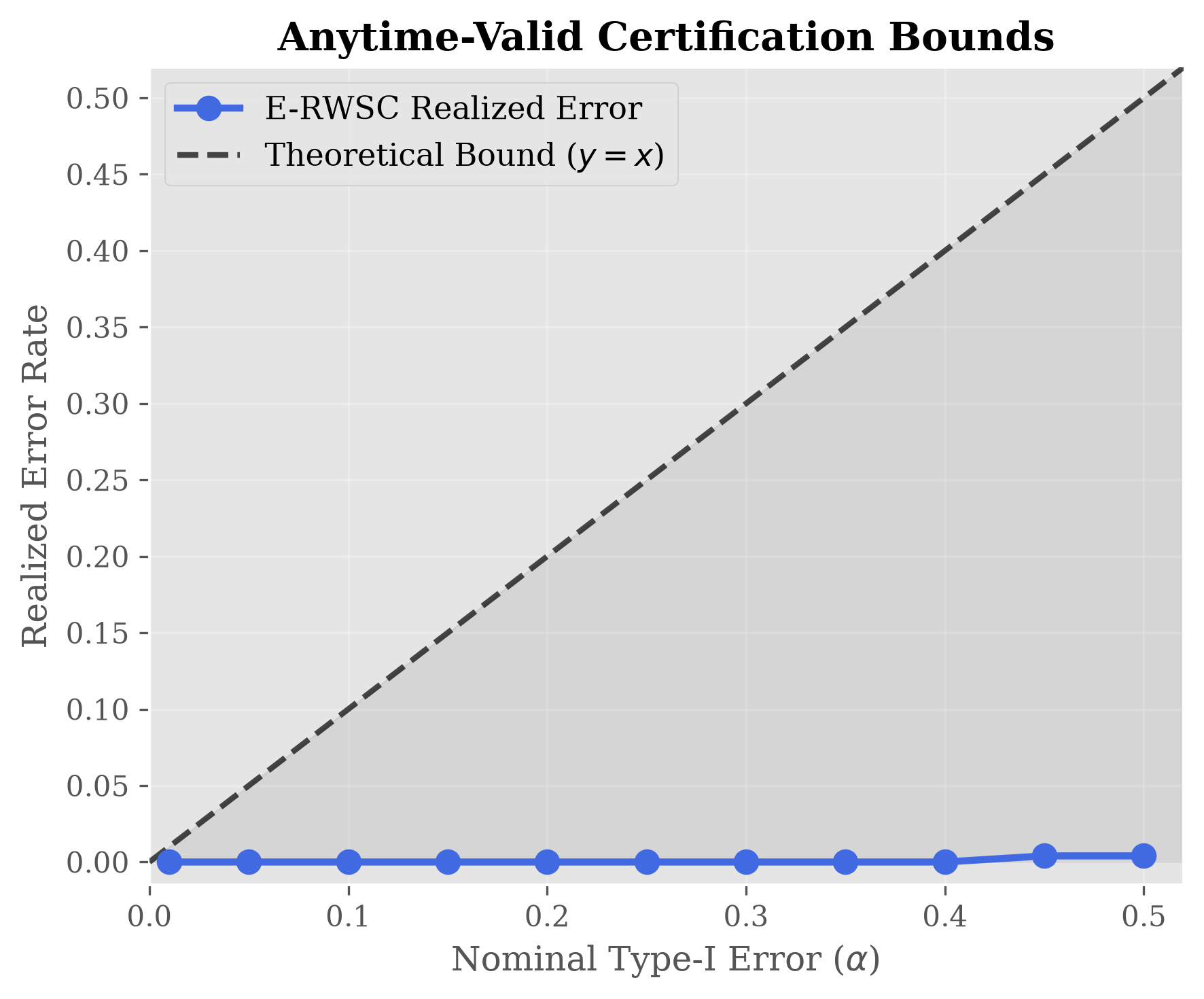
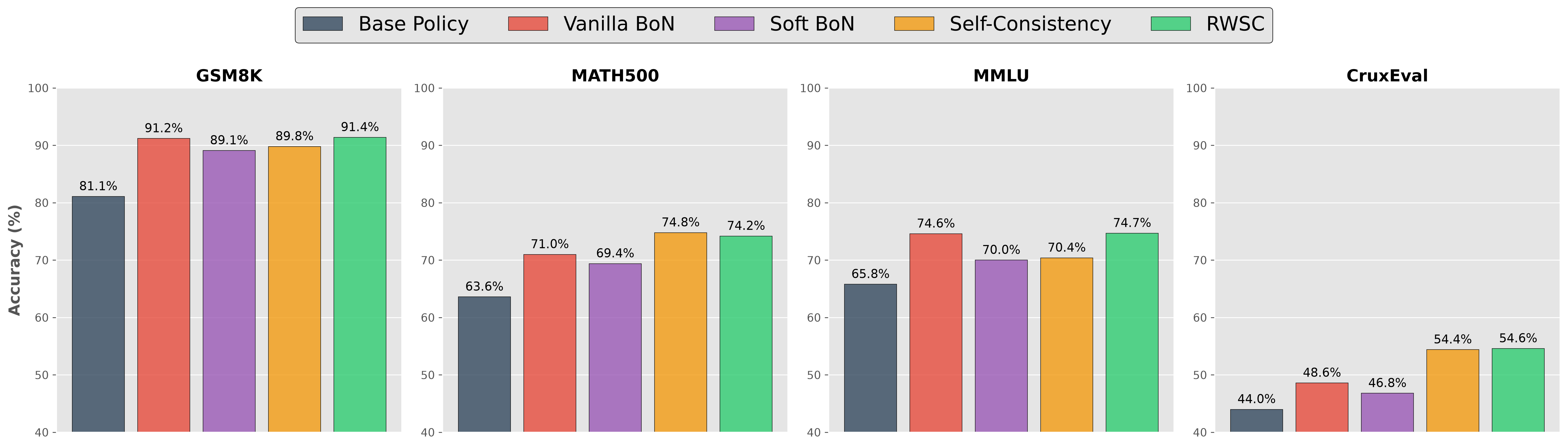
Figure 1 shows a comparison of different selection methods across various benchmarks, illustrating how these methods perform under different budget constraints. The research confirms that the per-response cost follows the predicted scaling. Figure 4 provides empirical validation of the theoretical bounds, showing that the realized error rate respects the chosen threshold and that the relationship between signal strength and the stopping step is linear as predicted.
What are the experimental results?
The researchers tested the e-RWSC rule across five different language models, including Qwen2.5, Llama-3, and Mistral, using four distinct reward models. The experiments were conducted on several challenging benchmarks such as GSM8K and MATH500.
The results demonstrated that e-RWSC can match or even outperform existing baselines while using substantially fewer tokens. For instance, in tests using the Qwen2.5-3B model with the ArmoRM reward model, the method achieved high accuracy on certified early stops. Crucially, the study found that the error control remained robust; the actual error rate stayed below the nominal level specified by the user, providing a level of reliability that heuristic-based adaptive methods cannot offer.
How can researchers apply these concepts?
For researchers working with complex datasets or long-form AI reasoning, understanding the trade-offs between token expenditure and statistical certainty is vital. While the e-RWSC method is a specific algorithmic contribution, the underlying principles of managing error budgets in sequential testing are applicable to many areas of AI development.
If you are looking to dive deeper into the mathematical foundations of these papers or explore how different models handle complex reasoning tasks, you can use Reader to analyze the original research papers or use Chat to compare the outputs of multiple models side-by-side to observe how different alignment strategies might affect their responses.
Frequently asked questions
What is the primary benefit of the e-RWSC rule?
The e-RWSC rule provides a way to stop AI answer generation early without losing statistical reliability. It allows the system to adapt the number of generated samples to the difficulty of each specific prompt, which reduces the total number of tokens used while guaranteeing that the error rate stays within a user-specified limit .
How does e-RWSC differ from standard Best-of-N selection?
Best-of-N selection uses a fixed number of generations for every single prompt, which is often inefficient. In contrast, e-RWSC is an adaptive method that continuously monitors the evidence for different answers and halts the process as soon as a dominant answer is mathematically certified, potentially saving significant computational costs.
Can the error rate be controlled by the user?
Yes, the user can set a formal error tolerance level as an input to the stopping rule. The e-RWSC framework uses an anytime-valid construction to ensure that the probability of erroneously certifying a non-dominant answer is strictly bounded by this value, providing rigorous statistical control over the model's output accuracy.
Source: Grafy Research Lab — Sequential Anytime Valid Tests for Efficient Inference-Time Alignment
More news

New QOC framework replaces Chain-of-Thought for better reasoning
Researchers propose the Question-Option-Criteria (QOC) model to replace Chain-of-Thought, offering more structured and interpretable AI decision making.

Training Limits Restrict AI Reasoning Scaling
Researchers found that fixed training budgets in reinforcement learning limit an AI's ability to scale accuracy at test time. Learn why this matters.

New Client Exits mechanism aims to increase LLM transparency
Researchers have introduced Client Exits, a method to separate AI semantic intent from presentation. Learn how this could improve multimodal responses.