New QOC framework replaces Chain-of-Thought for better reasoning
Researchers propose the Question-Option-Criteria (QOC) model to replace Chain-of-Thought, offering more structured and interpretable AI decision making.
 Source: Grafy Research Lab
Large language models may be moving beyond the era of free-form reasoning toward more rigid, structured decision-making frameworks. According to a paper by Marc Jansen from the University of Applied Sciences Ruhr West, the traditional Chain-of-Thought (CoT) method—which encourages models to externalize intermediate reasoning steps—can be replaced by a more disciplined process called Question-Option-Criteria (QOC).
This shift aims to address the limitations of unconstrained reasoning by forcing the model to follow a specific analytical sequence. While CoT often results in a narrative-style rationale, QOC decomposes a task into three distinct pillars: an explicit decision question, a set of competing options, and the specific criteria used to evaluate those options. This structured approach is designed to improve both the accuracy of the final decision and the ability for humans to audit why a specific choice was made.
How does the QOC thinking model work?
As described by Jansen, the QOC process begins by taking an input task and formulating a concrete decision question. The model then identifies the relevant alternatives (options) and the dimensions (criteria) required to judge them. To move from qualitative thought to quantitative decision-making, the model assigns an importance weight to each criterion.
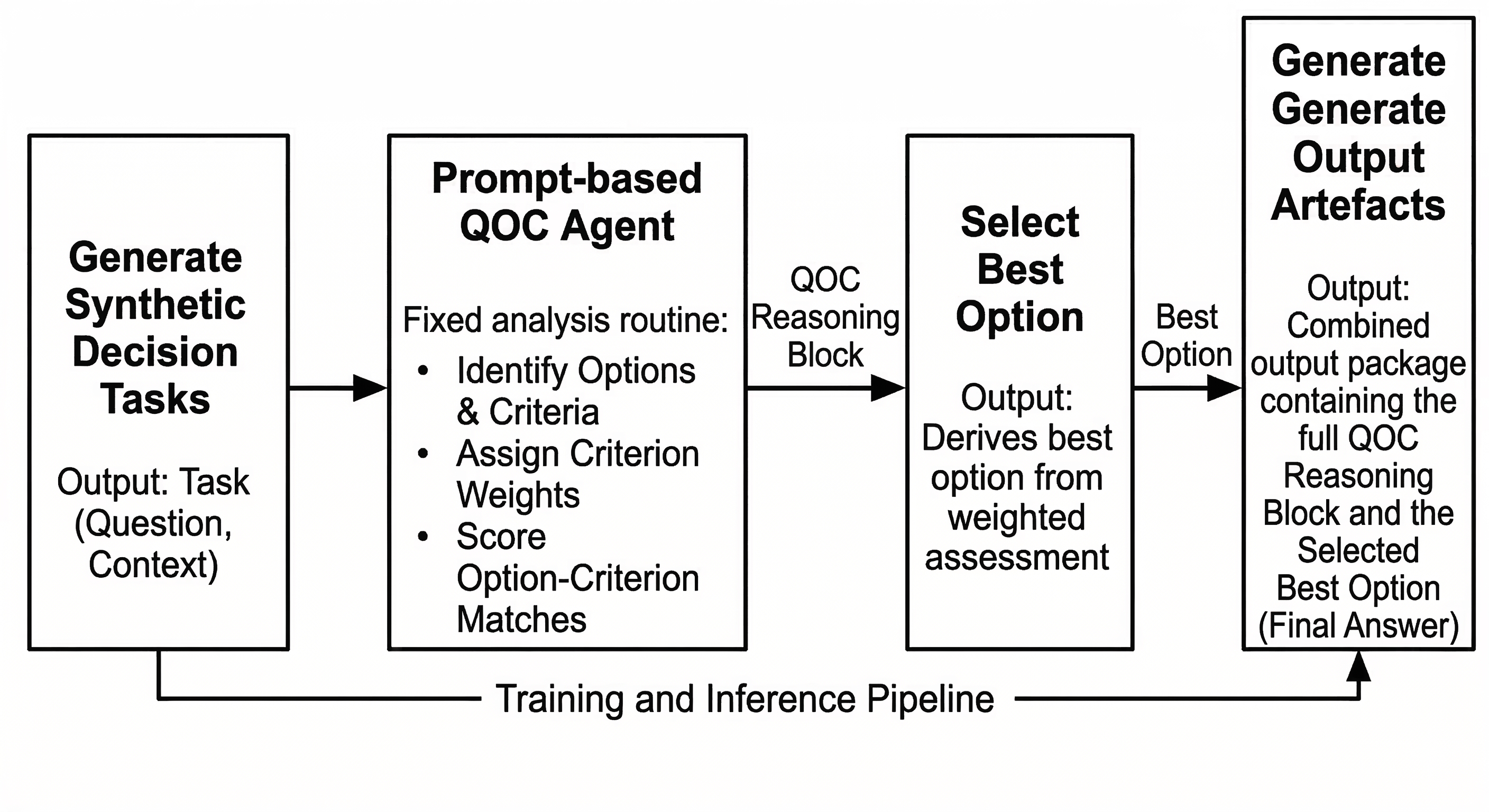
Each option is then scored against every criterion. The final decision is reached through a mathematical summation: for every option-criterion pair, the criterion weight is multiplied by the option score, and these values are summed to produce a total weighted score. The option with the highest total score is selected as the recommendation. Figure 1 shows the first generation of this pipeline, where the model performs this structured analysis and outputs only the best-performing option.
What are the different generations of this research?
To test the effectiveness of this method, the research utilized a three-generation development pipeline. Each stage increased the complexity and utility of the model's output:
- Generation 1: A basic decision core that produces the QOC structure but only returns the top-ranked option to the user without further explanation.
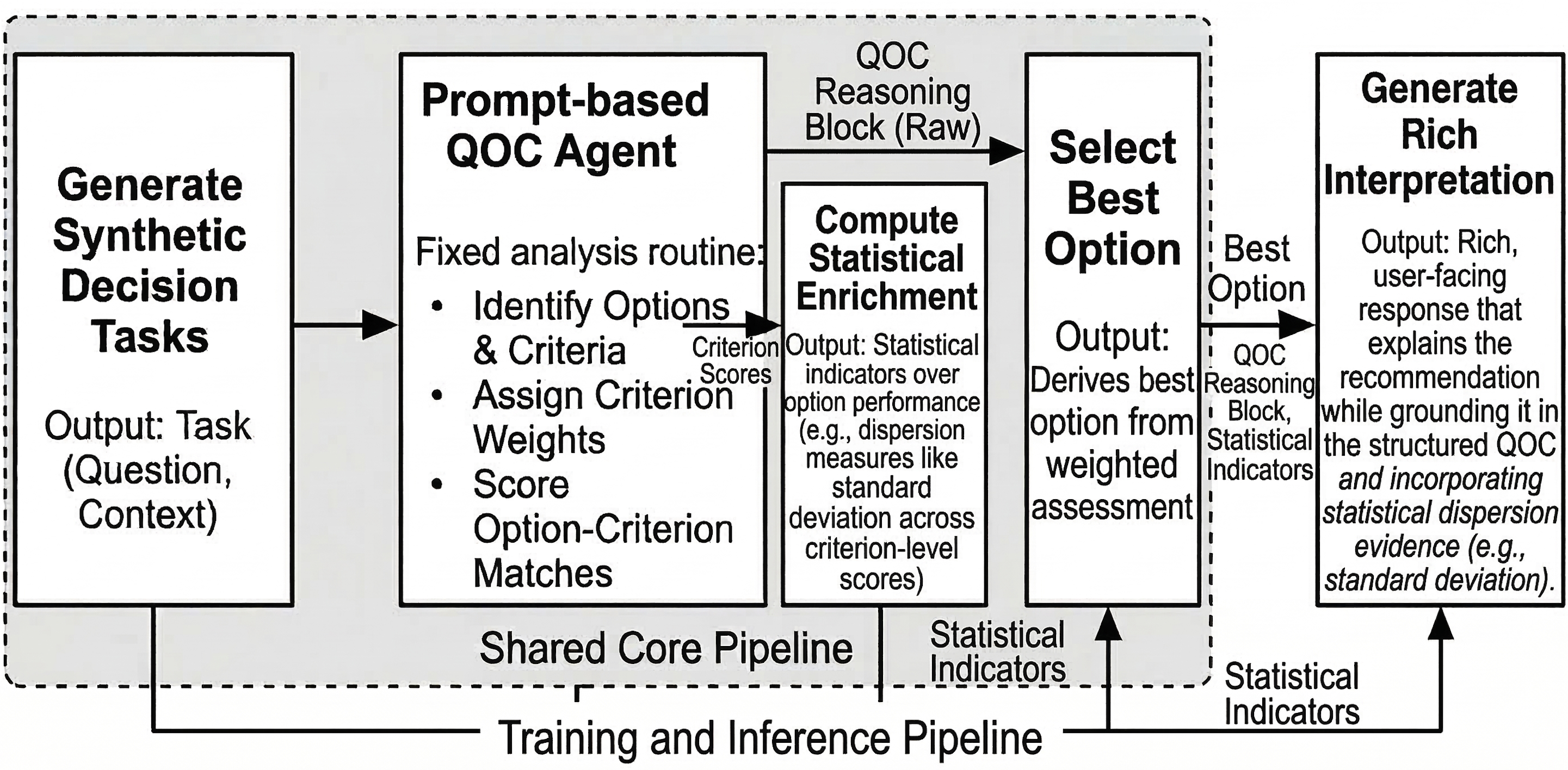
- Generation 2: An architecture that adds an interpretation layer. After the QOC process is complete, the structured reasoning is fed back into the LLM to generate a detailed, natural-language explanation of the decision.
- Generation 3: A more advanced version that incorporates statistical enrichment. As illustrated in Figure 3, this version adds lightweight statistical analysis to the QOC stage, such as computing standard deviation to reflect the stability and sensitivity of the options across the chosen criteria.
Does QOC improve model performance?
According to the paper, the results of the experiments suggest that QOC-based fine-tuning improves answer quality compared to non-fine-tuned base models. The research highlights that the benefits become particularly pronounced once the models are large enough to execute the underlying QOC computations reliably.
Beyond mere accuracy, the framework offers a significant boost to interpretability. Because the model must explicitly state its criteria and weights, it exposes the trade-offs involved in a decision. This makes the reasoning process more transparent and suitable for high-stakes environments where understanding the "why" behind an AI's recommendation is as important as the recommendation itself.
Why is this better than Chain-of-Thought?
While Chain-of-Thought has been a standard for eliciting reasoning, it often produces free-form, sequential rationales that can be difficult to supervise or standardize. QOC imposes a design-space analysis that separates the decision question from the evaluation. This separation allows for better internal consistency checks; researchers can verify if the model identified reasonable criteria, if the weighting was logical, and if the mathematical sums were calculated correctly. This makes the reasoning process not just a narrative, but an auditable computational trace.
How can researchers apply these findings?
For those working in AI research or complex data analysis, this methodology provides a blueprint for creating more reliable decision-support agents. By moving away from "thinking out loud" and toward "structured computation," developers can build models that are more predictable and easier to debug.
If you are currently reviewing technical papers on the evolution of LLM reasoning or looking to dive deeper into the mathematical foundations of these new architectures, you can use Reader to analyze the full PDF and ask specific questions about the implementation details or the statistical measures used in the third generation of the QOC model.
Frequently asked questions
What is the main difference between CoT and QOC?
Chain-of-Thought relies on the model generating a free-form, narrative sequence of reasoning steps to reach an answer. In contrast, QOC enforces a structured decision-making process that explicitly separates the problem into a question, a set of competing options, and specific evaluative criteria with assigned weights.
How does the model calculate the final score in QOC?
The model assigns a weight to each criterion and a score to each option based on how well it meets that criterion. It then multiplies each option-criterion score by its corresponding weight and sums these products across all criteria to determine the total weighted score for each option.
Does the QOC model provide explanations to the user?
In the first generation of the research, the model only provides the best option. However, in the second and third generations, the model uses an interpretation layer to transform the structured QOC reasoning into a rich, natural-language response that explains the decision to the user.
Source: Marc Jansen, "What If Chain-of-Thought Is Not Enough?", arXiv:2611.26282
Source: Grafy Research Lab — What If Chain-of-Thought Is Not Enough?
More news

Beam model offers frontier reasoning with efficient MoE architecture
The Beam model uses a sparse Mixture-of-Experts architecture to deliver high-level reasoning with 3-4x less inference compute than similar models.

Training Limits Restrict AI Reasoning Scaling
Researchers found that fixed training budgets in reinforcement learning limit an AI's ability to scale accuracy at test time. Learn why this matters.

New Client Exits mechanism aims to increase LLM transparency
Researchers have introduced Client Exits, a method to separate AI semantic intent from presentation. Learn how this could improve multimodal responses.