Beam model offers frontier reasoning with efficient MoE architecture
The Beam model uses a sparse Mixture-of-Experts architecture to deliver high-level reasoning with 3-4x less inference compute than similar models.
 Source: Grafy Research Lab
A new technical report introduces Beam, a sparse Mixture-of-Experts (MoE) model designed to achieve frontier-level reasoning while significantly reducing the computational cost of inference. According to the technical report by the Reflection Team, the model is specifically optimized for tasks involving coding, reasoning, and agentic workloads.
How does the Beam model architecture work?
Beam is built as a sparse Mixture-of-Experts model, which allows it to maintain a large total parameter count while remaining efficient during use. The report states that the model possesses 501.3B total parameters, but only 23.4B of these are active during any single inference step. This sparsity is key to its performance, as it enables the model to deliver high-quality reasoning while requiring 3-4x less inference compute than many other models in its class.
To support complex tasks, the model was pretrained on a massive dataset consisting of 23.8T diverse and curated tokens. A notable feature is its 1M-token context window, which the authors achieved through a novel two-stage midtraining phase. This phase utilized data that was anchored in verifiability and correctness to ensure the model could handle long-range dependencies effectively.
What makes Beam effective for coding and reasoning?
The model's effectiveness stems from a rigorous data curation and post-training process. The training recipe included specialized data for software engineering, competitive programming, and STEM subjects. For instance, the authors utilized repository-level understanding for software engineering tasks and integrated competitive programming data to sharpen logic.
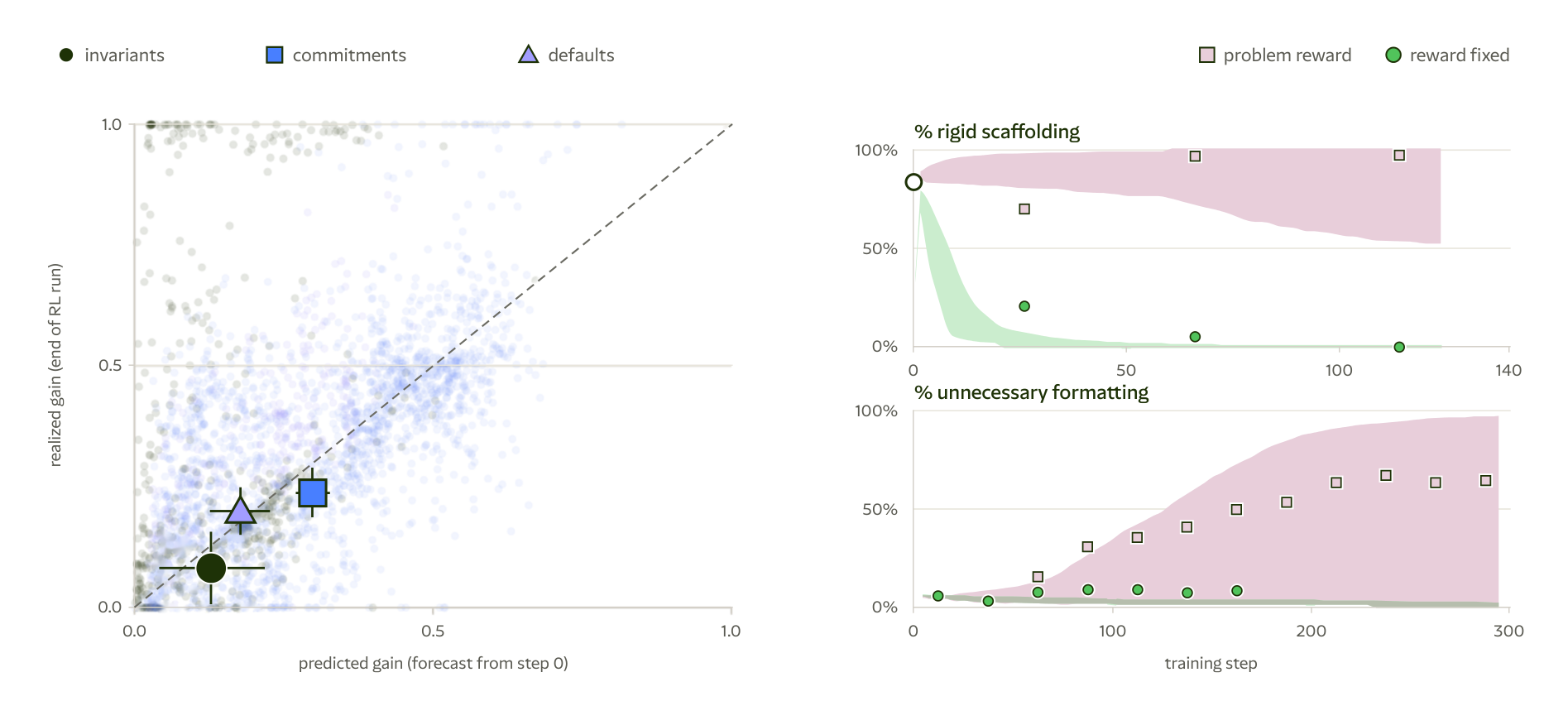
Post-training involved a large-scale, fully asynchronous reinforcement learning (RL) campaign. This process helped refine the model's ability to act as an agent. Figure 25 illustrates the predictable evolution of the model during this RL phase, showing how realized gains in performance align with predicted reward gains across different components. This iterative refinement ensures that the model's reasoning capabilities are not just broad, but also deeply grounded in correctness.
How does the model handle long context windows?
Achieving a 1M-token context window requires more than just large datasets; it requires specific architectural and training optimizations. The Beam report describes a two-stage midtraining process designed to stabilize the model as it processes increasingly longer sequences. This ensures that the model maintains coherence and retrieval accuracy even when the input spans vast amounts of information.
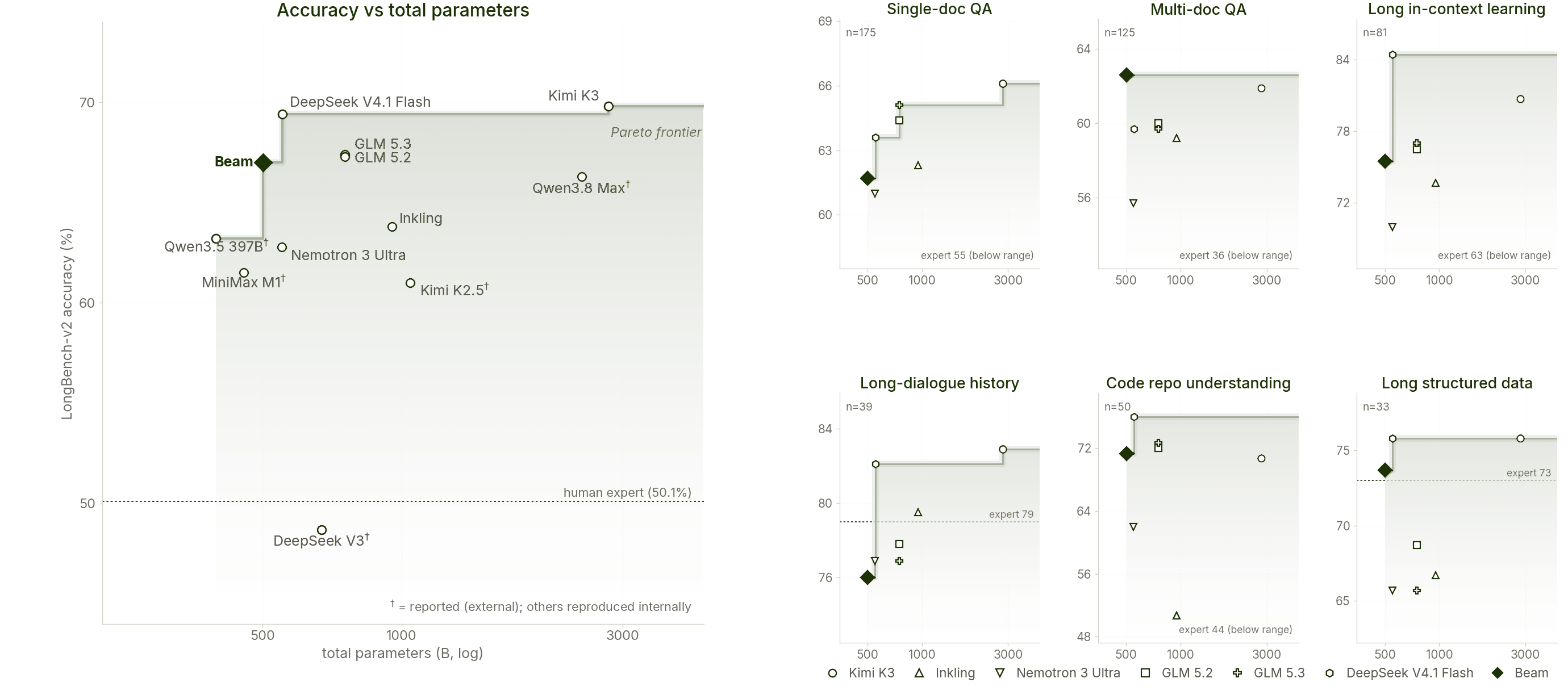
In evaluations, the model's ability to handle long contexts was tested against standard benchmarks. Figure 28 shows the relationship between LongBench-v2 accuracy and total parameter count, demonstrating how Beam maintains high performance levels. This capability is particularly vital for researchers and developers who need to process entire codebases or extensive scientific papers in a single prompt.
What are the safety and alignment measures?
Because Beam is designed for agentic workloads—tasks where the AI can interact with tools or environments—the authors implemented extensive safety protocols. These include safety pretraining data filtering, supervised fine-tuning (SFT), and reinforcement learning (RL) specifically aimed at preventing harmful outputs. The report details evaluations against systemic risks, such as biological and chemical weapon capabilities, as well as cyber offense risks.
The alignment process also included an "Alignment Teacher" approach to ensure the model adheres to human values. This involved rewarding calibrated accuracy, meaning the model is trained to recognize the limits of its own knowledge and abstain from answering when uncertainty is too high. This calibration helps prevent the model from generating confident but incorrect information, a common issue in large-scale reasoning models.
How can developers apply these advancements?
While the full 501.3B parameter model is a massive undertaking, the principles of efficient MoE architectures and agentic fine-tuning are becoming standard for high-performance AI. For developers working on complex logic or software development, models with these specialized training recipes provide a much more reliable foundation for building autonomous tools.
If you are working on coding projects or need to analyze large-scale technical documentation, you can explore these capabilities through Grafy Code, which provides an AI coding studio designed for development workflows. For researchers looking to dive into the technical specifics of papers like the Beam report, Grafy Reader allows for deep research and questioning of complex PDFs and academic documents.
Frequently asked questions
What is a Mixture-of-Experts model?
A Mixture-of-Experts (MoE) model is an architecture where only a subset of the total parameters is activated for any given input. This allows the model to have a very large total capacity (in Beam's case, 501.3B parameters) while keeping the actual computational cost per token much lower (23.4B active parameters), leading to more efficient inference.
Why is the context window important for AI?
A context window determines how much information the model can "see" and consider at one time. A large context window, such as the 1M tokens provided by Beam, allows the model to process entire books, massive code repositories, or long research papers without losing track of the earlier parts of the text, which is essential for complex reasoning.
How does reinforcement learning improve reasoning?
Reinforcement learning improves reasoning by rewarding the model when it reaches a correct conclusion through a logical process. In the Beam model, asynchronous RL campaigns were used to train the model to perform better in agentic tasks, helping it learn how to use tools, follow complex instructions, and maintain accuracy during multi-step problem-solving tasks.
More news

New QOC framework replaces Chain-of-Thought for better reasoning
Researchers propose the Question-Option-Criteria (QOC) model to replace Chain-of-Thought, offering more structured and interpretable AI decision making.

New DEO Method Fixes AI Retrieval Failures in Negation Queries
Researchers have introduced Direct Embedding Optimization (DEO) to solve how AI fails at exclusion queries. Learn how this training-free approach works.

Researchers find browser-embedded models can be used for attacks
Researchers demonstrate how attackers can leverage local models like Gemini Nano for post-exploitation, bypassing traditional network monitoring.